
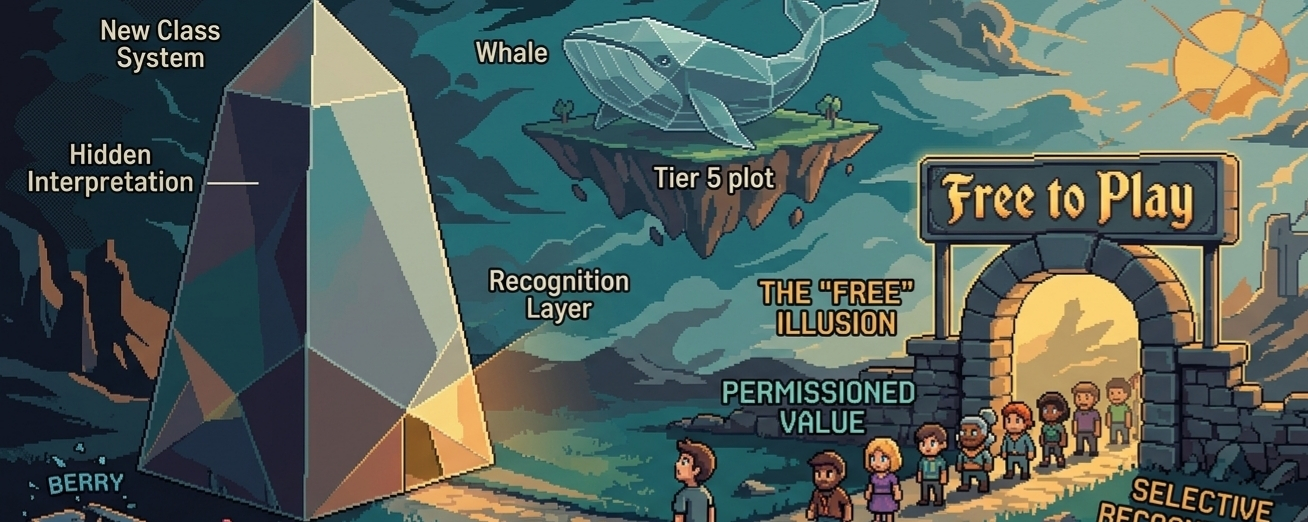

I’ve been watching the charts, the Discord channels, and the whitepapers for long enough to know that in the crypto trenches, the word "Free" is often the most expensive word in the dictionary. We all carry the collective trauma of the P2E collapse—the Axie era—where we watched a beautiful dream of "Play-to-Earn" dissolve into a brutal exit liquidity event.
Most people saw a token crash. I saw a structural failure of honesty.
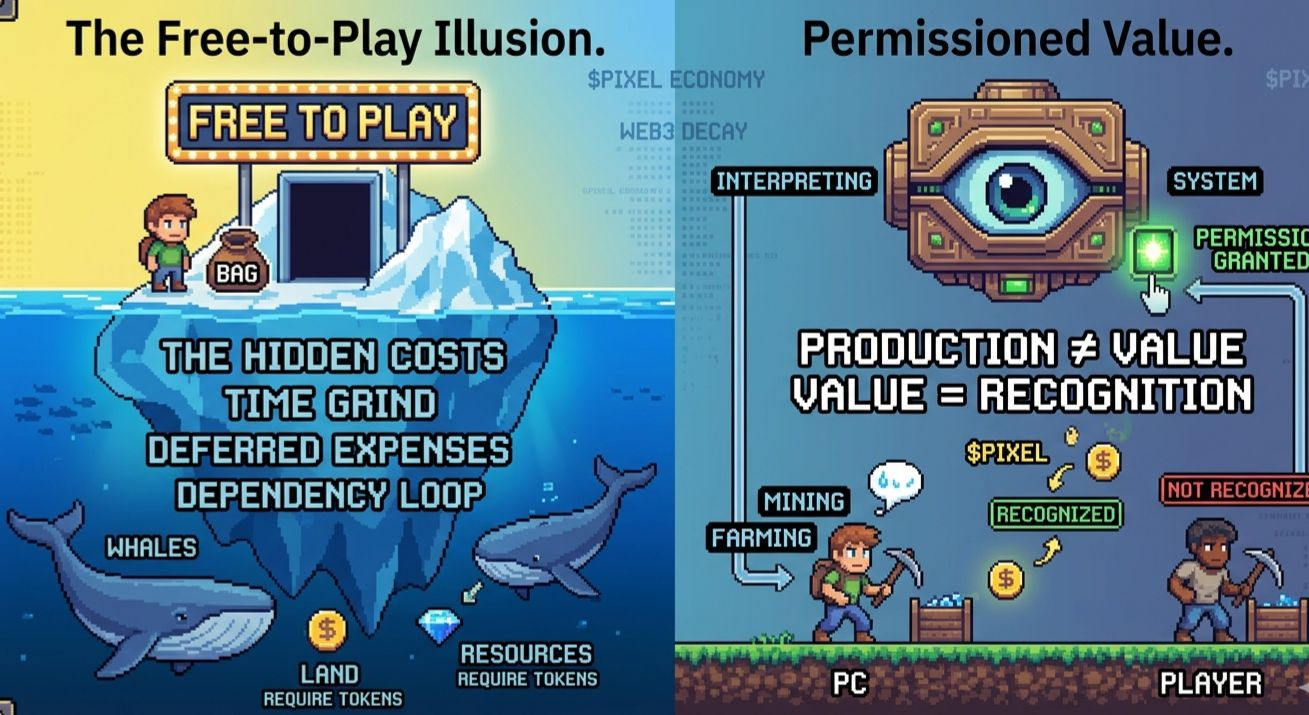
When a project shouts "Free to Play" today, I don't celebrate; I start looking for the bill. Because in a closed economic circuit, costs aren't deleted—they are just rearranged.
The Scholarship Trap and the New Class System
Let’s be real: the "Scholarship" model wasn't a charity. It was a clever way to bypass the high cost of entry while creating a digital feudal system. It lowered the barrier but cemented a hierarchy. You weren't a player; you were a yield-generating asset for someone else’s land.
I care about this because we’re seeing it happen again, just with better UI. In the $PIXEL universe, sure, you don't need a wallet or a $5,000 plot of land to walk through the gates. That’s the "Free" part. But the moment you start interacting with the BERRY economy (or whatever the current resource layer is), you realize the experience isn't equal. A new player and a whale owning a Tier 5 plot are playing two entirely different games. The gap isn't gone; it’s just been moved inside the house.
The Great Semantic Lie: Play-to-Earn vs. Play-to-Owned
The industry loves to pivot. Now they say "Play-and-Earn" or "Play-to-Own." But the structural rot remains the same: The Sustainability of the Token.
If a token has finite utility—meaning it’s only good for upgrading tools or buying digital seeds—then the moment the influx of new players slows down, the gravity of math takes over. The economy enters a death spiral. This isn't just a flaw in one project; it’s a foundational crack in the Web3 gaming floor.
What I find fascinating is that Pixels actually tried to fix this. They simplified the entry, added social layers, and reduced the "land-lord" dominance. It shows they learned. But as I always say: Understanding the problem is not the same as solving it.
The Philosophy of "Permissioned Value"
Now, let’s go deeper—into the psychology of the grind. This is where it gets existential for the market researcher in me.
We grew up believing in a linear relationship: Effort = Reward. You kill the boss, you get the loot. In Web3, that’s a fairy tale.
The Interpretation Layer (The Hidden Filter)
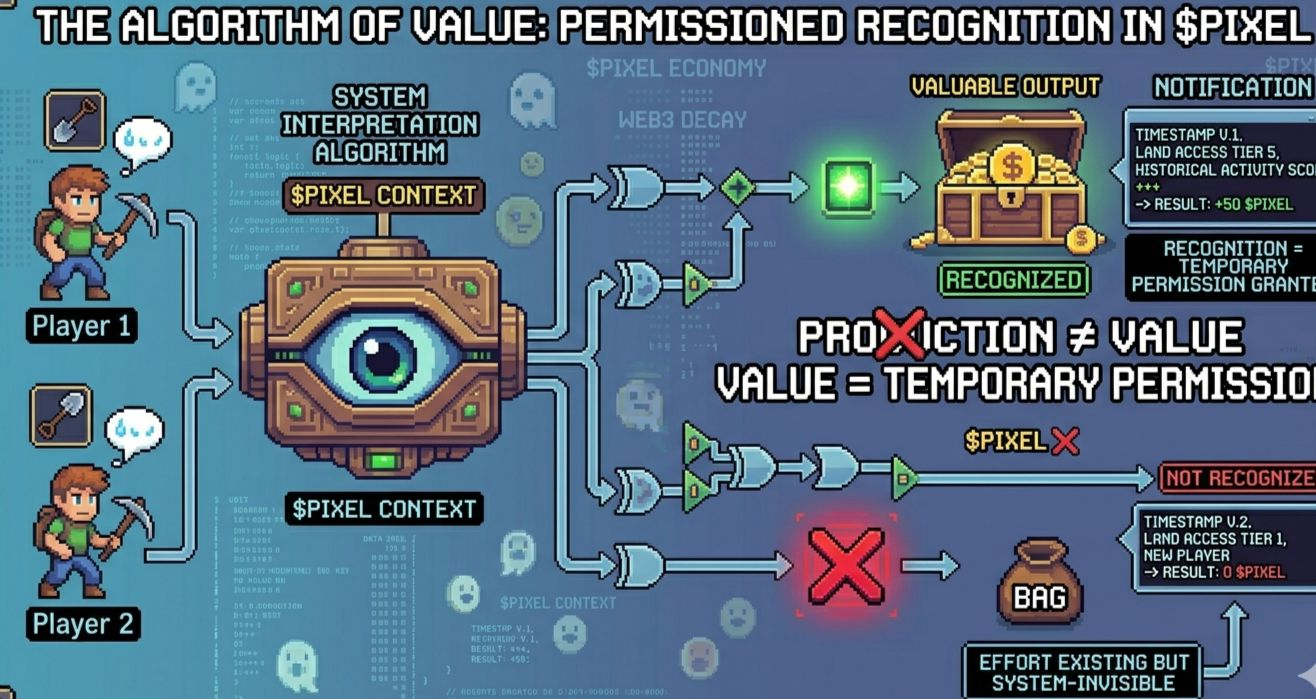
In $PIXEL, or any sophisticated DAO-led economy, value isn't something you produce; it’s something the system recognizes.
Think about it. You can spend 10 hours grinding, but if the system’s "Recognition Layer" (the algorithms, the reward distributions, the liquidity pools) doesn't "see" your effort as valuable at that specific timestamp, you get nothing.
This changes the player’s brain. You stop being a creator and start being a hunter of "System Permission." You start asking: "Is the system acknowledging me right now?" ### 4. Selective Value: The End of Digital Autonomy
This is the "Hidden Gap." Two players can do the exact same action, for the exact same time, and walk away with vastly different outcomes because of a "Layer of Interpretation" that remains opaque. It creates a psychological fracture.
You start to realize that the value you think you’re building isn’t actually yours. It’s an "Institutional Recognition" that can be switched off or adjusted by a developer's tweak to the scarcity model (like the Tier 5 updates we’ve analyzed).
If the system has to "validate" your effort before it becomes "value," then was it ever really value to begin with? Or was it just a temporary permission to participate in the wealth?
The "Silent" Conclusion
As a researcher, I am monitoring this shift from "Production" to "Recognition" very closely.
Web3 gaming is moving toward a model where your labor is only worth what a protocol's current mood allows. The "Free" entry is the bait; the "Hidden Cost" is your time and the psychological toll of playing a game where the rules of value are written in invisible ink.
If we want a sustainable Web3 future, we don't need more "Free" games. We need clarity of cost. We need to know who is paying, when they are paying, and why the system chooses to reward X while ignoring Y.
Until then, remember: in the world of PIXEL and beyond, you aren't just playing a game. You are participating in a live economic experiment where the most important resource isn't your token—it's the system's permission to let you keep it.
I say this not to discourage, but to ground us. We are in the trenches of a new digital frontier. Stay sharp, watch the "Interpretation Layer," and never assume "Free" means there isn't a bill waiting for you at the end of the grind.
