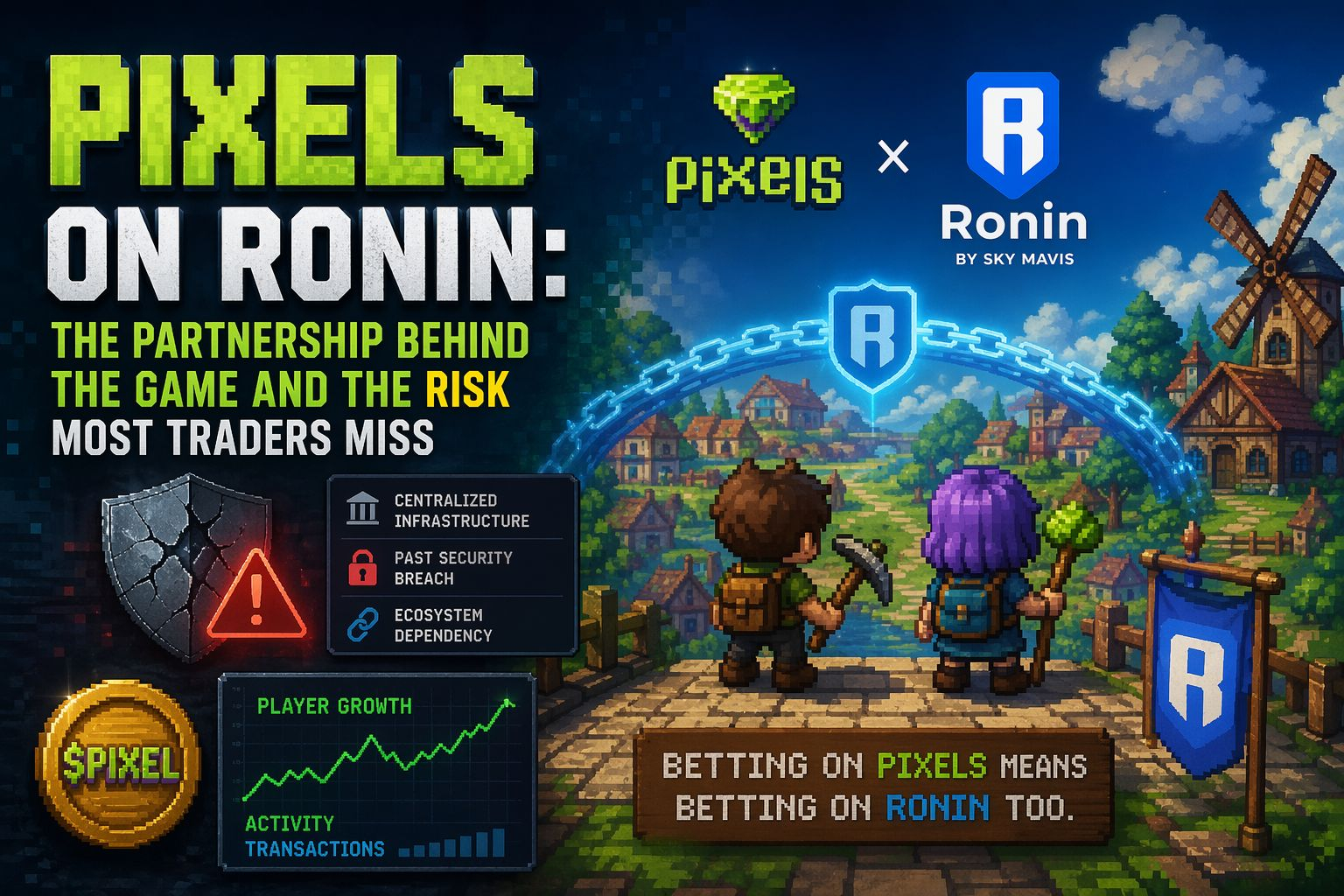
I opened a small $PIXEL position last night almost by accident. Not a conviction trade—more like one of those “I’ve been watching this too long, might as well test it” entries. It wasn’t even big, just enough to feel something if it moved. What actually stuck with me wasn’t the price action though. It was realizing I’ve been thinking about Pixels completely wrong this whole time.
I used to look at Pixels like a game with a token attached. Simple loop: more players → more demand → maybe price follows. But after digging a bit deeper into its move to Ronin, I’m starting to see it less like a standalone project and more like a piece inside someone else’s system.
And that changes how I think about the trade.
When Pixels migrated to Ronin, I initially wrote it off as a technical upgrade—cheaper transactions, smoother gameplay, less friction. That all checks out. If you’ve ever tried interacting with games on Ethereum mainnet, you know how quickly fees kill any casual engagement. So yeah, Ronin made Pixels playable at scale.
But that’s the obvious part. The more interesting layer is what Pixels inherits by being on Ronin.
Ronin isn’t just infrastructure. It’s an ecosystem built very intentionally around a specific type of user—people who’ve already gone through the pain of setting up wallets, understanding assets, and interacting with blockchain games. That’s not a small thing. Onboarding is where most Web3 games quietly fail.
Pixels skipped that entire problem.
When I think about it from a trader’s perspective, that’s actually bullish in a very specific way. It means user growth doesn’t have to fight the same uphill battle as most new projects. You’re not convincing someone to learn crypto—you’re just convincing them to switch games. That’s a much easier sell.
But here’s the part I didn’t really price in when I entered my position.
That same advantage creates a dependency.
Pixels isn’t just on Ronin. It’s tied to it in a way that’s hard to unwind. And Ronin itself is controlled by Sky Mavis, which has its own history, priorities, and risks.
I remember the Ronin bridge hack back in 2022—over $600M drained. At the time, it felt like a one-off disaster tied to Axie’s peak era. But looking at Pixels now, that history isn’t just background noise. It’s directly relevant to where the game—and by extension, its token—actually lives.
To be clear, Ronin today is much stronger than it was back then. The team patched weaknesses, reimbursed users, and rebuilt trust. In some ways, it’s probably more battle-tested than newer chains.
Still, it’s not neutral infrastructure.
That’s the part I think most people gloss over—including me, until recently.
When you hold $PIXEL, you’re not just betting on a game gaining traction. You’re also implicitly betting that:
Ronin continues to operate smoothly
Sky Mavis maintains its ecosystem
The relationship between the two stays aligned
And right now, those incentives are aligned. Sky Mavis needs successful games to drive activity on Ronin. Pixels benefits from that support and built-in user base. It’s a mutually reinforcing loop.
But loops like that come with constraints.
Pixels can’t easily leave even if it wanted to. Migrating again would be messy, risky, and potentially disruptive to its player base. That means part of its future is effectively locked into decisions it doesn’t fully control.
As a trader, that’s the kind of thing I usually try to spot early—not after I’m already in.
I’m still holding my position for now. It’s small, and I like the gameplay-driven traction Pixels is getting. But I’m treating it differently. Less like a pure upside bet, more like a structured exposure to an ecosystem.
If Pixels keeps growing, Ronin benefits. If Ronin strengthens, Pixels becomes more valuable. But if something breaks at the infrastructure level again, the downside won’t be isolated.
That’s the trade I’m actually in—even if I didn’t fully realize it when I clicked buy.
@Pixels #pixel $PIXEL