
At first glance, it feels familiar: plant, wait, harvest, repeat. A standard loop wrapped around a token. Easy to assume you’ve seen it all before. But the longer you observe how people actually engage, the less it looks like a typical “progress-driven” economy.
The real trigger for player behavior isn’t the reward, it’s the waiting.
That shift changes everything. Most GameFi models sell acceleration of progress: better tools, bigger yields, faster outputs. Pixels technically offers that, but the real tension sits elsewhere, in the time delays surrounding every action. Energy caps, growth timers, micro-pauses. Each one feels minor, but stacked together, they subtly shape the experience.

That’s where $PIXEL comes in, not just as currency, but as a way to negotiate with time itself.
Using it doesn’t always feel like buying something. It feels like choosing not to wait. Not to repeat. Not to deal with friction. And that choice happens more often than you’d expect. Many players aren’t chasing efficiency, they’re just smoothing the experience.
That’s a different kind of demand. Quiet. Repetitive. Hard to track, but very real.
There’s also a clear split in the system. Coins keep the base layer running, routine actions, steady participation. You can stay there indefinitely. But the moment you want more control over your time, you start leaning toward $PIXEL. It’s less about access, more about priority.
Almost like two versions of the same game: one where you follow the clock, and one where you bend it.
This reframes the usual “adoption” narrative. It may not be about how many new players enter, but how often existing players choose to compress time. Repetition over expansion. Small decisions, made constantly.
But it’s a delicate balance.
If the game becomes too smooth, the need for $PIXEL fades, nothing left to skip. If it feels too forced, players push back or leave. The friction has to feel natural, almost invisible. That’s difficult to maintain at scale.
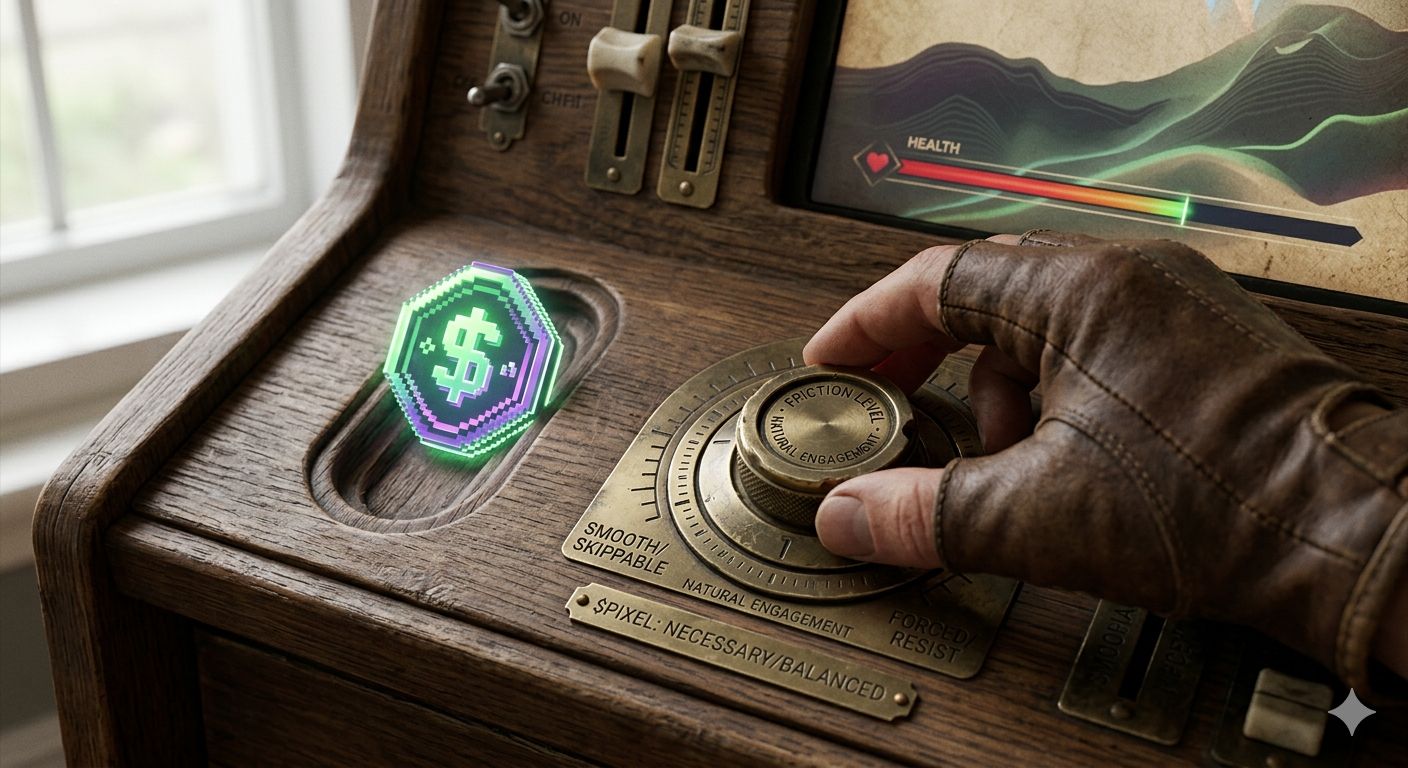
Most market takes still focus on surface metrics, supply, unlocks, user growth. Clean numbers. But they miss the behavioral layer: the tiny, repeated decisions to skip, speed up, or avoid friction.
That’s where the real utility sits.
Still, it’s not guaranteed to last. Some players will always choose the grind, or simply walk away instead of paying to optimize time. That tension never disappears.
So the model isn’t bulletproof. But it may be misunderstood.
Pixels doesn’t just sell progress, it engineers the feeling of time. And @Pixels lives at the point where that feeling can be altered.

Whether that turns into lasting demand or fades as a short-term habit depends on one thing: how subtle the system remains.
Because subtle systems are the easiest to overlook, and the hardest to price correctly.