
Something small started bothering me last Tuesday while I was checking inventory inside @Pixels . Not because anything dramatic happened, but because I noticed how much value in the system often just sits still. Resources held back, materials not immediately deployed, items waiting without obvious urgency. Normally I would have treated that as simple inactivity, maybe even inefficiency. If something is idle, it is not productive that is the usual instinct. But the longer I looked at it, the less convinced I was that “unused” was the right word. Because what if idle inventory in #pixel is not always dormant value? What if sometimes it is stored optionality? That thought came from noticing how often players delay using resources even when immediate deployment looks profitable. At first I assumed that was caution or indecision, but after watching it more, it started looking less passive than that. Holding back can be its own decision. And decisions that preserve alternatives often behave differently from decisions aimed only at maximizing output.

That shifted something in how I was reading the system. Most game economies are usually discussed through flows what enters, what exits, what circulates. Supply moving through activity loops, demand showing up through spending. It is a movement-focused lens. But movement may not be the whole story. Sometimes what does not move may matter too. And that feels underexplored. Because if players intentionally keep resources idle, not because they forgot them but because preserving flexibility has value, then part of the economy may be shaped by withheld action as much as executed action. That is a very different way of thinking about economic behavior. And it made me start looking at $PIXEL differently too. Usually the conversation around the token focuses on usage pressure where it gets spent, how often it converts activity into value. Standard utility logic. But what if some value also sits in reserve behavior? Not because players plan immediate use, but because holding optional resources changes how they engage with uncertainty.
Imagine two players with similar output, similar activity, similar balances. One deploys everything immediately. The other keeps part of their resources or $PIXEL intentionally uncommitted. Those players may not be taking the same economic posture at all. One is optimizing present returns. The other may be optimizing for unknown future states. That difference could matter much more than surface metrics show. And the strange thing is, idle inventory can sometimes strengthen systems. That sounds backwards, but in many economic environments, not all value being pushed into immediate use can create resilience. Reserves absorb shocks. Optionality preserves responsiveness. Full deployment can maximize efficiency, but sometimes at the cost of adaptability. I started wondering whether some of that logic quietly exists in @Pixels . Because if every player always converts resources as fast as possible, the economy may become efficient but also brittle. But if players naturally maintain pockets of idle capacity, the system may retain flexibility.
That possibility made me rethink what “unused” even means. Maybe some resources sitting still are not inactive. Maybe they are waiting because waiting itself carries strategic meaning. And once that thought appeared, I started seeing a tension in it. Because too much idle behavior could obviously weaken circulation. If everyone hoards, activity can slow, markets thin out, conversion pressure drops. But zero idle behavior may not be healthy either, because then everything is always fully committed. No buffers. No optionality. No slack. And systems without slack often break in strange ways. Somewhere between overdeployment and overreservation may be where stability lives. And maybe $PIXEL sits partly inside that balance, not only as something spent to push action forward, but as something whose value may partly depend on players wanting capacity in reserve. That feels like a much stranger role than people usually assign to game tokens.
There is another side that made me uneasy too. If experienced players begin understanding the value of reserve behavior better than newer players, does that quietly create a hidden edge? Because newer participants may interpret idle resources as waste and overcommit, while veteran players may treat reserves as positioning. Those are very different behaviors. And if the system rewards one more than the other over time, outcomes could separate in ways that look invisible from the outside. That possibility feels subtle, but subtle things often matter most. I have seen people analyze Pixels through growth numbers, retention metrics, emissions, token sinks all important. But very little attention seems given to how much of an economy’s health may depend on what participants choose not to do. That feels like a blind spot, because restraint can shape systems too, sometimes as much as action.
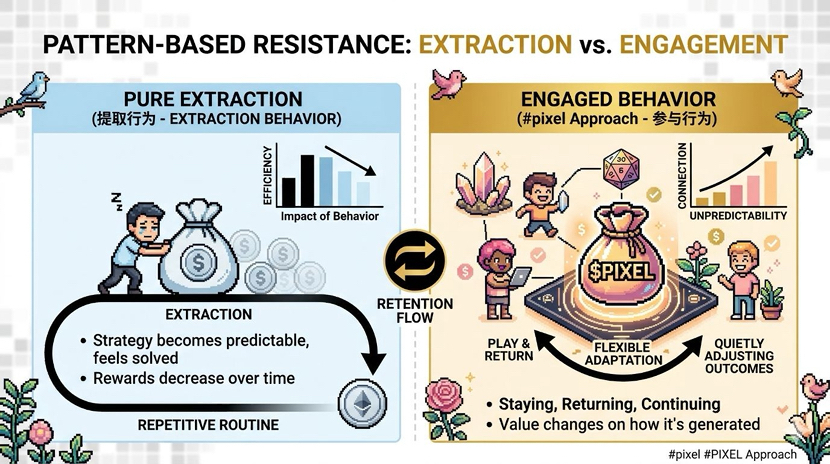
Maybe I’m overreading a pile of inventory slots. That possibility is there. But I keep returning to the same question. When resources sit idle in Pixels, are they simply waiting to be used, or are they quietly acting as economic reserves that help the system stay adaptive? That feels like a much more interesting question than whether players are just spending enough. Because one is about throughput. The other is about structure. And structure often matters when throughput changes. The more I think about it, the more I suspect some of the deeper logic in #pixel may sit not in visible activity, but in how much value players deliberately keep uncommitted. And that is not something I expected to find interesting, which is probably why I keep thinking about it.