


Got wrecked N times before I realized, there's a way out in the crypto space.
To be honest, I've been in the play-to-earn scene for over two years now. From jumping in with the hype of Axie Infinity to dabbling in a variety of farms and card projects, I've fallen into almost every pitfall you can imagine. Honestly, 90% of these play-to-earn games can't survive past three months before crashing, and their tokens go straight to zero. The real cash I put in and the late nights grinding for returns all went up in smoke.
What's the most frustrating? Whether it's during a BTC bull run or games on established chains like ETC, they all fall into the 'make quick money and bail' death loop. Studios use bots to farm and squeeze profits, while retail traders dump as soon as they make a little profit. Us, the ones who genuinely want to play and engage long-term, end up as the ones getting wrecked. Back then, I was constantly complaining: is this play-to-earn really a game or just a Ponzi scheme?
It wasn't until I randomly stumbled upon Pixels' white paper that I realized someone is actually working hard to clean up the industry's mess.
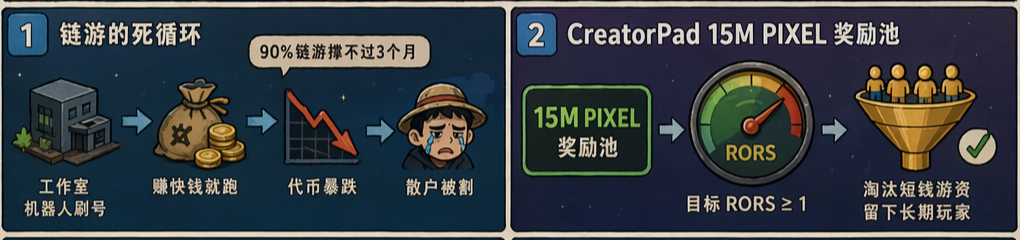
CreatorPad's 15M PIXEL pool[^2^]: it's not just throwing money around; it's the fuel for RORS stress testing.
This time in Binance Square's campaign, on the surface, it looks like a 15,000,000 PIXEL reward pool, which seems enticing. But for the knowledgeable, when deconstructing the underlying logic, it reveals an extremely clever 'chip tempering' operation—using extremely suppressed horizontal fluctuations to precisely eliminate those short-term funds looking to make quick profits.
The core mechanism is called RORS, Return on Reward Spend. For every dollar spent on rewards, how much revenue can be recouped? Currently, RORS ≈ 0.8, with a target of breaking 1.0. Once Phase 3 opens the pool, an RORS ≥ 1 becomes a hard entry threshold, not a benefit, but a survival game.
This is just like the ROAS logic in traditional advertising; both advertisers and users are on-chain players. Pixels treats rewards like ads, with each distribution tied to attribution—Events API collects behavior in real-time, unifying cross-game first-party data into an ID graph, predicting LTV and retention probabilities, and ultimately only rewarding actions that can bring back long-term value.
$vPIXEL: the 'ecological handcuffs' that lock in sell pressure.
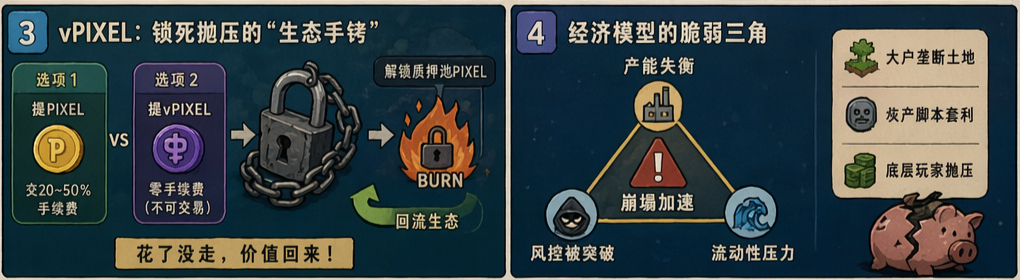
vPIXEL is based on the ERC-20c standard and is the most ruthless design of this economic model. When players claim rewards, they have two options: withdraw PIXEL and pay a 20-50% Farmer Fee, or withdraw vPIXEL with zero fees but it cannot be traded on exchanges and can only be spent within the ecosystem. Every vPIXEL spent triggers burn-to-unlock, permanently unlocking the PIXEL corresponding to the underlying staking pool, flowing back to studios to continue user acquisition.
You spent money, the value didn’t disappear; it came back.
Directly targeting the biggest poison of blockchain games: rewards create sell pressure. All previous blockchain game collapses boil down to 'earn and sell'; the sell pressure is infinitely large—how can a token not crash? $vPIXEL locks rewards within the ecosystem, providing real benefits to players while firmly controlling sell pressure. This design is way smarter than those single-token projects—economics isn't just 'printing money to smash the market', but creating an internal circulation.
But I burned the midnight oil figuring out the model, and the more I calculated, the colder my back got.
Pixels' Task Board did one thing: it abstracted all players into schedulable computational units, matching dynamic task supply with labor output at different levels. Skill Tree upgrade paths, VIP Tier resource unlock ladders, pet systems consuming $PIXEL—these indeed form a deep consumption system.
But I’ve run through several extreme scenarios, and the outcomes aren't pretty.
High-end land is monopolized by big players, with core production materials concentrated in the hands of a few. The output of low-tier retail investors is priced down to an unsustainable level, with no constraints. If the yields of Crops and Resources drop below what one could earn elsewhere, people will leave. Even more deadly is the potential break in the material consumption chain—upgrading Tier 3 equipment requires Tier 1 raw materials at an assumed ratio of 1:1000, but there are a hundred thousand active Tier 1 producers. Who will take on the labor value of the 99,000 in between?
This isn't a hypothesis. Before the collapse of Axie's SLP, this was the path.
I understand the logic of the reputation system—it’s built on on-chain interaction depth, social media binding, Pixel spending records, creating a multi-dimensional 'attention proof'; if your score isn’t high enough, you’re locked out of lucrative tasks. Essentially, it's built a wall for identity verification in the virtual world.
But static thresholds against dynamic evolution have never won historically. Gray market teams specialize in this—they buy low-weight social accounts in bulk, use scripts to simulate random delays and walking paths, and fabricate false interaction depth on-chain. I’ve roughly calculated the cost; it’s far lower than the gold farming yield from high-reward tasks. Once the cost of forgery is less than the gold farming profit, the defense line is made of paper.
There's also an overlooked cost: compliant players are also experiencing interaction friction. Every added verification threshold discourages a batch of real users. The reputation system has an inherent paradox—while trying to prevent bots, you're simultaneously preventing players.
"The design blueprint can illustrate a deflationary closed loop, but it can't capture human nature."
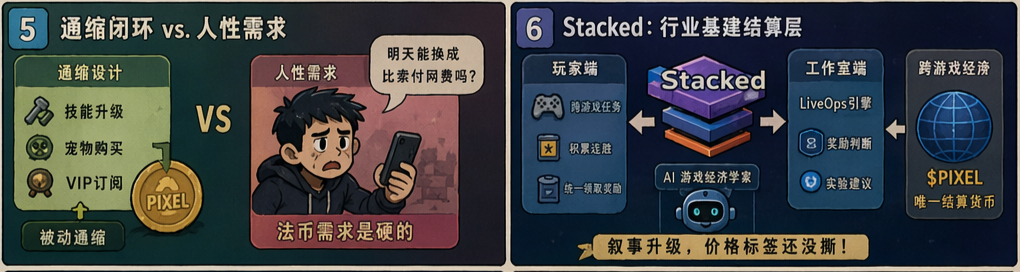
Chapter 2 cuts off sub-tokens, compressing all value flows onto $PIXEL—skill upgrades, pet purchases, VIP subscriptions, forming a passive deflationary closed loop. Studios wanting to mine must invest, and to invest, they must stay; the sell pressure pathway has been narrowed. The numerical aspect is indeed clever.
But a full-time gold farmer in the Philippines grinding out some $PIXEL late at night doesn’t care about the next season's Balance Update; he cares about whether he can exchange it for pesos to pay for internet and buy groceries tomorrow. The elasticity of in-game sinks is soft, but the fiat currency demand of bottom-tier players is hard.
When the Pixel price drops, gold farmers won’t wait for the "next consumer scenario to launch"; they'll accelerate their sell-off, causing prices to drop further and more people to follow suit.
Liquidity’s pull doesn’t care about feelings. The team knows this issue exists, but there’s a chasm between knowing and solving it. You can control the output rate with code, but you can’t control a person needing to eat who’s placing sell orders at 3 AM.
The three dimensions of fragility are not isolated. An imbalance in production capacity leads to labor loss, labor loss magnifies liquidity pressure, and risk controls being breached accelerate studios draining reward pools; the three are coupled, collapsing faster than anticipated.
Stacked: From 'farm game tokens' to 'industry infrastructure settlement layer' narrative time lag.
What truly makes me feel the narrative time lag isn’t those game updates, it’s Stacked.
The Pixels team has taken four years of hard lessons—how to manage bots, how to design reward distribution, and how to keep players engaged for the love of the game rather than just for profit—and turned it into a comprehensive infrastructure for the entire industry. The player side is an application that allows cross-game task completion, winning streak accumulation, and unified reward collection; the studio side is a LiveOps engine that helps developers decide who to reward, when to reward them, and how to do it; behind it all runs an AI game economist, providing real-time data analysis and experimental suggestions.
$PIXEL is the only underlying settlement currency in this system.
So here’s the question: a token's demand scenario has shifted from 'in-game consumption' to 'cross-game economic infrastructure settlement layer'; what basis does the market have to price it with the logic of 'farm game tokens'?
$BTC rose from 16,000 to 30,000 in 2023, and the story the market told shifted from 'electronic cash' to 'digital gold'. The narrative upgraded, and the price was re-anchored. The reality of PIXEL has already changed scripts, but the price tag hasn’t been torn off.
This kind of mispricing isn’t a coincidence; it has a manufacturing mechanism: fear.
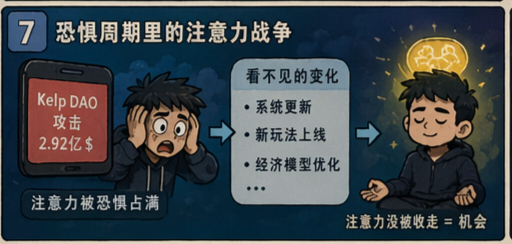
Yesterday Kelp DAO was attacked, losing $292 million. The group went silent in an instant—some were cursing, some were cutting losses. When fear kicks in, everyone's attention is forced onto the same issue—risk. Your bandwidth for processing information is filled with fear, and you become blind to those 'changes that are happening but not exciting'. It's not that you don't want to see; it's that you simply have no time to look.
Fear doesn’t directly create losses; fear creates attention distraction. Attention distraction is the breeding ground for mispricing.
This reminds me of $ETC. It’s always lived in the shadow of ETH's narrative, with the market consistently pricing it under the old label of 'forked chain', even though its PoW mechanism and independence represent entirely different asset attributes in specific contexts. The narrative time lag has caused many to underestimate it, and many are missing out when it finally takes off.
CreatorPad's task board[^3^]: what are you focusing on during the fear cycle?
The 15M PIXEL prize pool in Binance Square is a temptation for retail investors but a diagnostic tool for those in the know.
There’s a gap between market pricing logic and the actual state of the project: execution continues, but the narrative hasn’t kept up, and fear is blocking the way. Stacked has substantial updates every 14 days—massive revisions to the animal system, 150+ alchemy forging recipes, the merchant ship system integrated with fishing pools, a permanent live maze in the neon district, and Chapter 3 'The Drop of Bounty' with three major alliances fighting against each other—these aren’t just previews; they’re real things to engage with.
But when fear drains all your attention, who’s watching those unglamorous yet changing things for you?
The most underrated asset in the crypto market isn't any token. It's the attention during fear cycles.
When the next Kelp DAO arrives, will your attention be consumed by fear, or will it be liberated from fear—this is something only you can decide.
My actual trading strategy: holding a 3% position as an observation stake.
I still believe Pixels is worth studying, not because I think it will succeed, but because it’s seriously experimenting with economic models. How long it lasts and how far it can go is itself the most expensive stress test in this cycle.
From an investment perspective, I'm keeping a 3% position as an observation stake; I’ll hold the rest until it completes at least two full economic cycles. The design blueprint can illustrate a deflationary closed loop, but it can't capture human nature.
CreatorPad's 15M PIXEL[^4^]: you can choose to clock in daily as a cyber laborer, save up for four days to clear out the rewards, or snipe deals in the market at dawn, or simply hang out in the chat room.
But no matter which path you take, remember: you're betting on human greed and fear, while the system is against you, a harvesting machine designed from the start to make you lose.
Fear creates distraction, distraction creates mispricing, and mispricing creates opportunities—the premise is that your attention hasn’t been taken away.