
I didn’t really understand Pixels the first time I looked at it.
It seemed too simple. A farming game, some land, some rewards, a token economy around it. Easy to place it in the same mental folder as every other crypto game that appears for a cycle, gets attention, then disappears once the incentives cool down.
But the more time I spent around it, the less that explanation worked.
Pixels does not feel interesting because it is loud. It feels interesting because it keeps creating small reasons to return. That sounds ordinary, but in crypto gaming it is almost rare. Most projects try to impress you immediately. Pixels does something slower. It lets routine do the work.
You log in. You plant. You collect. You check what others are doing. You notice prices. You remember where you were yesterday. Nothing feels dramatic in the moment, yet over time those small actions begin to form a kind of personal history.
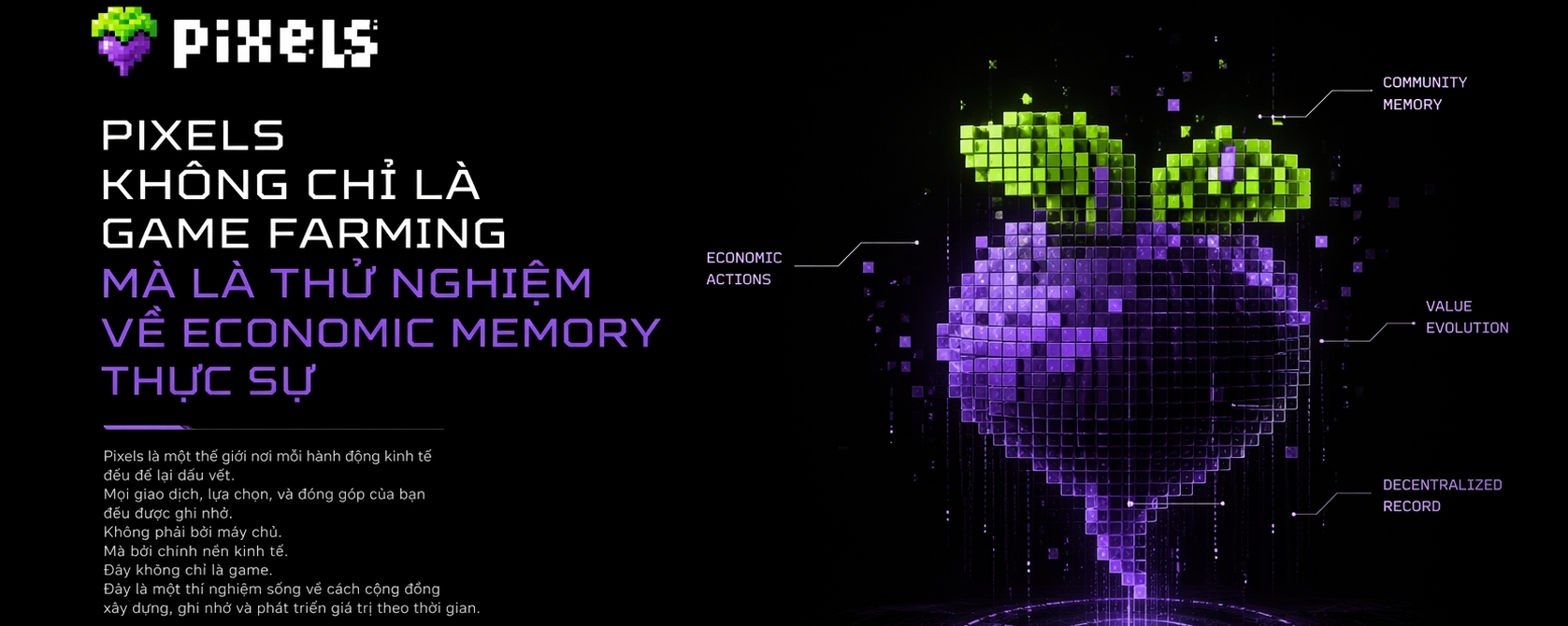
That is where the idea of economic memory starts to make sense.
A real economy is not just buying and selling. It is remembering.
Remembering which resources became useful. Remembering who was reliable. Remembering which habits paid off. Remembering what changed after an update. Remembering the feeling of being early in a place before everyone else understood it.
Most crypto games never reach that point. They create activity, but not memory. People come in, farm rewards, sell, move on. The world does not hold them.
Pixels has a chance to be different because it feels more like a place than a campaign.
That does not mean everything is perfect. It still has to prove that the economy can stay healthy. It still has to give long-term players enough depth. It still has to avoid becoming too focused on extraction, because once everyone enters only to take value out, the world starts losing its soul.
But there is something real in the way Pixels builds attachment.
The community does not feel like a crowd waiting for the next announcement. It feels more like people slowly learning a shared environment. That matters. A game economy becomes stronger when users stop acting like visitors and start acting like residents.
That is the hidden strength many people miss.
The token is important, but it is not the whole story. The deeper question is whether the token becomes part of natural behavior inside the world. If it supports progression, access, ownership, identity, and meaningful choices, then it has a reason to exist. If it only becomes a reward people extract, then the system becomes fragile.
Pixels’ long-term value depends on that difference.
What I find most interesting is that its strongest asset may not be visible on a chart. It is the time people have already spent inside it. Time creates attachment. Attachment creates memory. Memory creates loyalty.
And loyalty is much harder to copy than mechanics.
There are many games that can look better. Many economies that can sound more complex. Many teams that can use bigger words.
But very few can make people feel like they were part of something before it was obvious.
That is why I keep coming back to Pixels with a different kind of attention. Not hype. Not blind belief. More like quiet curiosity turning into conviction.
Maybe Pixels is not trying to be just another GameFi project.
Maybe it is trying to become a living digital economy where yesterday still matters tomorrow.
And if it can do that, then the market may only understand it after the memory has already been built.
