
You may have noticed that even a small grocery store is actually a pretty complex system. From the outside, you only see shelves and products, but inside, it runs on supply chains, credit for goods, customer trust, and daily demand forecasting—all of which operate on a delicate balance. If one day the supplier is late or customer trust wavers, the whole system gets disturbed. So, even things that seem simple actually depend on incentives, coordination, and consistency.
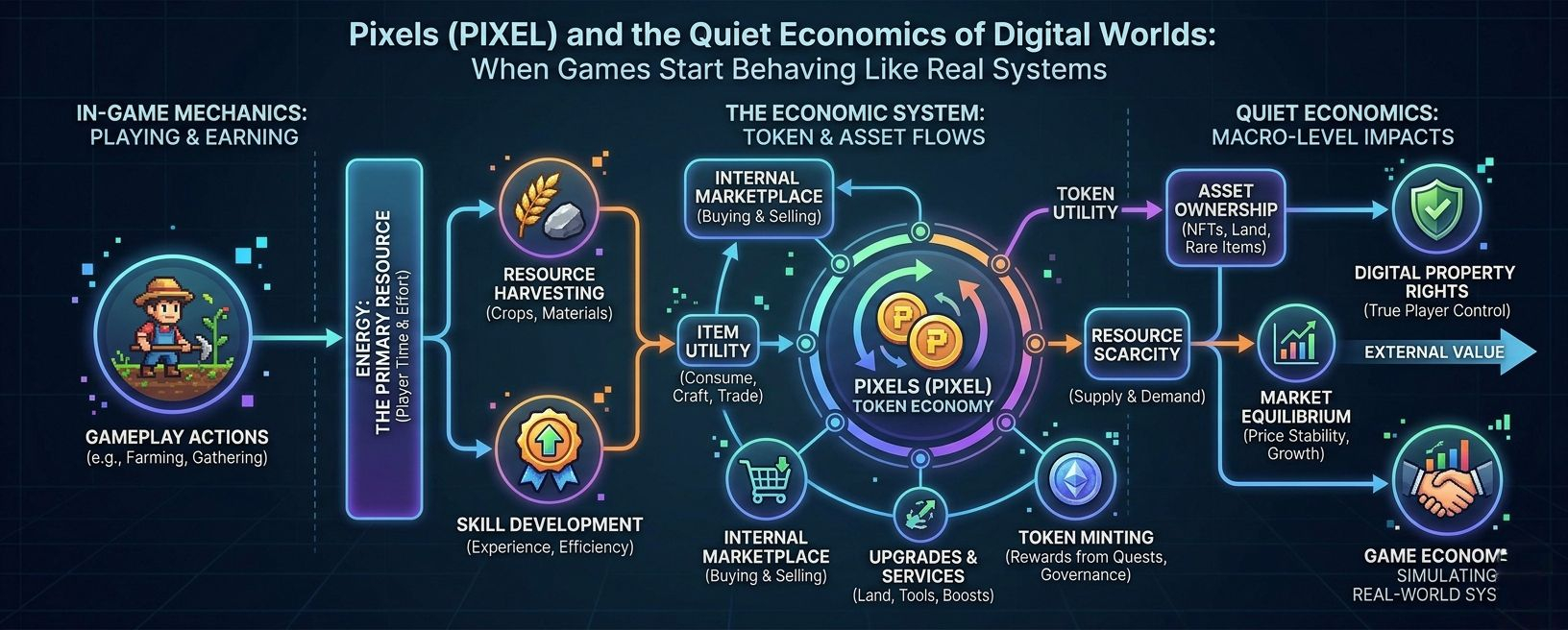
Through this lens, if I look at a Web3 game like Pixels (PIXEL), it doesn't just seem like a farming and exploration game to me; it feels like a digital economy that's running between players, developers, and blockchain infrastructure. On the surface, it’s a relaxing open-world experience where players farm, explore, and express their creativity. But beneath, it's an incentive-driven system where time, effort, and digital ownership are linked to economic value.
Building on the Ronin Network means Pixels gets an infrastructure specifically optimized for gaming. This is a practical decision because high fees and slow transactions on general-purpose blockchains can break the gaming experience. But having the infrastructure is just one part; the real question is whether the economy designed within this system is sustainable or not.
If I compare this to real-world farming, resources are also limited there, the weather is unpredictable, and market prices fluctuate. Farmers need to understand efficiency, timing, and risk management to survive. Pixels gamifies this idea, but there’s a twist: the digital assets and tokens players earn are influenced by external markets. This means that the activity within the game and the speculation outside become linked.
Here, an important tension arises. Are players playing the game for fun, or to earn? If the majority come to earn, the system could turn into a kind of digital labor market. In this scenario, attracting new players becomes crucial; otherwise, the rewards for existing players get diluted. It’s just like a business that can only thrive as long as new customers keep coming in—otherwise, growth halts and pressure builds.
Verification is also an interesting aspect. Blockchain theoretically makes ownership and transactions transparent, but measuring the effort or skill involved in gameplay is tricky. If bots or automated systems start farming, it could create an imbalance for genuine players. In the real world, when ways to exploit the system are discovered, those who follow the rules end up at a disadvantage.
Operational risk cannot be ignored either. Game servers, smart contracts, and network reliability are all interconnected. If there's an issue on the Ronin Network or if game developers can't manage updates properly, user trust can be damaged quickly. It's just like a factory where if one machine fails, the entire production line comes to a halt.
The adoption angle is also critical. Real-world systems aren't stable until they're not just limited to early adopters. For Pixels to survive long-term, they need to attract people who can enjoy the game even without crypto. If the core value of the game relies solely on token rewards, it will be vulnerable to volatility. But if the gameplay is genuinely engaging, then the economic layer could become a bonus, not the foundation.
I think Pixels is an interesting experiment where they're trying to merge gaming and digital ownership. However, it's essential to stay away from the hype to understand it fully. Like any system, it depends on the alignment of incentives. If players, developers, and the network's interests come into a stable equilibrium, then this model could work. Otherwise, it could turn out like those systems that look promising at the start but struggle in operational reality.
In my opinion, it would be wrong to see Pixels merely as an 'earn-to-play game.' It should be viewed as an evolving system where many assumptions are still being tested. I'm cautiously optimistic—the idea is interesting, but sustainability needs to be proven. If this system can't maintain its internal balance, Pixels could just become another digital experiment that started out interesting but couldn't sustain itself.
However, if the incentives align correctly, it could become a virtual economy model that blurs the line between gaming and real value.
The real question isn't how fun Pixels is, but whether anyone would want to return to this system once the excitement fades.
And perhaps the most important point—what seems like a game today could become an economic reality tomorrow, where every click carries its weight.
Or it could be that we're looking at a system that seems really beautiful on the outside... but inside it's just temporary trust and shifting incentives that still need to hold up.
