Everyone knows what a validator does in crypto. Nobody expected a game to become one.
That is the shift Pixels is making and most people reading the whitepaper gloss over it because it sounds like a technical detail. It is not a tEchnical detail. It is a complete restructuring of how publishing power works in Web3 gaming.
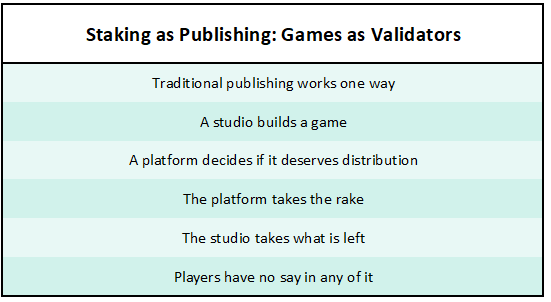
Traditional pUblishing works one way. A studio builds a game. A platform decides if it deserves distribution. The platform takes the rake. The studio takes what is left. Players have no say in any of it.
Pixels flipped the model.
Instead of nodes validating transactions, games validate economic contribution. Players stake $PIXEL directly into individual game pools not into a generic protocol fund, not into a DAO treasury, into the game itself. That staking aLLocation becomes an on-chain signal. It tells the ecosystem which games deserve resources, emissions, and user acquisition budget.
The game has to earn that stake. Not through marketing. Not through pRomises. Through actual retention numbers, net in game spend, and real RORS performance.
I find this more interesting than most people seem to. Because what it creates is a competitive publishing environment that did not exist before. Games are not waiting for a platform to approve them. They are competing for community capital and the community is voting with locked tokens, not likes.
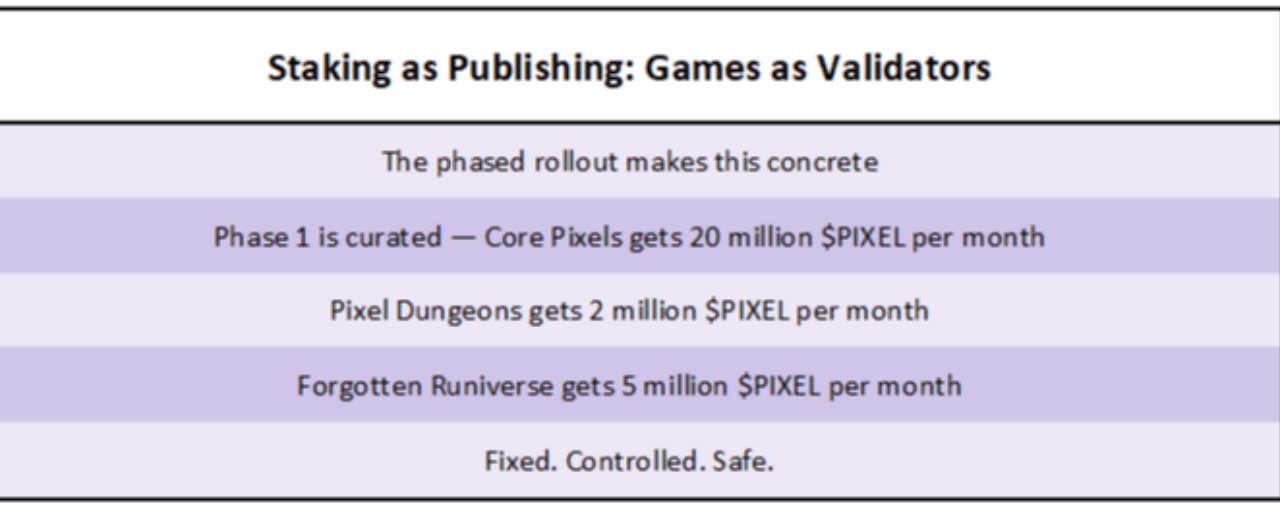
The phased rollout makes this cOncrete. Phase 1 is curated Core Pixels gets 20 million per month, Pixel Dungeons gets 2 million, Forgotten Runiverse gets 5 million. Fixed. Controlled. Safe.
Phase 2 changes everything. Dynnamic pools. The global cap of 28 million nthly gets split based entirely on how much is staked to each game. A new title with strong retention can pull emissions away from an established one. No platform manager needed. No approval process.
Phase 3 opens it further. Any game crossing RORS threshold of 1.0 or hitting certain DAU benchmarks becomes eligible. The ecosystem itself becomes the gatekeeper.
The uncomfortable part and I think about this more than I should is what happens to games that lose the staking competition. Their emissions shrink. Their UA budget shrinks. Their player acquisition slows. The model rewards winners compounding and punishes losers fading. That is efficient. It is also brutal for studios that built something genuinely good but could not win the attention war early enough.
Whether community staking actually reflects game quality or just reflects which game marketed itself better to token holders that question does not have a clean answer yet.
Phase 2 will tell us a lot.
What would make you stake into a game its mechanics, its economics, or just how early you got in?