
Something odd started bothering me a few days ago while looking at assets inside @Pixels , and it came from noticing not what grows, but what quietly weakens when attention leaves it. Most people, including me, tend to think about game economies through accumulation. More land, more output, more resources, more progress. Growth becomes the natural lens. But the longer I watched how players actually behave, the less convinced I became that growth alone explains much. Because some value in #pixel doesn’t seem shaped only by what players build up. It may also be shaped by what slowly deteriorates when players stop tending to it. And that is a very different thought.
At first I did not take that seriously. I assumed neglect was just inactivity. If a player disengages or lets parts of a strategy drift, of course outcomes soften. Nothing profound there. But then I started wondering whether decay itself may be doing economic work inside the system. Not dramatic collapse, just subtle erosion. The kind where a neglected asset, neglected routine, or neglected positioning loses quality over time in ways players may not fully notice until rebuilding costs more than maintenance would have. And once I looked at it like that, a strange possibility appeared. What if part of the economy is not organized around maximizing growth at all, but around balancing growth against decay pressure?
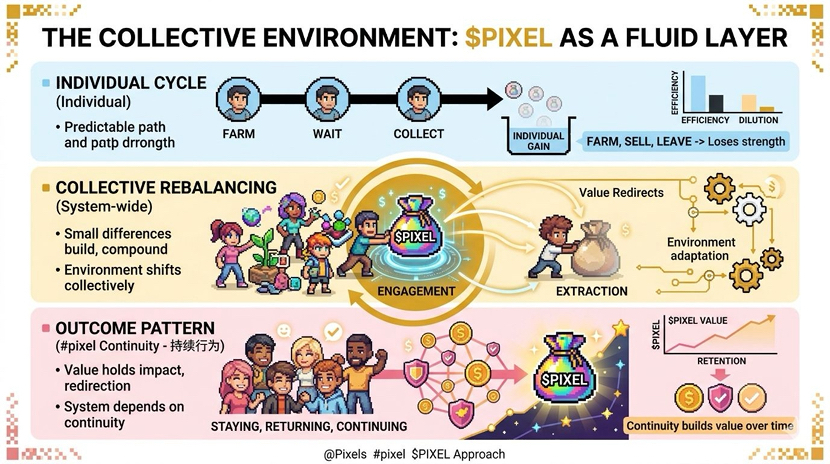
That changes how I look at $PIXEL too. Because people usually treat the token as tied to expansion, upgrades, acceleration. But what if part of its deeper role sits where players resist deterioration rather than pursue growth? That is a different kind of demand. Not demand created because people want more, but because they do not want slippage. And demand shaped by avoiding slippage behaves differently. It can be quieter, more recurring, less visible. But sometimes more durable.
The thought kept expanding because many systems actually become fragile not when growth slows, but when maintenance gets underestimated. People optimize expansion while ignoring slow value erosion underneath. I have seen versions of this in markets too, where preserving asset quality matters as much as chasing return. And I keep wondering whether some of that logic exists inside @Pixels more than people recognize. Because if players continually face small decay pressures whether in positioning, routines, or economic relevance then value may partly come from managing entropy, not just producing output.
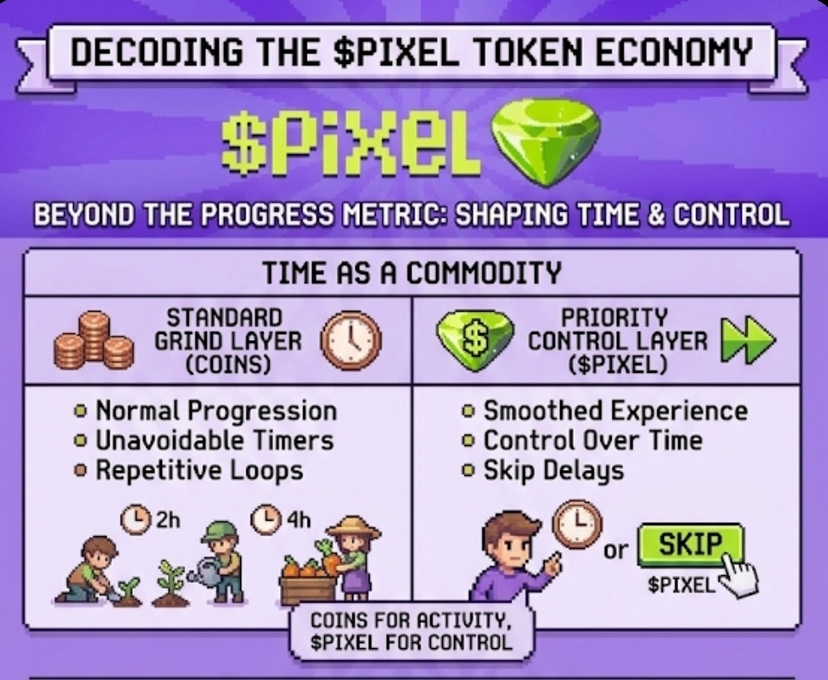
There is tension in that. Too much decay pressure and players feel burdened. Too little and assets may lose seriousness because neglect carries no consequence. Somewhere between those may be where a system feels alive. And maybe that balance matters more than people realize. Because economies often do not break through visible shocks. They soften through unattended erosion.
That is where the idea starts feeling uncomfortable. Because if experienced players understand decay dynamics better than newer players, they may hold hidden advantages that do not show up through obvious rewards. Not because they earn more in one moment, but because they lose less quietly over time. And losing less can compound just as powerfully as gaining more. That is a much stranger edge than most people talk about.
Maybe I am overreading ordinary maintenance behavior. That is possible. But I keep returning to one question. When players use $PIXEL or make decisions that preserve position inside @Pixels , are they always chasing growth… or sometimes simply resisting slow economic decay? Because if the second matters, then the system may be pricing something much subtler than progression. It may be pricing preservation against entropy. And that feels like a far more interesting mechanism hiding inside a farming economy than I expected.