

I usually look at gaming tokens with some caution, because many of them sound exciting at first but become weak once the reward loop meets real users.
What matters to me is not whether rewards exist, but whether the system can tell the difference between temporary activity and real economic demand. That is why the staking design in Pixels feels worth studying from a more practical angle.
The main friction in gaming economies is simple: incentives can attract attention, but they can also distort behavior.
If rewards are pushed into games without a strong feedback system, developers may optimize for short bursts of activity instead of long-term retention. Players may come for extraction, not participation.
The ecosystem then spends tokens, but it may not always learn which games are actually creating durable value.
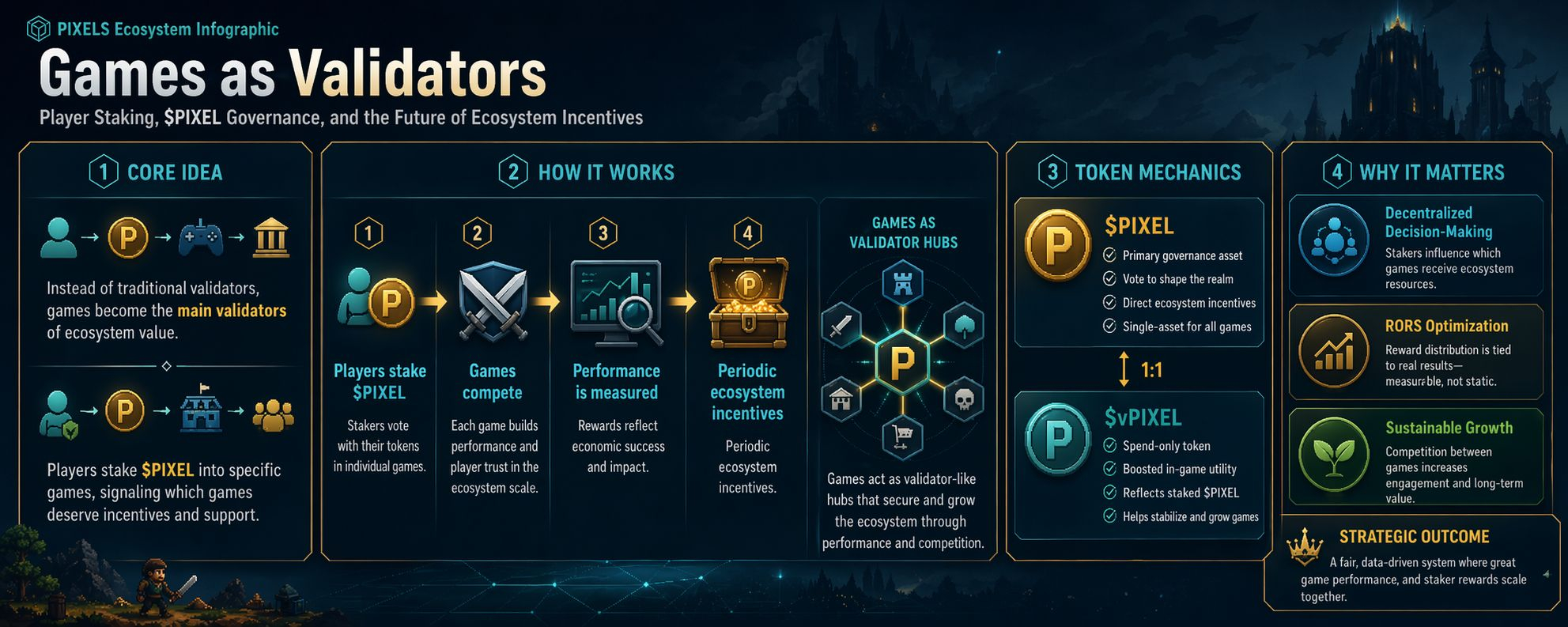
This is where the “games as validators” idea becomes interesting.
A normal validator proves network participation through infrastructure, while here a game has to prove economic usefulness through player behavior.
That analogy matters because it changes what staking represents. Instead of treating staking as a passive lockup, the network turns it into a signal of confidence around individual games. Players are not only supporting a token; they are directing attention and incentives toward the games they believe can use those resources well. In that sense, staking becomes a kind of decentralized publishing filter.
The mechanism is not only social. It also has a measurable layer.
When players stake their governance asset into specific games, the system can observe where support is going and compare that support with game-level performance.
A game that attracts stake but fails to retain users or convert incentives into meaningful in-game spending may not look strong for long. Another game that uses incentives efficiently, improves player retention, and creates healthy net spend can become more convincing to stakers over time.
This creates a quiet form of competition between developers.
Not competition based only on trailers, promises, or short campaigns, but competition based on how well each game turns ecosystem support into useful activity.
That is a healthier standard than simply asking which game can generate the loudest launch. In a publishing ecosystem, the difficult question is always where rewards should go.
This design tries to answer that with a mix of staking choice, game performance, and reward efficiency.
The state model can be understood through a few layers. At the player layer, the important state is how much has been staked and which game receives that stake.
At the game layer, the state is tied to performance signals such as retention, net in-game spend, and efficient use of the tools available inside the ecosystem.
At the reward layer, the system needs periodic accounting so incentives are not distributed blindly but routed according to game-specific results.
That is the part I find most important.
If the system is serious about optimizing Return on Reward Spend, then rewards should not be treated as a fixed marketing expense.
They should behave more like a budget that is tested against outcomes. The stronger the outcome, the better the justification for continued support.
The weaker the outcome, the less convincing the allocation becomes. This gives the network a way to learn from its own spending instead of repeating the same reward pattern across every game.
Consensus selection in this design is not the same as block validation, but it still has a decision-making function. Stakers help decide which games deserve more weight inside the ecosystem.
The “selection” happens through where stake is placed, and the result affects incentive direction. That makes governance more active because the player’s decision is tied to a real game, not just a broad vote with abstract consequences.
The economic model also becomes more layered.
$PIXEL remains the main governance and staking asset, so it carries the decision-making function. $vPIXEL adds another layer because it is designed as a spend-only token backed 1:1 by the main asset.
That detail is important because it separates reward withdrawal from immediate external selling behavior. If players can use rewards inside the ecosystem without extra fees, the flow becomes more circular. Rewards can move back into games instead of instantly becoming pressure outside the system.
I would not overstate this point, though.
Spend-only mechanics do not automatically create sustainability. They only improve the path if players actually find enough reasons to spend inside the network.
That depends on game quality, utility, retention, and whether developers design sinks that feel natural instead of forced. A token flow can guide behavior, but it cannot replace product strength.
The price negotiation side should be understood carefully. This is not about predicting token price or attaching a market target. It is more about how value is negotiated inside the ecosystem. Players negotiate by choosing where to stake.
Games negotiate by proving they can convert incentives into measurable performance. The network negotiates reward allocation by comparing stake, game outcomes, and RORS efficiency. Fees, staking, and governance all sit inside this same loop.
That makes the system less like a simple reward faucet and more like an internal marketplace for attention, capital, and performance.
For developers, this can be demanding. A game can no longer rely only on being present in the ecosystem.
It has to compete for stakers, show retention, and make a case through data. For players, it adds responsibility because staking becomes a decision about which games should receive more ecosystem support. For governance, it creates a more grounded signal because votes are connected to economic behavior.
The strongest part of the model is that it does not assume every game deserves the same incentive flow.
That feels realistic. Some games will use rewards well. Some will not. Some may generate activity that looks good on the surface but fades quickly.
Others may grow more slowly while building a healthier spending loop. A decentralized publishing model needs a way to tell those differences apart, otherwise the reward system becomes too easy to waste.
The remaining question is transparency.
Stakers need enough visibility to understand why rewards are going to certain games. Developers need clear rules so they know what performance actually matters.
The ecosystem needs protection against short-term farming, artificial spend patterns, and behavior that tries to look productive without creating real demand. If those parts are not handled well, even a strong staking design can become noisy.
Still, I think the direction is worth taking seriously because it frames games as active economic participants rather than passive content inside a token system.
The protocol is trying to make games prove their value through retention, spending behavior, and reward efficiency. That is a stricter standard than ordinary incentive distribution.
For me, the real idea is not just staking.
It is whether a gaming network can use staking to discover which games deserve resources, which developers can handle incentives responsibly, and which reward loops are actually sustainable over time.
That is a more useful question than whether rewards can bring users in. The harder question is whether the system can learn who should keep receiving them.
