
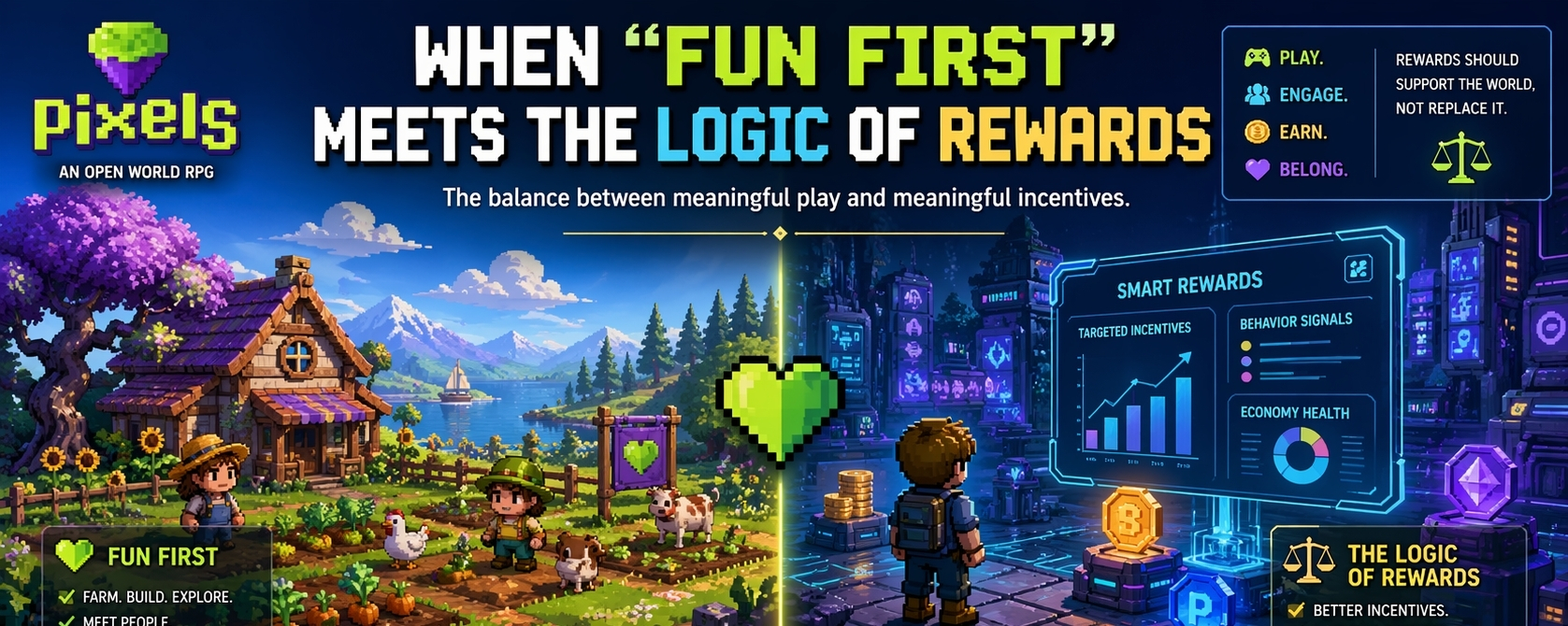
When “Fun First” Has to Prove Itself
I always slow down a little when a web3 game says it is fun first. Not because that cannot be true, but because I have seen that line used so many times that it no longer feels innocent. It often sounds like something a project says before you have even had the chance to ask the harder question. So when I looked at Pixels, I tried not to get stuck on the phrase itself. I paid more attention to the shape of the project underneath it. Pixels talks about farming, building, raising animals, exploring, and spending time with other players. But it also makes rewards part of the picture. And that is where the real tension begins for me: are rewards here to support engagement, or do they slowly become the thing replacing it?
What I appreciate is that Pixels does not completely dodge that tension. In the litepaper, it says very directly that the goal is to rethink the old play-to-earn model through better incentives and more targeted rewards. At the same time, it keeps returning to the idea of “Fun First,” as if it knows that none of the economic design matters if the game itself does not feel worth staying in. I think that part is important. If people would not spend time in a world without being rewarded for it, then the reward layer is probably doing too much.
That is the test I keep coming back to. If I mentally remove the incentives for a moment, what is actually left? In Pixels, there does seem to be a real attempt to build a place that has its own texture. The project leans into the slower pleasures of tending land, building routines, meeting people, and making the world feel lived in. That matters more than projects like this sometimes admit. A game does not become meaningful just because behavior can be tracked or rewarded. It becomes meaningful when players start developing habits that feel natural to them, not habits that feel like they were gently pushed into by a system.
Still, rewards change the mood of a game even when the world itself is appealing. The litepaper talks about data systems and smart reward targeting, which sounds efficient, but it also reveals something deeper. The system is not just rewarding “play” in some broad, open-ended way. It is deciding which kinds of play count more. Some actions are treated as more valuable than others. And once that starts happening, the idea of fun becomes a little more complicated. Is a player spending time farming because it genuinely feels calming and satisfying, or because the system has quietly made that loop the smartest one to repeat?
That question is where things get real for me. Rewards can absolutely support engagement when they strengthen something that already feels enjoyable. They can help players stay longer, explore more, or take social play more seriously. In that version, rewards are helping the world breathe. But rewards can also do something more controlling. They can narrow curiosity. They can turn a world into a path, a rhythm into a grind, a place into a system to be optimized. The player may still be active, but being active is not the same as being genuinely drawn in.
Pixels feels aware of that line, but it is also clearly building something bigger than a simple cozy game. The project talks about ownership, staking, rewards, and a larger ecosystem built around player activity. The litepaper also points toward a broader publishing and growth model shaped by player data and reward design. That makes the project more ambitious, but it also raises the stakes for the “fun first” claim. The more precisely a system learns how to direct behavior, the easier it becomes to mistake retention for enjoyment. A player can stay busy for a long time without ever feeling truly connected.
Maybe that is the real challenge sitting inside Pixels. Not whether it has rewards, but whether it can keep rewards from quietly becoming the author of the whole experience. A strong game can hold incentives without letting them take over its soul. A weaker one starts bending around them until the player no longer feels invited into a world, only managed by one. What keeps Pixels interesting to me is that it still seems to be standing in that uncertain middle space, trying to show that a game can be economically clever without becoming emotionally hollow. And in the end, I do not think that proof comes from the reward layer at all. It comes from the moment a player keeps playing for reasons that no system had to manufacture first.