

$PIXEL At first, it honestly didn’t stand out much. Pixels just looked like another routine loop — grow something, wait it out, collect, and repeat. The kind of system you don’t think twice about because you’ve already seen versions of it before.
But after spending some time actually observing how people move through it, something started to feel a bit… different.
Not broken. Not revolutionary either. Just slightly off from what you’d expect.
It’s not really the rewards that keep people engaged.
It’s the pacing.
Most systems like this try to pull you in with progress — faster output, better efficiency, clearer upgrades. Pixels does offer that, but it doesn’t feel like the main driver.
What you start noticing instead are the constant little slowdowns. Small timers. Energy limits. Tiny pauses that don’t seem important on their own.
But when they stack up, they change how the whole experience feels.
And that’s where PiXels starts to make sense.
It doesn’t behave like a typical in-game currency. It feels more like a shortcut around friction. Not something you use to gain an edge, but something you reach for when you’re tired of waiting.
You’re not buying progress.
You’re buying back your time.
And that decision shows up more often than you’d think.
What’s interesting is that this isn’t just coming from competitive players. Even the ones who aren’t chasing efficiency end up using it — not to win, just to keep things flowing smoothly.
That creates a kind of demand that’s easy to overlook.
It’s not loud or hype-driven. It doesn’t spike suddenly. It just happens in small, repeated moments — skip this delay, speed that up, move on.
There’s also a subtle boundary inside the system.
You can stay in the basic loop for a long time without ever touching $PIXEL. Everything still works. You can progress slowly, at your own pace.
But the moment you start valuing control over your time, things shift.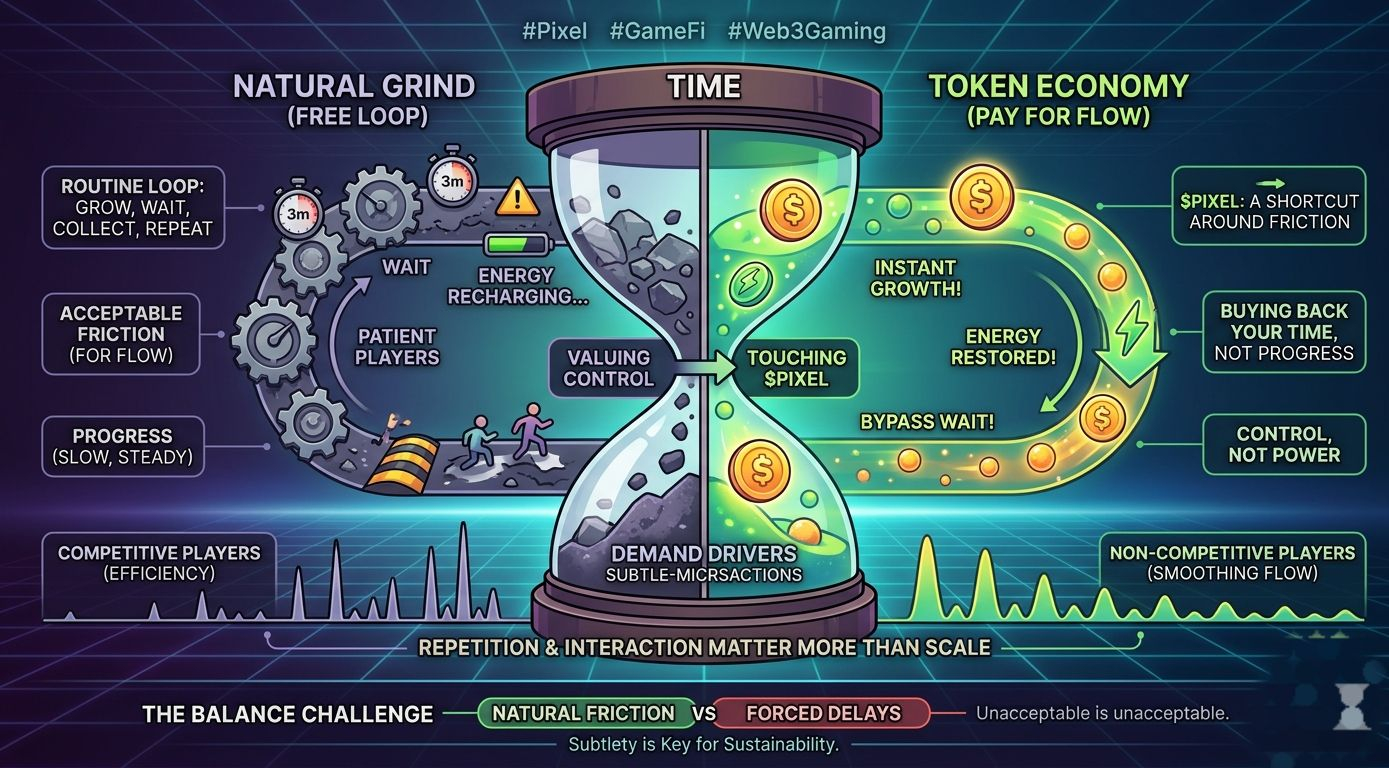
You don’t leave the system — you just interact with it differently.
And that’s where $PIXEL sits.
Not as a necessity, but as an option that quietly becomes relevant.
The challenge is balance.
If everything becomes too fast or efficient, then there’s no reason to use it. But if the delays feel forced or artificial, players notice that too — and that usually doesn’t end well.
People don’t like feeling pushed.
They either resist, or they walk away.
Which is why this kind of design is tricky. The friction has to feel natural. Like it belongs there. Not like it was placed just to be removed later.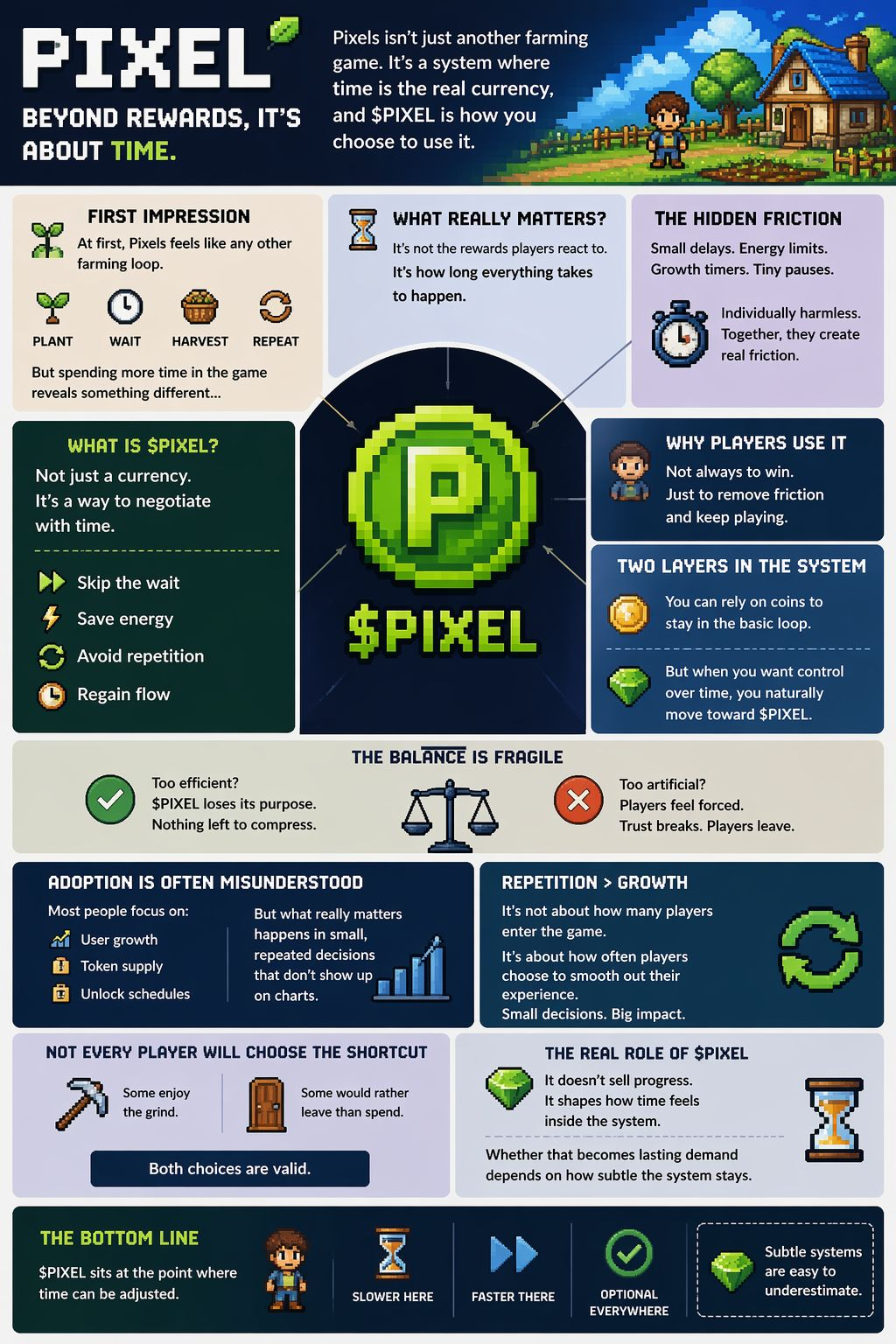
And that’s not easy to maintain.
What’s also interesting is how this changes the usual way people look at these systems. Most conversations focus on growth — more users, more activity, more expansion.
But here, it feels like repetition matters more than scale.
Not how many players join, but how often existing players choose to skip a delay or smooth out their experience.
Those choices are subtle. Almost invisible.
But they’re where the real interaction with the token happens.
Of course, not everyone will make those choices. Some people are fine with the grind. Others would rather stop playing than spend to speed things up.
That option is always there.
So it’s not guaranteed that this model holds over time.
But it also doesn’t feel like it’s being fully understood yet.
Pixels isn’t just about earning or upgrading.
It’s about how time feels while you’re playing — where it slows down, where it speeds up, and when you decide to change that.
And PIXEL exists right at that point of control.
Whether that turns into something sustainable or just a short-term behavior probably depends on how subtle they can keep it.
Because once the system becomes too obvious…
people start seeing it differently.