
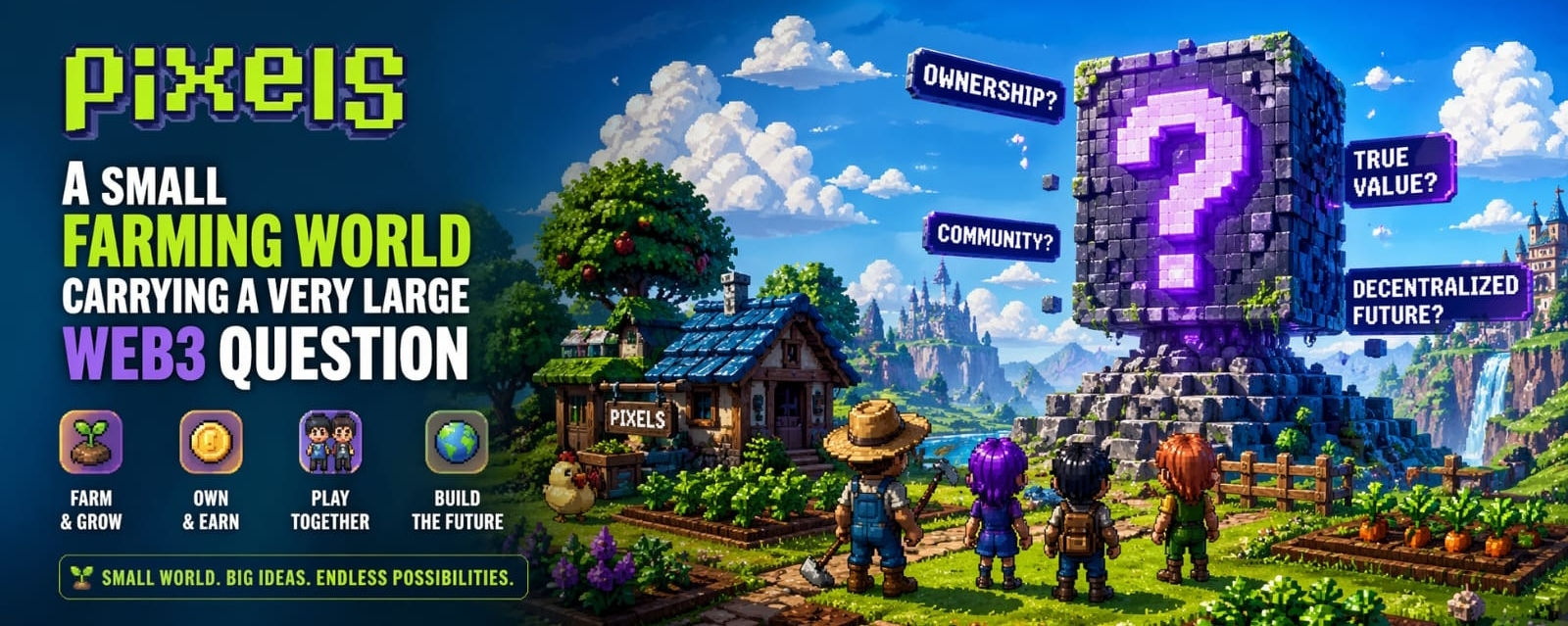

Pixels is the kind of project that looks harmless until you remember what crypto does to harmless things. It starts as a farming game. Soft pixel art. Crops. Land. Quests. Little routines. People walking around doing small tasks. On the surface, nothing about it screams pressure. But under the hood, Pixels is dealing with one of the oldest wounds in Web3 gaming: how do you let people earn without turning the whole place into a farm for extractors?
Look, anyone who has been around crypto games for more than one cycle knows the mess.
People don’t just play.
They optimize. They multi-account. They bot. They grind whatever has a reward attached to it. They turn Discord roles into work. They turn quests into spreadsheets. They turn casual gameplay into a job they do not even enjoy. Then the token launches, rewards get dumped, the economy starts leaking, and everyone acts shocked.
Pixels walked straight into that problem.
That is why I find it interesting. Not because it is perfect. Not because farming games are new. Not because PIXEL as a token magically fixes Web3 gaming. It does not. The interesting part is that Pixels is trying to build a real game loop inside a space that usually eats game loops alive.
The thing is, Pixels understands routine better than most crypto projects. A lot of projects only know how to create noise. Listing noise. Airdrop noise. Partnership noise. Snapshot noise. Pixels has something quieter. You log in. You farm. You craft. You check your land. You do a task. You come back later.
That sounds boring.
Honestly, boring is underrated.
Crypto has enough fireworks. Most of them burn your hand. What Pixels has tried to build is closer to plumbing. Daily actions. Resource flows. Land use. Token sinks. Player progression. Social presence. All the unsexy infrastructure that needs to work if a Web3 game is going to survive after the reward hunters leave.
And yes, reward hunters are everywhere here too.
That is unavoidable.
Pixels sits on Ronin, and Ronin comes with history. Everyone remembers Axie. Everyone remembers the boom. Everyone remembers people calling games “jobs.” Everyone remembers the crash after the incentives got too heavy and the economy could not breathe. So when Pixels became one of Ronin’s main games, it was not entering a clean room. It was entering a chain with scars.
That actually makes the project more honest to me.
Pixels does not exist in theory. It exists after we already saw what went wrong.
The trauma here is clear: Web3 games got overrun by extraction. The fun became secondary. The token became the main character. Players became farmers. Farmers became sellers. Sellers became pressure. Then the community split between people who liked the game and people staring at the chart like it owed them rent.
Pixels has not escaped that tension.
No serious crypto game has.
But Pixels has at least built enough of a world that the conversation is not only about the token. There is land. There are upgrades. There is crafting. There are tasks. There are players moving around. There is social noise. There are systems that need tuning. There are people who actually care about what happens inside the game, not only what happens on an exchange.
That matters.
The land system is a big part of it. Land in Pixels is not just a pretty JPEG sitting in a wallet. It is a place inside the game. You can shape it. Use it. Improve it. Treat it like a home, a production tool, or an asset. That flexibility is also where the mess begins, because crypto never lets anything stay emotionally simple.
A farm becomes property.
Property becomes status.
Status becomes speculation.
Speculation becomes stress.
That is the Pixels experience in one line. Cozy on top, complicated underneath.
The PIXEL token added even more pressure. Tokens always do. Before a token, people ask what they can do in the game. After a token, they ask what every action does to price. Suddenly, a crafting requirement is not just a crafting requirement. It is a sink. A VIP feature is not just a feature. It is demand. A reward is not just a reward. It is potential sell pressure waiting to hit the market.
This is the part outsiders miss.
Crypto gaming is not just game design. It is economy design with angry users watching the chart every minute.
That is hard to build.
Pixels has had to deal with bots, grinders, casual players, landowners, token holders, guilds, and people who only show up when there is something to farm. All of them want different things. The player wants fun. The farmer wants yield. The holder wants price. The landowner wants utility. The team wants retention. The bot wants weakness in the system.
Good luck balancing that.
Still, Pixels has lasted longer than most of the games that came in with louder promises. That is probably because it did not rely only on one big moment. It created repeat behavior. Small actions. Daily loops. A reason to come back even when there is no giant announcement.
It is not flashy.
It is just necessary.
The real test for Pixels is whether people spend inside the world because they want to, not because they are forced to. That is the difference between a game economy and a reward drain. If people only earn and sell, the system gets hollow. If people earn, spend, upgrade, decorate, compete, socialize, and reinvest, then maybe something healthier can form.
Maybe.
I am careful with that word because crypto has taught me not to trust clean narratives. Every project sounds sustainable until the emissions hit. Every economy sounds balanced until users find the exploit. Every community sounds loyal until price drops for six months.
Pixels is not immune.
The token has felt market pressure. The game still needs deeper reasons for long-term players to stay. The economy needs constant tuning. The project has to keep fighting fake users and shallow farming behavior. And the more it grows, the harder that gets.
But that is also why I take it more seriously than the usual Web3 game pitch. Pixels is working in the ugly part. Not just the cute part. The ugly part is reward design, sinks, retention, land utility, player identity, and making sure the system does not get drained by people who never cared about the game in the first place.
That is not glamorous work.
That is plumbing.
And in crypto, plumbing is usually what breaks first.
Honestly, the thing I like most about Pixels is that it feels unfinished in a believable way. Not unfinished like vapor. Unfinished like something live, messy, and being adjusted while people are already inside it. That comes with frustration. Players will complain. Token holders will complain louder. Some updates will feel too strict. Some systems will need time. Some ideas may not work.
That is normal.
A real game economy is not born clean.
Pixels is trying to prove that a Web3 game can be more than a temporary extraction event. It still has the token. It still has speculation. It still has farmers. It still has all the crypto baggage. But it also has a world people recognize, routines people repeat, and enough social weight to make the whole thing feel alive.
That is not a small thing anymore.
Most crypto games die after the first wave of attention leaves. Pixels is still here, still being argued over, still being played, still trying to turn a farming loop into something that can hold value without collapsing under the people farming it.
Look, I do not know if Pixels fully pulls it off.
Nobody does.
But I know what it is fighting against, because we have all seen the wreckage before. Bad token loops. Fake users. Empty game worlds. Reward systems that attract everyone except actual players. Pixels is trying to build through that mess instead of pretending it does not exist.
And maybe that is the part worth watching.
Not the cute crops. Not the token chart by itself. Not the clean project description. The real story is under the hood, where Pixels is trying to make the boring parts work well enough that the world can keep breathing after the farmers have taken what they came for.