I used to read farming in @Pixels in the simplest way.
You plant.
You grow.
You harvest.
You repeat.
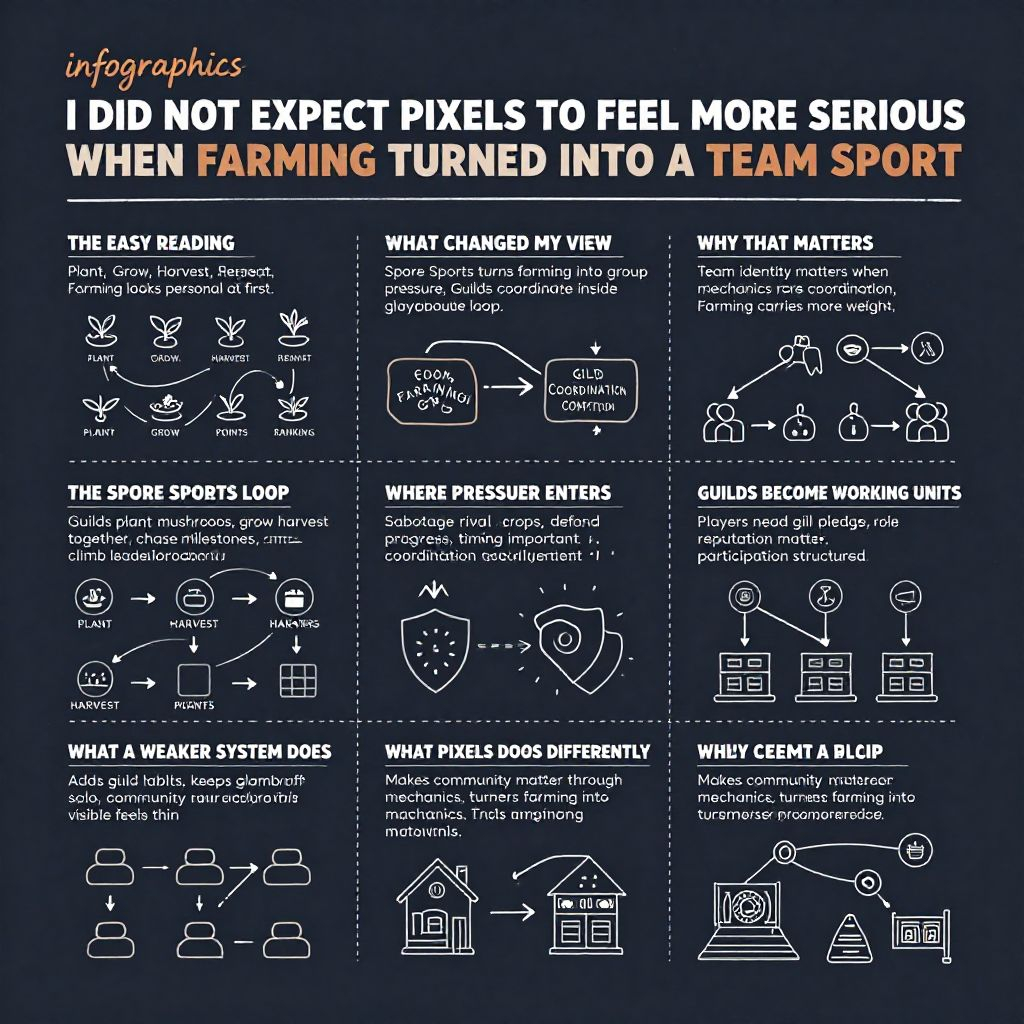
That was the easy reading, and it made sense. Farming usually feels personal. It feels like a routine built around your own time, your own land, your own choices, and your own progress. For a while, I looked at Pixels through that same lens. The farm felt like the center of the experience, and everything else felt like an extension of that individual loop.
But the more I looked into Spore Sports, the less farming felt like a quiet solo routine.
It started feeling like coordinated pressure.
That is where Pixels started reading differently to me.
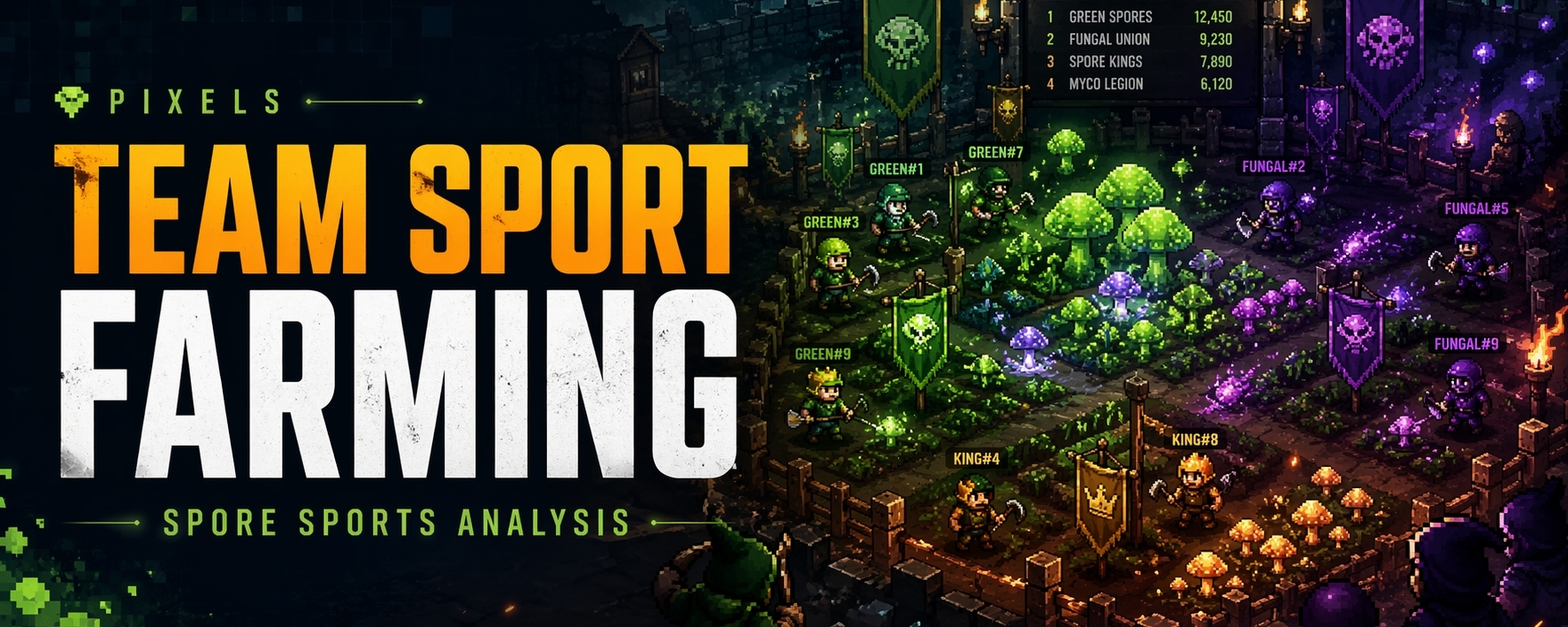
What caught my attention was not only that guilds plant, grow, and harvest mushrooms together. That already makes the loop more social. What changed my view was everything added around that loop: milestones, sabotage, defense, leaderboards, guild tiers, and timing pressure. Suddenly, farming is not only about what one player can do alone. It becomes about how well a group can coordinate when other groups are also trying to win.
That difference matters to me.
A lot of games add social systems around the outside of gameplay. They add guilds, chats, rankings, and team labels, but the core loop still feels mostly individual. You may belong to a group, but you still play like you are alone. Spore Sports feels more interesting because the guild layer is not sitting beside the farm. It pushes itself directly into the farm. The same action that looks calm in the normal loop starts carrying team pressure when points, sabotage, and leaderboard position are involved.
And honestly, that is where weaker systems lose me.
A weak social layer can make players visible, but it does not make them necessary. You can join a guild and still feel like nothing about your gameplay has really changed. You can wear the label without needing the coordination. That kind of system looks social from the outside, but inside it feels thin. Spore Sports feels more serious because participation depends on being pledged to a guild, having a valid role, and meeting the reputation requirement. That makes the guild structure matter in practice, not only in name.
That is where farming stops feeling small to me.
The moment sabotage enters the loop, the whole meaning changes. A mushroom is not just something you grow. It becomes something that can be attacked. A harvest is not just output. It becomes timing. A guild’s farm is not just a production space. It becomes a shared target and a shared responsibility. Even the short harvest window matters, because once timing becomes tight, coordination is no longer optional. People have to show up at the right moment, not just whenever they feel like it.
That difference matters more than people admit.
Farming by itself can become repetitive if nothing pushes against it. You do the task, collect the result, and move on. But when another guild can interfere, when your own guild has to protect what it is growing, when points move a leaderboard, and when every action connects back to team performance, the same farming loop starts feeling heavier. It is still farming on the surface, but underneath it becomes strategy.
Who plants?
Who protects?
Who sabotages?
Who manages energy?
Who shows up at the right time?
Those questions make the loop feel more alive.
That is why Spore Sports feels like a smart extension of Pixels to me.
It does not abandon the identity of the game. It does not force a random competitive mode just to create noise. It takes something already native to Pixels and adds teamwork, conflict, risk, and public ranking around it. That is better design than simply attaching competition to a game from the outside. The competition still speaks the language of the world: mushrooms, spores, harvesting, energy, guilds, timing, and coordination.
And I think that is the important part.
A lot of games try to make community matter by talking about community. Pixels feels more interesting when it makes community matter through mechanics. In Spore Sports, guild members are not just standing under the same banner. They are producing points together, protecting crops together, sabotaging rivals together, and climbing rankings together. The guild stops being only a social identity and starts becoming a working unit inside the game.
That is where the whole thing started feeling more serious to me.
I do not think Pixels becomes deeper only when it adds more rewards, more resources, or more features. I think it becomes deeper when the same simple loop starts carrying more meaning. Farming is still there. But now farming can become coordination. It can become pressure. It can become attack and defense. It can become a reason for guilds to organize instead of just exist.
That is the part that stayed with me.
I did not expect farming in Pixels to feel more serious because it became competitive. But once I looked at Spore Sports properly, the shift made sense.
For me, Pixels starts feeling different when farming stops being only a personal routine.
And starts becoming a team sport.