
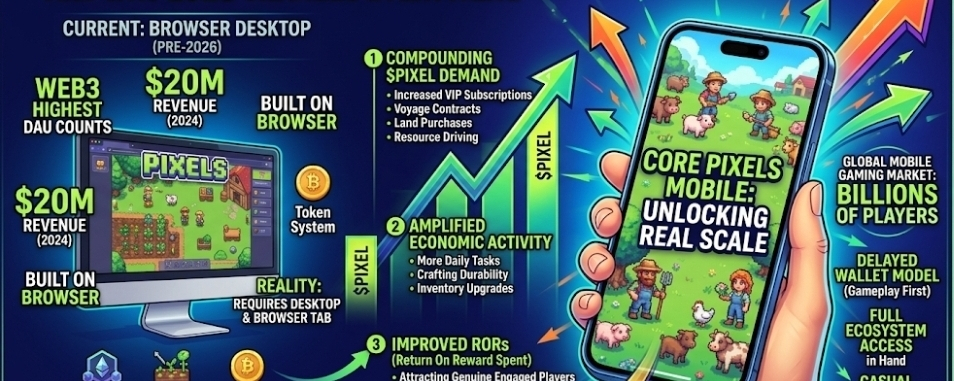
core pixels mobile — what happens to the entire ecosystem when the flagship game reaches the device in everyone's pocket
i've been sitting on this for a while — most conversations about pixels focus on what's already live. the staking system, the farming mechanics, the token economics. but there's one thing sitting quietly in the whitepaper that i think changes the entire scale calculation for this ecosystem. core pixels mobile. planned for 2026. and the more i think about what that actually means, the harder it is to overstate.
where pixels sits right now
here's the current reality. core pixels is a browser-based desktop game. it already achieved one of the highest daily active user counts in all of web3 gaming. it generated $20 million in revenue in 2024. it built an entire staking ecosystem, a rewards infrastructure, and a data network — all on top of a game that requires you to sit at a computer and open a browser tab. that's the baseline. and it's already significant.
what mobile actually unlocks
this is the part that got me. the global mobile gaming market is not comparable to desktop web3 gaming. it's not 10 times bigger. it's not 50 times bigger. mobile gaming reaches billions of players across every demographic, every geography, every income level. the casual player who would never open a browser-based blockchain game will download an app in thirty seconds if it looks fun. pixels pals already proved that the delayed wallet model works — bring players in with gameplay first, introduce the web3 layer after seven days of habit are built. core pixels mobile takes that exact same approach and applies it to the flagship title. the full farming experience, the full progression system, the full economic loop — in the palm of your hand.
what this does to $PIXEL demand
okay so here's where the numbers start to matter. every new mobile player who enters the core pixels ecosystem is a potential staker, a potential $vPIXEL spender, a potential VIP subscriber, a potential land buyer. the demand surface for $PIXEL doesn't grow linearly with new players — it compounds. more players mean more daily tasks completed, more $PIXEL spent on VIP access, more voyage contracts purchased for exploration realms, more crafting durability driving resource demand, more inventory caps being upgraded. every economic mechanism pixels has built gets amplified by the size of the player base underneath it. mobile doesn't just bring more players. it brings more economic activity across every single system simultaneously.
the RORS implication
i keep thinking about this specifically. pixels is currently sitting at a RORS of around 0.8 — every reward token spent generates 0.8 worth of revenue back. the entire ecosystem is engineered to push that number above 1.0. and RORS improves when genuine engaged players outnumber extractors. mobile onboarding — especially with the delayed wallet model — is specifically designed to bring in players who engage with the game before they engage with the token. that demographic profile is exactly the type of player that improves RORS. not because they spend more individually, but because they stay longer, churn less, and contribute more consistently to the economic loops that keep the ecosystem healthy.
the verdict
honestly i think core pixels mobile is the single most underpriced catalyst in the entire pixels roadmap right now. everything that's been built — the staking system, the smart-reward infrastructure, the data loop, the $vPIXEL mechanics, the RORS framework — was built to scale. and it hasn't been tested at real scale yet. mobile is what real scale looks like. the question isn't whether a mobile version of core pixels will bring more players. the question is — when billions of mobile devices become potential entry points into the pixels ecosystem, does the infrastructure pixels has spent years building finally get the audience it was always designed for? 🔥