Honestly... I didn't expect to feel this specific kind of attention reading through how Pixels has been building its Community Treasury.
Not skepticism. not alarm. something closer to the feeling you get when a balance sheet item that reads like a reserve fund turns out to be one of the most consequential design decisions the team made at the protocol level, and one whose full significance most players have not yet had a reason to examine.
because there's a pattern in how Web3 games handle treasury accumulation that this space accepts without examining what the accumulation is actually preparing for. the standard framing treats the treasury as a safety net. funds held in reserve for future development, for marketing, for liquidity support if the token needs stabilization. the treasury is a buffer between the project and uncertainty.
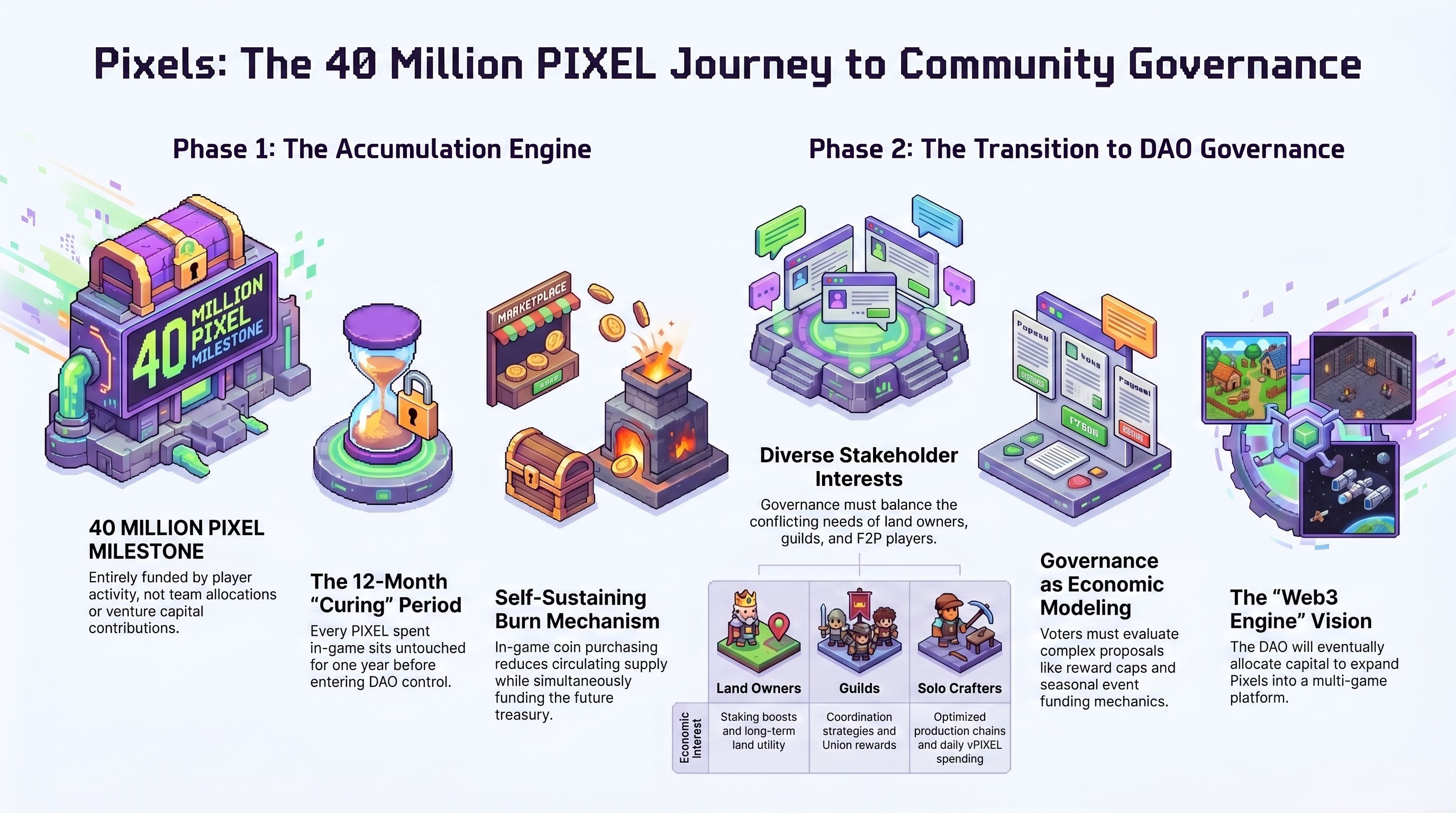
but Pixels built its Community Treasury with a different destination. every PIXEL spent in-game flows into the treasury. it sits untouched for twelve months. and then control transfers to a decentralized autonomous organization governed by PIXEL holders.
the treasury is not a buffer. it is a handoff scheduled in advance.
because the numbers they are describing are real. the Community Treasury had grown to nearly 40 million PIXEL as of late 2024, built entirely from in-game spending activity rather than team allocation or investor contribution. in-game coin purchasing had become the largest single PIXEL burn mechanism by that point, meaning the treasury was being funded by the same player activity that was simultaneously reducing circulating supply. the treasury and the burn rate were being driven by the same economic behavior.
so yeah... the treasury design is genuinely interesting.
but treasury design has never been the hard part of building a community-governed protocol.
the hard part is what governance actually means when the community that votes controls a treasury this size and the decisions being made affect the economy that generated it.
because here's what I keep coming back to. a DAO governed by PIXEL holders is not a uniform body making decisions with aligned interests. it is a collection of participants whose relationship to the Pixels economy differs significantly depending on how they hold PIXEL and what they want from it.
a land owner staking PIXEL for the 10% boost has a different economic interest than a free-to-play player earning through Task Board completions. a guild coordinating Union strategy has different priorities than a solo crafter optimizing a single production chain. a long-term holder waiting for token appreciation has a different time horizon than a player spending vPIXEL daily on in-game upgrades.
all of them are PIXEL holders. all of them will have governance rights over the same treasury. and the decisions that treasury funds will make, development priorities, reward adjustments, economic parameter changes, will affect each of those groups differently.
then comes the proposal design question. because of course.
and here's where the governance becomes genuinely compelling to examine. the quality of a DAO is not determined by the size of its treasury or the number of its participants. it is determined by the quality of the proposals that reach a vote and the depth of economic understanding that holders bring to evaluating them.
a proposal to adjust the monthly staking reward cap requires voters to understand how staking rewards interact with circulating supply, vPIXEL withdrawal behavior, and the Farmer Fee mechanism simultaneously. a proposal to fund a new seasonal event requires voters to understand how event-driven burn rates have historically moved relative to the distribution they offset. these are not simple yes-or-no questions. they are economic modeling exercises dressed in governance language.
the PIXEL holders who will vote on these proposals include players who have spent years inside the economy and understand its mechanics at a level most outside observers do not. that distributed expertise is one of the genuine advantages of a player-governed DAO over a centrally managed development fund.
there's also a dimension nobody talks about enough.
CEO Luke Barwikowski has described Pixels' strategic vision as transforming the game into a user acquisition engine for Web3 gaming broadly, not just a single title. a Community Treasury governed by a DAO is not just a fund for maintaining what already exists. in that vision, it is the capital allocation mechanism for an ecosystem meant to grow beyond its original boundaries into partner games, third-party scripting experiences, and a multi-game publishing platform where PIXEL functions as the connective economic tissue.
the decisions the DAO makes in its first governance cycles will signal whether that broader vision is being directed by the community that built the economy or by the subset of holders with enough concentrated voting power to shape outcomes independently.
still... I'll say this.
the decision to route in-game spending into a community-controlled treasury rather than a team-controlled development fund reflects a genuine commitment to the principle that the players who built the economy should have a meaningful voice in where it goes next. most Web3 gaming projects announce decentralization as a future aspiration. Pixels built the treasury first and structured the handoff into the original tokenomics.
the question is whether the PIXEL holder community that takes control of that treasury will bring the same depth of economic understanding to governance decisions that the best players have already demonstrated inside the game economy itself.
and in this world, the governance quality of the first DAO cycles will tell you more about Pixels' long-term trajectory than any single chapter update ever could.
@Pixels #pixel $PIXEL $KAT $LAB