
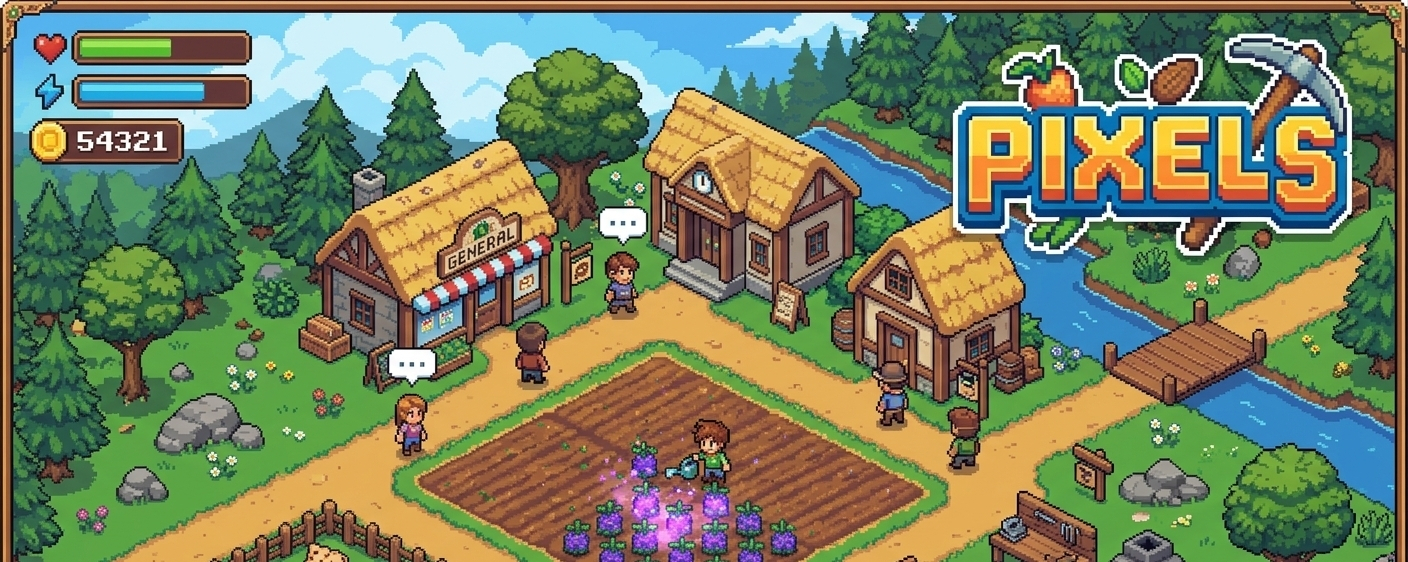

I Will Be Honest...
I didn’t expect a Simple farming game to make me rethink how value is created in GameFi. But after spending time with Pixels, I found Myself asking a different Question than usual: what if players aren’t really Paying for progress at all… but for Control over time?
Yeah... At first glance, Most play-to-earn systems look the same. You perform tasks, wait for outcomes, and slowly improve your Position. The logic is familiar. The more effort you put in, the more rewards You expect. But over time, I’ve noticed a pattern across many of these ecosystems. The issue isn’t that rewards are too Small or tokens are Poorly designed. The deeper problem is that time inside These systems is often rigid, and players don’t always want to Engage with it on Those terms.
In traditional Games, waiting is part of the experience. But in blockchain-based economies, waiting becomes Something else. It becomes measurable, repeatable, and Eventually, monetizable. This is where things start to get complicated. If every action requires time, And time Becomes predictable, Then the system quietly shifts from being about gameplay to being about Managing Delays.
Most GameFi Projects try to solve this by increasing Rewards. They offer better yields, higher Returns, or more incentives to stay engaged. But that doesn’t Really Address the core friction. Players don’t Always leave because rewards are low. Sometimes they leave because the experience feels slow, repetitive, or Unnecessarily stretched.
This is Where Pixels starts to feel different to me.
When I looked Closer, I didn’t see a system aggressively pushing rewards. Instead, I saw a system carefully shaping how time is Experienced. Small delays, energy limits, Growth cycles. None of these are Unusual on their own. But together, they Create a rhythm that players Constantly interact with. And more importantly, They create moments where players Make decisions about whether to Wait… or not.
That’s where PIXEL comes in, but not in the usual way we Think about tokens.
From my Perspective, PIXEL doesn’t act like a traditional in-game currency. It behaves more Like a Tool for adjusting time. When Players use it, they’re not Necessarily buying something new. They’re choosing to remove friction. They’re deciding that waiting no Longer fits their Current Intention.
I’ve seen players Who don’t care much about maximizing output still use PIXEL just to smooth Their experience. That’s interesting Because it suggests demand isn’t always tied to profit. Sometimes it’s tied to comfort, Efficiency, or simply avoiding Repetition.
There’s also a Subtle separation inside the system that I think is important. Basic in-game coins handle everyday activity. They keep Players moving, participating, and engaged. But the moment a player wants more Control over how their Time is spent, they naturally move toward PIXEL. It’s not Forced. It’s more like a boundary you Cross when your behavior changes.
In simple terms, Pixels works like this: you perform Farming and resource-based actions that take time to complete. You can wait Through these cycles and continue playing at a steady pace, or you can use PIXEL to Speed things up, skip steps, or reduce repetition. The system doesn’t remove waiting. It gives you the option to Reshape it.
This design has broader implications than it might Seem at first.
If GameFi Continues to evolve, we might see more systems where value is not just tied to assets or Rewards, but to time flexibility. In a way, this mirrors real-world digital services. Many platforms today offer free access with limitations, and paid access that Reduces friction. Pixels seems to apply a similar idea Inside a game economy.
But this Model is not Without risk.
If the system Becomes too efficient, and waiting no longer feels meaningful, then the role of PIXEL weakens. There’s no reason to pay for speed if everything already feels Fast. On the other hand, if delays start to feel artificial or excessive, players may feel pushed rather than empowered. And when that happens, trust can erode Quickly.
From what I’ve observed, the balance is extremely delicate. The friction needs to feel natural, Almost invisible. Players should feel like they are choosing convenience, Not being forced into it. That’s a difficult line to maintain, especially as the user base grows and behavior Patterns change.
Another thing I’ve been thinking about is how this affects token valuation. Most discussions focus on supply, unlock schedules, or User growth. These are important metrics, but they don’t fully capture what’s happening here. The real activity is in small, Repeated decisions. Moments where players decide to skip a timer, speed up a process, or Avoid repeating a Loop.
These actions don’t always show up clearly in Traditional data models. But they represent a form of demand that is behavioral rather Than speculative.
Still, this demand is not guaranteed to last. Players can Adapt. Some will choose to embrace the slower pace. Others may Leave instead of paying to optimize their experience. I’ve personally done that in Other games. Closed the app instead of spending. That option is Always present.
So the long-term Question becomes: can a system Like this maintain its subtlety?
If Pixels can Keep the experience balanced, where time friction feels organic and optional, then PIXEL could sustain a unique role in the ecosystem. Not as a reward multiplier, but as a time management layer. But if that balance shifts too far in Either direction, the model Could weaken.
Looking ahead, I think this idea of “tokenized time control” might expand beyond gaming. We could see similar mechanics in Digital platforms, productivity tools, or even social systems where users choose how they allocate and optimize Their time through micro-transactions.
But that Depends on execution. Subtle systems are Powerful, but they are also fragile.
So I keep Coming back to a few questions.
What do players really value more in the long run rewards, or Control over their experience?
Is paying to save time a sustainable behavior, or just a Temporary habit?
And if more Systems start monetizing time instead of output, how will that change the Way we interact with digital economies?
My view is simple.
From what I’ve seen so far, Pixels isn’t just another play-to-earn experiment. It’s exploring something quieter, But potentially more Important. And I think that’s exactly Why it’s easy to underestimate.