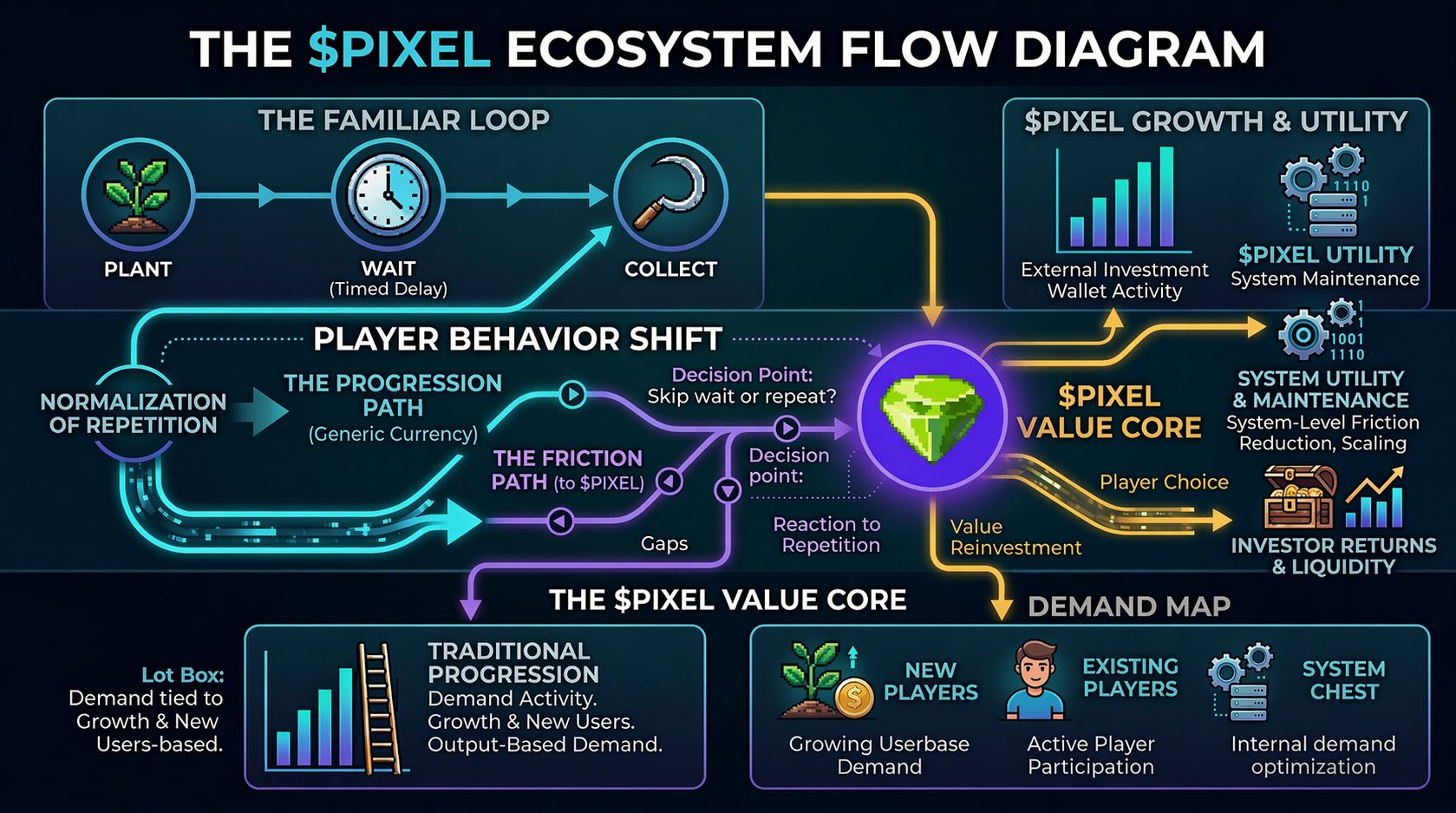

I didn’t pay much attention to Pixels ($PIXEL) when I first came across it.
It looked like another farming loop system plant, wait, collect, repeat, log off.
Nothing about it felt unusual at the beginning. I didn’t really think much of it then just another familiar loop I’d seen in different forms before, so I moved past it without questioning it.
But the longer I stayed around it, the harder it became to describe it as simply “playing a game” in the usual sense. It didn’t shift suddenly or dramatically. It was more gradual than that like the label just stopped fitting at some point, even though nothing obvious changed.
It didn’t feel like pressure or force was involved. It was quieter than that more like the system just continued at its own pace, and I slowly adjusted around it without really noticing when that shift happened.
They don’t force engagement.
They normalize repetition until it becomes the default behavior.
You don’t consciously decide to keep going.
You just return almost automatically.
And inside that repetition, something subtle begins to change. Not suddenly, and not in a way you notice immediately, but slowly enough that it only becomes visible after enough cycles.
People rarely describe it in technical terms.
They describe it in simple reactions instead:
“I’ll just skip this part.”
“This takes too long again.”
“There must be a faster way through this.”
It doesn’t feel like optimization.
It feels like tolerance gradually adjusting to repetition.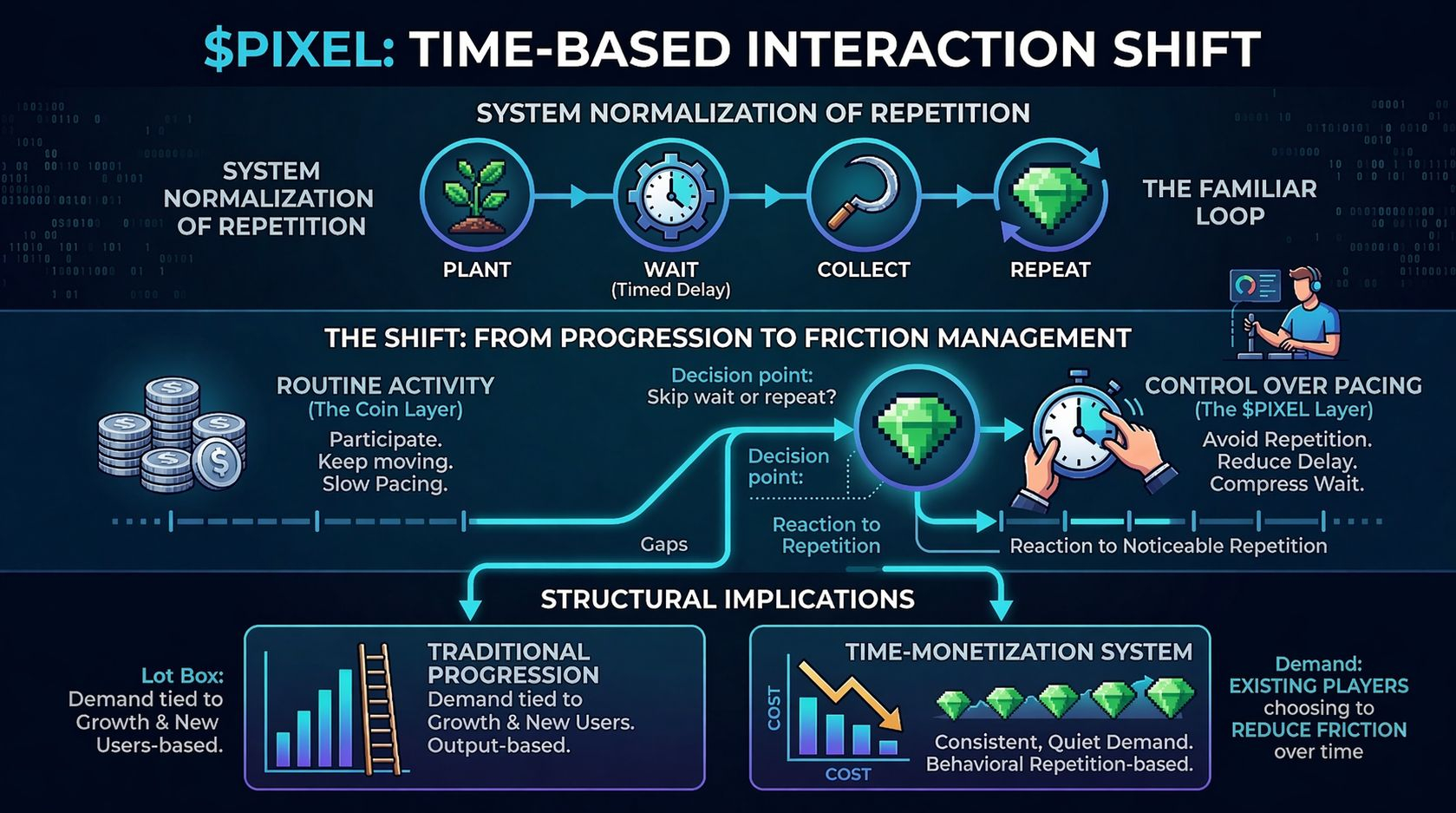
That’s the real shift.
Not in what the game is doing.
But in how long players are willing to stay inside unchanged loops.
Sessions get shorter.
Delays feel more noticeable.
And gradually, players stop just “playing” and start managing friction instead.
This is where $PIXEL starts to take on a different role.
Not as a reward system.
Not as a progression mechanic.
But as something positioned exactly at the point where a decision splits:
Do I go through the wait… or remove it?
Do I repeat the loop… or compress it?
There’s also a structural separation inside the system that’s easy to miss at first.
The coin layer handles routine activity. It keeps everything moving at a basic level, and most players can remain there without thinking deeply about structure.
But once a player starts prioritizing control over pacing rather than just participation, the interaction naturally shifts toward $PIXEL.
Not as a “better currency,” but as a different type of interaction, one tied to time rather than output.
It starts to feel less like buying items and more like removing delay.
I’ve seen myself do similar things in other systems, paying small amounts just to avoid repeating a delay I’ve already experienced many times. It’s rarely a calculated decision. It’s usually a reaction to repetition becoming more noticeable than value.
And I don’t think that pattern is unique.
Most players don’t realize when it happens.
One day it’s just farming.
Later, it becomes quiet decisions about what level of repetition is still acceptable.
That shift matters more than it looks, because it changes what actually drives usage.
In that sense, demand for $PIXEL isn’t only tied to growth or new users.
It can also come from existing players repeatedly choosing to reduce friction over time.
That creates a quieter but more consistent form of demand.
Most traditional analysis misses this because it doesn’t appear clearly in metrics.
Supply schedules, unlock timing, and wallet activity are easy to track.
Behavioral repetition is not.
But that is exactly where the real interaction sits.
What stands out is how naturally this structure has been built so far.
The pacing, timers, and spacing between actions don’t feel artificially inserted. They feel like part of the environment itself.
That matters because players usually notice when friction is designed purely to extract spending. Here, that balance still feels relatively intact, and maintaining it over time is harder than it appears.
I’m not fully convinced how this holds at scale. I’m not making predictions.
But I do think the way $PIXEL functions inside this system is still being underestimated.
It’s not just about progress systems.
It’s about how time is experienced inside repetition and where players decide that experience is worth changing.
Systems built on that idea are usually understood later than they should be.#pixel @Pixels