
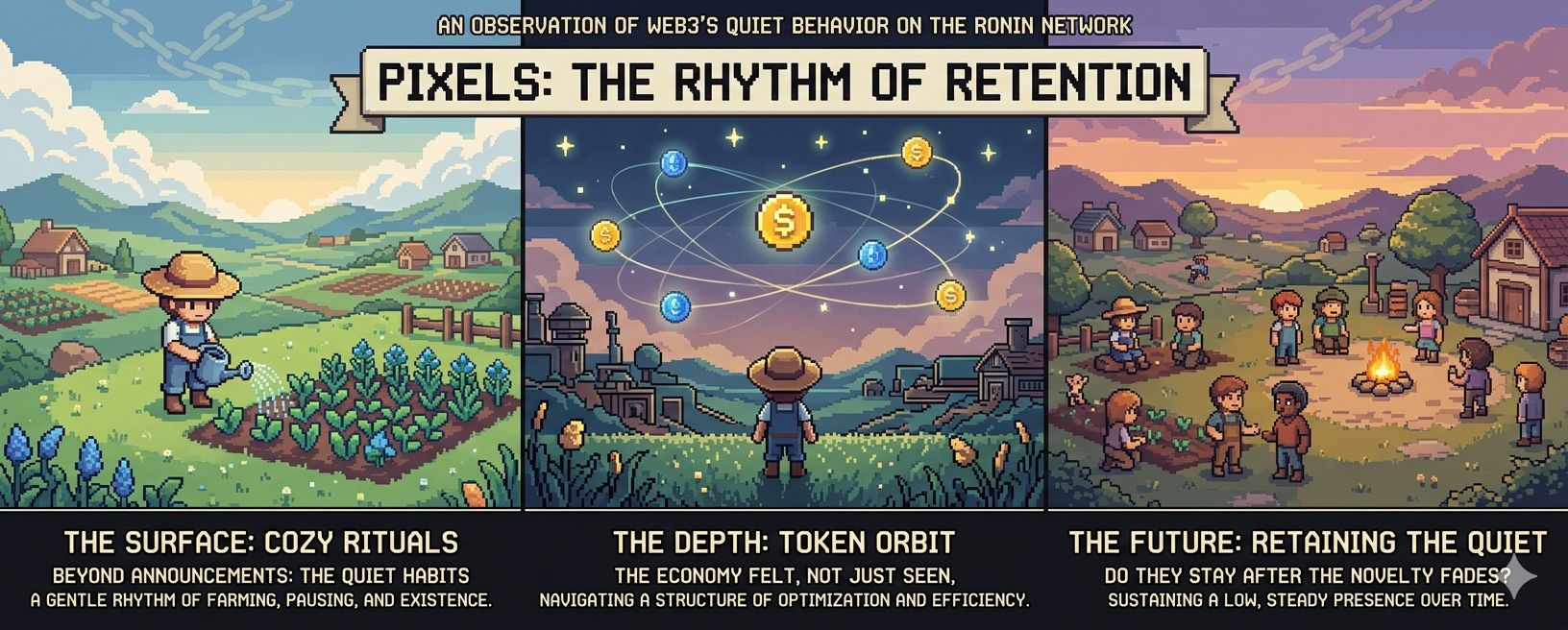
I’m watching how Pixels moves, not in big announcements but in the quieter patterns of how people return to it. I’m waiting to see if the rhythm holds. I’ve seen games like this before—simple on the surface, layered underneath—but what keeps my attention here is not what it promises, it’s how it behaves over time. I focus less on the idea of a Web3 world and more on the small habits forming inside it: the repetition of farming cycles, the pauses between actions, the way players drift rather than rush.
Built on the Ronin Network, Pixels carries the weight of expectation that comes with anything tied to tokens and ownership. But in practice, that layer often fades into the background. What’s left is something slower, almost deliberately so. You log in, you plant, you harvest, you explore, and somewhere in between, you notice whether it feels like routine or ritual. That distinction matters more than any roadmap.
The $PIXEL token exists as both a motivator and a question mark. For a trader, it’s easy to reduce it to volatility, entries, exits, and short-term narratives. But from inside the game, its presence feels more subtle, almost like a quiet pressure shaping behavior rather than dictating it. Players don’t just chase it—they orbit it. They adjust their time, their land, their choices, all in response to an economy that isn’t fully visible but is always felt.
What’s interesting is how the recent updates have shifted that feeling. There’s a noticeable move toward deeper systems—more layers in production, more decisions in how land is used, more friction in how progress is made. It doesn’t feel like expansion for the sake of growth. It feels like the game is testing its own limits, asking how much complexity it can carry before it starts to lose its softness.
And that softness is important. Pixels isn’t trying to overwhelm you. It doesn’t push you aggressively. It lets you exist inside it. But that also raises a quiet concern: can something this gentle compete for attention in a space that rewards intensity? People come in, they explore, they settle for a while—but do they stay when the novelty fades?
I’ve been looking at how players behave after the first few days. The initial curiosity is easy to understand. The art style, the simplicity, the openness—it draws people in. But what keeps them is less obvious. Some begin optimizing, turning their farms into efficient systems. Others wander, treating it almost like a social space. And then there are those who drift away, not because they dislike it, but because it never fully anchors them.
For traders watching $PIXEL, this creates an unusual dynamic. The value isn’t just tied to hype cycles or announcements. It’s tied to retention, to quiet engagement, to whether the game becomes part of someone’s routine rather than just another thing they tried. That’s harder to measure, and slower to reveal.
There’s also a subtle tension between game and mechanism. As more economic systems are introduced, the balance shifts. It starts to feel less like a world you inhabit and more like a structure you navigate. Not in a negative way, but in a noticeable one. You begin to think in terms of efficiency, of output, of optimization. And when that happens, the experience changes, even if the visuals remain the same.
Still, there’s something about Pixels that resists easy judgment. It doesn’t demand to be seen as groundbreaking. It doesn’t rush to prove itself. It just continues, quietly expanding, quietly adjusting. And maybe that’s its real test—not whether it can explode in popularity, but whether it can sustain a low, steady presence in people’s lives.
I’m still watching. Not for a breakout moment, but for consistency. Not for hype, but for signs of depth that hold over time. Because in the end, what matters isn’t how strong something looks at its peak, but how it feels when everything around it goes quiet.
