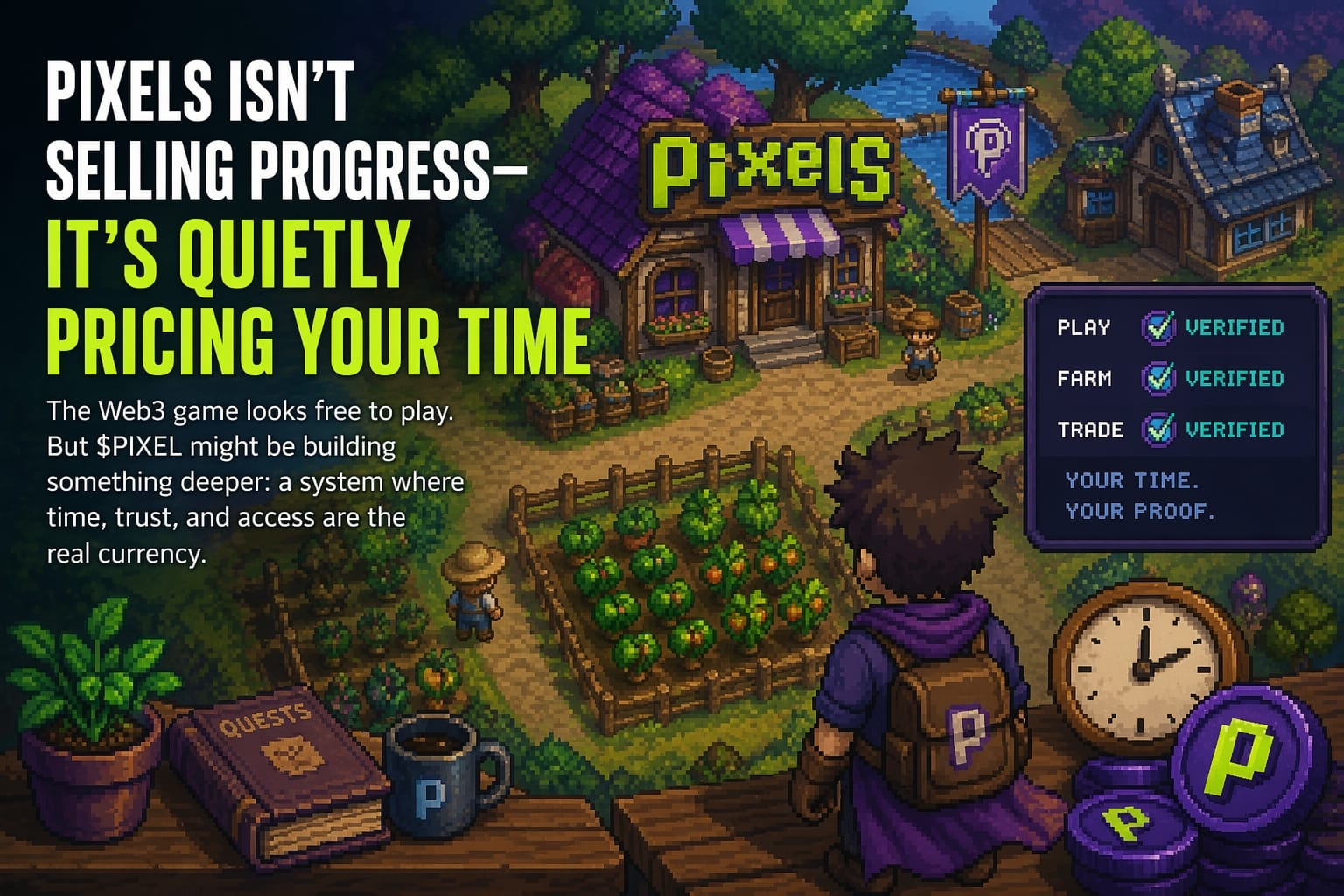
At first, Pixels doesn’t feel like a crypto game at all. It feels familiar in a comfortable way—the kind of loop you’ve seen before. You log in, tend to your farm, explore a bit, slowly build something over time. There’s no immediate pressure to think about tokens or efficiency. You just play. And honestly, that’s probably the most deliberate choice the team has made.
But if you stay a little longer, something starts to feel different. Not in a loud or obvious way—more like a quiet shift in how the game responds to you. The longer you engage, the more it feels like your time inside the game isn’t being treated equally across the board.
That’s where $PIXEL comes in, but not in the way people usually expect. It’s not just about buying items or speeding things up in a straightforward “pay-to-progress” sense. It feels more like it’s shaping how smooth—or how frustrating—your experience is. Some players seem to move through the game with fewer interruptions, less waiting, less friction. Others take the longer route, even if they’re doing similar things.
And that difference doesn’t always come down to skill.
What Pixels seems to be doing is building a kind of quiet trust layer on top of normal gameplay. It’s not asking you to create a new identity or learn some complicated system. Instead, it watches what you do. Your actions—how often you show up, what you produce, how you interact—start to matter in a deeper way. Over time, those actions feel like a form of proof. Not formal credentials, but something close. A track record the system can recognize.
$PIXEL then becomes a tool that can amplify or ease your position within that system. Not by making you “stronger” in the traditional sense, but by changing how much resistance you face. It’s a subtle shift, but an important one. The real advantage isn’t always progress—it’s how cleanly you move through the process of getting there.
There’s something smart about this approach. Instead of forcing players into a new model, Pixels builds on behavior people already understand. It lets trust emerge naturally from participation. In theory, that’s more sustainable than systems that rely purely on speculation or hype. If people enjoy the game first, they’re more likely to accept the economy that sits behind it.
But this is also where things get tricky.
People are surprisingly sensitive when it comes to time. You can sell power, you can sell cosmetics, you can even sell progress—but the moment players feel like their time is being valued differently than someone else’s, it starts to bother them. Not always immediately, but eventually. It creates a quiet awareness that the experience isn’t entirely even.
And once that awareness sets in, the mindset shifts. You stop playing as freely. You start noticing delays. You start questioning whether something is designed to slow you down. The game doesn’t change—but your relationship with it does.
There’s also a longer-term question here. If smoother, more efficient experiences are consistently tied to tokens or accumulated advantages, the player base could slowly split. Not into winners and losers, but into different versions of the same game. One group deals with friction. Another barely feels it. That gap is subtle, but it can grow over time.
Still, it’s hard to dismiss what Pixels is trying to do. The idea of building systems around real participation—where actions become proof, and identity doesn’t need to be fully exposed to be trusted—is genuinely interesting. It’s a more grounded way of thinking about Web3, even if it’s being tested in a messy, real-world environment.
What makes Pixels stand out is that it doesn’t try to announce all of this. It just lets you experience it. On the surface, it’s a simple game. Underneath, it’s experimenting with how time, trust, and value interact.
Whether that balance holds is the real question.
Because if players continue to feel like they’re just playing a game, then Pixels is doing something right. But if they start to feel like every minute has a price attached to it, the illusion breaks—and once that happens, it’s very hard to make it feel like a game again.