
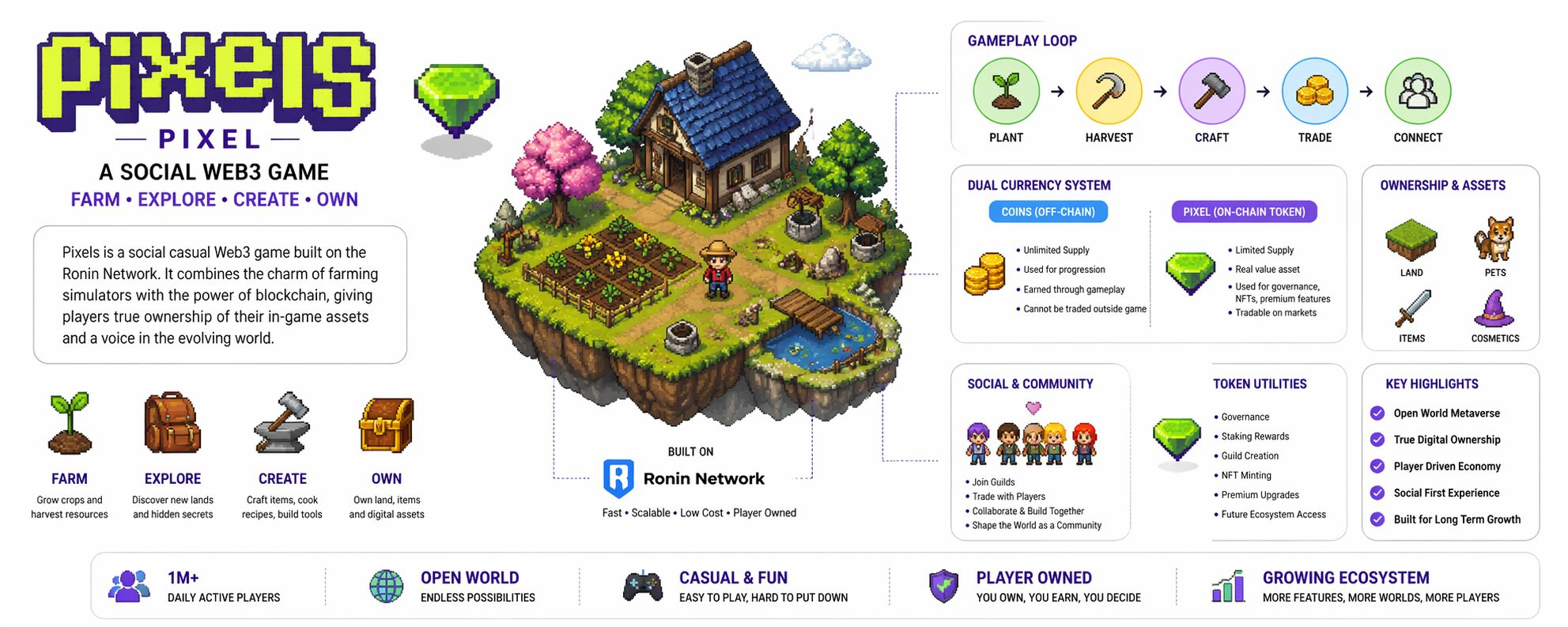
To really get a grip on Pixels PIXEL, just calling it a game isn't enough. When a player enters this world, everything seems straightforward at first glance. There's land, crops, and a basic farming life on display. But after a while, it hits you that this isn't just a farming system; it's a thriving digital universe where every little action has its own impact.
In the beginning, Pixels was one of those projects that popped up around 2021 when blockchain gaming was starting to carve out its niche. Back then, most projects were all about the earnings, where people jumped in to make money rather than enjoy the game itself. That model didn't hold up for long. Slowly, Pixels shifted its focus away from just earning and started emphasizing user experience, routine, and community.
When Jab Pixels upgraded its system, a new growth phase kicked off. This move wasn't just a technical improvement, but a smart decision where players already understood the concept of digital ownership. Because of this, Pixels didn't have to put in much effort to convey its value, and people got straight into the experience.
Gameplay seems straightforward, but there's depth hidden within that simplicity. Players grow crops, collect resources, craft items, and trade with others. It all feels like a normal farming game, but in reality, everything operates within a balance. The energy system is a clear example. Each task has its limit, which means no player can produce endlessly. This restriction controls the economy and keeps the system stable.
The currency system is also quite intriguing. On one side, there are coins that are used only within the game, and on the other side, there's the PIXEL token, which holds real value. Keeping both systems separate is a smart approach. Casual players can enjoy the game without any risk while serious players can dive deeper.
The concept of ownership becomes crucial here. If a player owns land, it’s not just decoration; it becomes a productive asset. Land generates production, earns income, and sometimes other players benefit from it indirectly. This is where the game starts feeling like the real world. Some players end up in strong positions while others stay at a basic level. This difference develops naturally.
The strength of Pixels lies in its social system. This game doesn't let players feel alone. People join guilds, trade, and interact. Gradually, the game becomes a community where folks don't just grind but also build relationships. This aspect sets it apart from other projects.
The role of the PIXEL token is also significant. It's not just a currency; it's a means of access where players unlock premium features and special options. When the token was introduced, it gained a lot of attention, but there’s a challenge too. When money becomes part of the game, people sometimes focus more on profit than on gameplay. Maintaining this balance is crucial for the system.
If you think about it deeply, Pixels feels like an experiment. It's testing how people behave when their time and effort can convert into real value. Here, players collect resources, optimize systems, and sometimes competition develops. All this together gives a sense of a small digital society.
Challenges are also present. The biggest question is about sustainability. If new players decrease or interest wanes, the system can slow down. Pixels has to manage this risk to maintain long-term balance.
Another issue is inequality. Players with more assets naturally earn more. This creates a scenario similar to the real world, where some people get ahead while others lag behind.
Looking into the future, Pixels doesn't seem to be limited to just farming games. There’s potential for expansion where new systems and features can be added. It could become a platform where players not only play but also create.
The last thing to note is that Pixels provides a fresh perspective. It shows that games are not just for passing time but are becoming social and economic systems. The line between play and work is gradually blurring.
And perhaps the most interesting thing is that when people gain ownership in a digital world, they don't just play it; they start living it.