
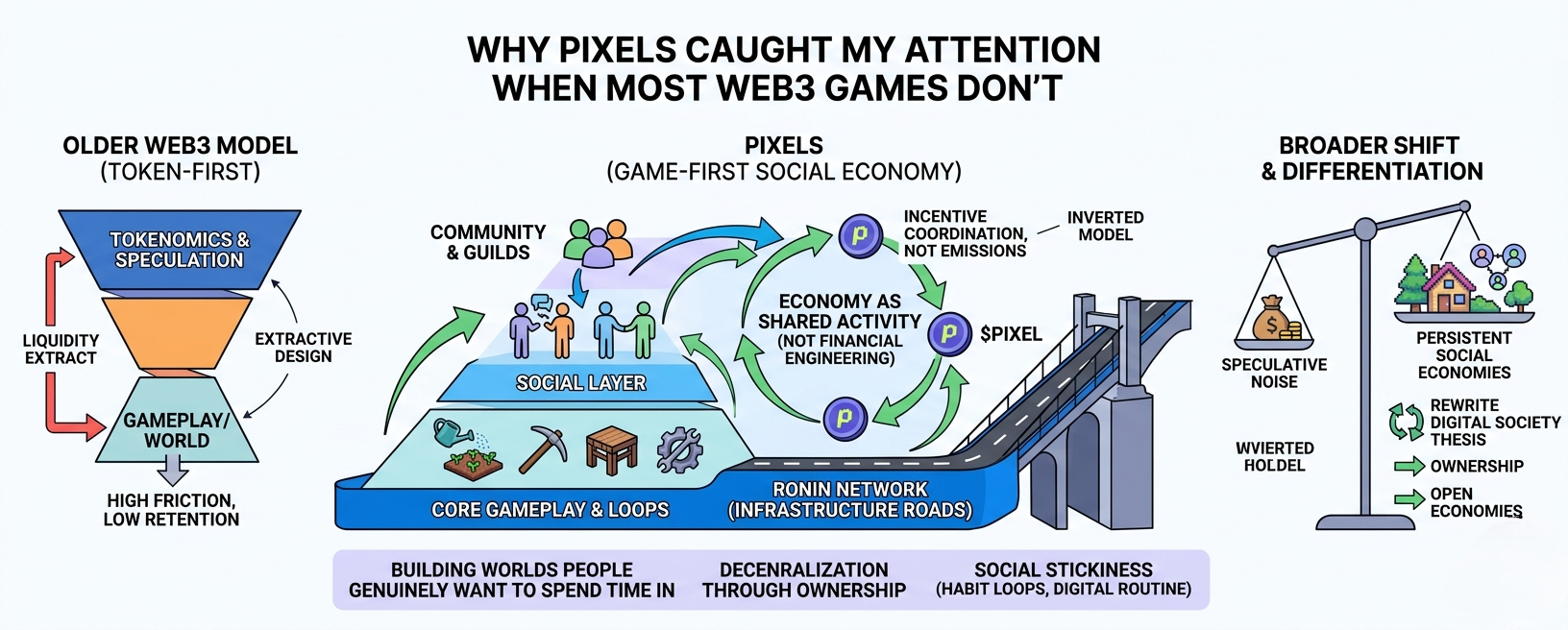
Lately I’ve noticed something interesting in crypto — when liquidity gets selective and narratives rotate faster than people can keep up, attention starts flowing toward projects that actually keep users around, not just tokens people trade for a week. That shift made me start looking closer at gaming again, even though I’ve been skeptical of most Web3 games for years. And honestly, Pixels caught me off guard.
At first I didn’t fully get it.
I saw people talking about farming, pixel art, land, resource loops, and social gameplay on Ronin Network, and my first reaction was: why is a simple-looking farming game getting this much attention in a market obsessed with AI, modular infrastructure, and high-beta speculation?
It felt too casual to matter.
But that confusion is exactly what made me dig deeper.
What caught my attention wasn’t the farming mechanics themselves. It was realizing Pixels isn’t really trying to be a flashy “play-to-earn” revival. I think it’s quietly testing something much more important — whether Web3 games can feel like actual games first, and economies second.
That sounds obvious, but in crypto it hasn’t been.
I’ve watched so many GameFi projects build token systems before building worlds people genuinely want to spend time in. Pixels seems to invert that. The world, the social layer, the loops of gathering, crafting, and exploration come first. The token and ownership mechanics sit underneath instead of screaming for attention.
That subtle difference matters.
Once I understood that, the whole design made more sense. The economy feels less like financial engineering and more like a town running on shared activity. Players farm resources, trade, craft, contribute to guild structures, interact with land systems, and those actions feed incentives rather than existing just to farm emissions. In simple terms, it feels more like participating in a living village than clicking through a DeFi wrapper disguised as a game.
And I think that ties into a broader shift happening in Web3 right now.
People seem tired of extractive token models. I’m seeing more interest in systems where incentives coordinate behavior instead of distort it. Pixels sits in that conversation. Decentralization here isn’t some abstract governance pitch — it shows up through ownership, open economies, community participation, and a world that players help shape instead of merely consume.
The token, PIXEL, only became interesting to me once I stopped viewing it as “the thing to speculate on” and started seeing it as a coordination layer. That’s a very different lens. It ties progression, staking dynamics, governance participation, and ecosystem sustainability into something closer to network design.
And running on Ronin Network matters more than I first appreciated. I’ve always thought infrastructure in crypto is like roads in a city — nobody talks about them until they’re broken. Ronin already proved it can support large gaming communities. For Pixels, that lowers friction in a way many chain-first games struggle with.
One underrated thing I keep coming back to is social stickiness.
People often analyze Web3 games through token sinks and emissions, but I think retention often comes from softer things — habit loops, friendships, identity, digital routine. Pixels seems unusually aware of that. And that may be harder to replicate than people think.
Competition is real, though. There are other blockchain games chasing sustainable economies, and traditional games entering Web3 experiments can pressure everyone. Execution risk is huge. If content cadence slows, if token unlocks create sell pressure, if player incentives drift too financial again, cracks show quickly. Regulation around gaming tokens is still a wild card too.
I’m not ignoring those risks.
But from what I’m seeing, the traction around Pixels feels less like speculative noise and more like something testing whether crypto-native worlds can become persistent social economies.
That’s different.
And compared with earlier GameFi cycles, that may be the biggest evolution. Not better rewards. Better design.
I didn’t expect this, but one of my personal takeaways is that Pixels may be less a gaming bet and more a quiet thesis on digital societies. That sounds bigger than a farming game should justify, but the more I sit with it, the more I think there’s something there.
Because if Web3 is supposed to be about ownership, coordination, and user-shaped systems, maybe those ideas become real not through giant infrastructure narratives… but through people planting crops together in a pixelated world.
That thought keeps staying with me.
Are projects like Pixels showing what the next consumer layer of crypto actually looks like, or are we just watching another fascinating experiment trying to survive the gravity of token economics in real time? I’m honestly still thinking about that.
