
I used to think joining a guild in Pixels was mostly a social decision.
You find a group, share a few tips, maybe borrow land, coordinate occasionally, and that’s the end of it. The core game still feels individual. Energy management, taskboard optimization, crop cycles. The usual loop of personal efficiency.
That assumption holds for a while. Especially early on, when progression is still fragmented and everyone is experimenting.
But Bountyfall changes the texture of that experience in a subtle way. Not immediately. Not through any obvious mechanic. More like a slow inconsistency that builds up over time.
Two players with similar time investment, similar assets, even similar understanding of mechanics… start to diverge. Not slightly, but structurally. One stabilizes income, the other fluctuates. One accelerates progression, the other plateaus.
At first, it’s tempting to explain this through skill differences.
Maybe one player is more optimized. Maybe one is more active during peak windows. Maybe one simply understands the system better.
But the longer you observe, the less satisfying that explanation becomes.
Because the gap doesn’t behave like skill. It behaves like coordination.
And coordination is not something you can see directly in isolated gameplay.
It only becomes visible when you look at patterns across multiple players interacting together.
Inside active guilds, something changes in how play itself is structured. Land stops being just an asset and becomes a shared allocation system. Tasks are no longer independent decisions but distributed responsibilities. Even simple farming loops start to feel pre-arranged, as if the “best path” has already been collectively discovered and assigned.
This is where the idea of guilds as “social infrastructure” starts to feel more accurate than “community.”
But even that framing still feels incomplete.
Because infrastructure suggests stability. And what you actually observe is closer to adaptive flow.
Guilds are not just static coordination layers. They actively respond to volatility inside the economy.
When reward systems shift, guild behavior shifts faster than individuals can react alone. When Union mechanics in Bountyfall require synchronized effort, guilds compress reaction time by pre-aligning members into roles before the system demands it.
That creates a second-order effect.
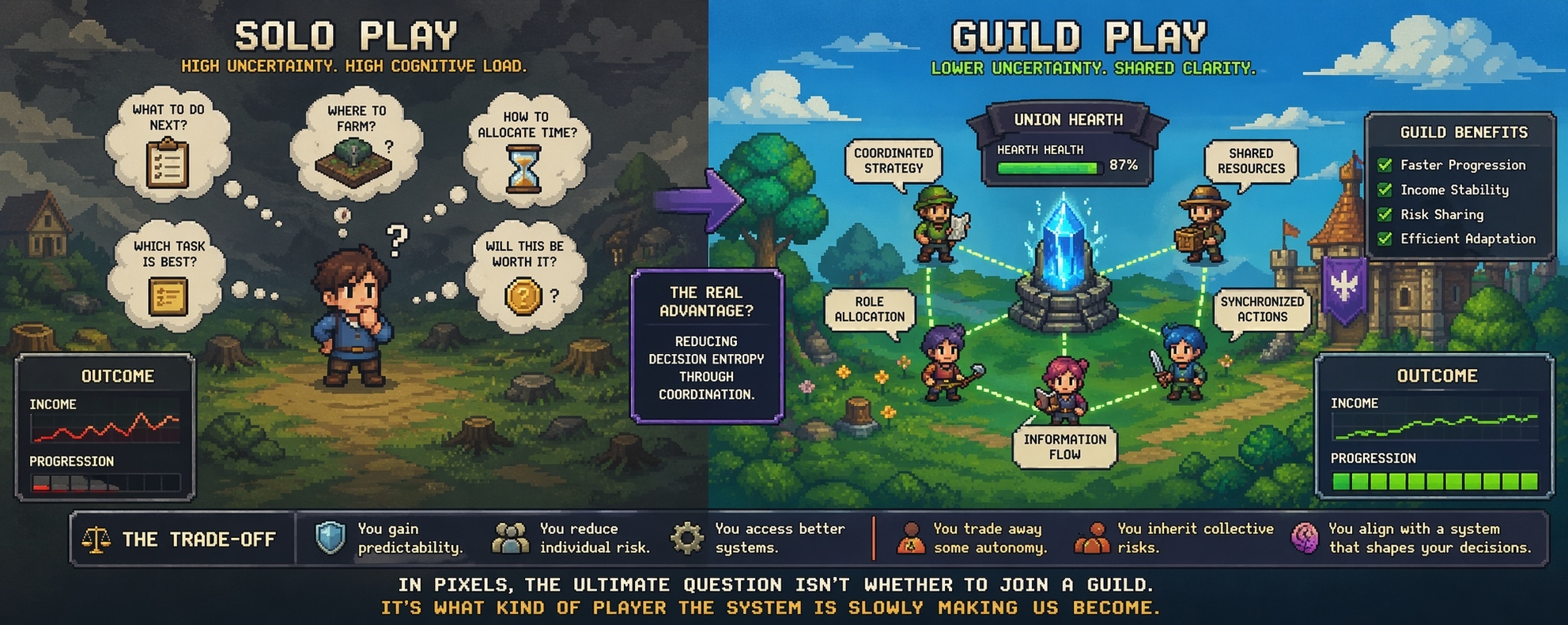
Players inside guilds are not only optimizing gameplay. They are reducing uncertainty about what to do next.
And that reduction of uncertainty might be the real product being exchanged.
Not rewards. Not land access. Not even efficiency.
But predictability.
This introduces a deeper layer that is easy to overlook:
Pixels is not just rewarding activity. It is rewarding coordination that reduces decision entropy.
In solo play, every decision carries full cognitive load. What to do next, where to farm, how to allocate time. In guild play, a portion of that decision-making is externalized. You don’t fully choose; you execute within a pre-shaped structure.
That shift sounds subtle, but it changes behavior in a measurable way.
Players inside strong guilds tend to move faster, but think less about alternatives. They converge on shared strategies not because they are objectively superior, but because divergence becomes costly.
At this point, a tension appears.
If coordination is the real advantage, then guild strength is not just about size or resources. It becomes about how tightly behavior is aligned across members without breaking adaptability.
Too loose, and the guild becomes inefficient. Too tight, and it becomes rigid.
And it is not obvious where most guilds fall on that spectrum.
Some guilds in Bountyfall seem to function like fluid networks. They redistribute tasks dynamically, adjust roles frequently, and rely on constant communication. Others behave more like structured hierarchies with stable roles and predictable outputs.
Both can be effective. Both can fail. But in different ways.
The uncertainty lies in what actually determines long-term dominance.
Is it coordination speed? Resource density? Leadership quality? Or something more intangible, like how quickly a guild can reconfigure itself when the game changes?
Because the game will change. It always does.
And when it does, the advantage may temporarily shift away from efficiency toward adaptability.
There is also a quieter risk that emerges here, one that is harder to quantify.
As guilds become more efficient at smoothing individual variance, they also become more influential over player behavior itself. Over time, your decisions are less about personal experimentation and more about fitting into an existing system.
That raises an uncomfortable question:
If most optimal play happens inside coordinated groups, what happens to discovery outside of them?
Solo play begins to look less like a parallel path and more like a training phase. Something temporary before integration. And once integrated, your experience is shaped not just by the game, but by the guild’s interpretation of the game.
This is where the “social investment” framing becomes more precise, but also more uneasy.
Because what you are investing is not just time or assets.
You are investing alignment.
And alignment has its own cost structure.
Contribution requirements, participation expectations, internal rules, even implicit social pressure. None of these are necessarily harmful on their own. But together, they gradually redefine what “freedom” means inside the game.
It is not removed. It is reallocated.
Which leads to another unresolved tension.
If guilds are the most efficient way to extract value from Pixels’ systems, then participation becomes almost rational by default. But if participation also reduces optionality, then rationality and autonomy begin to drift apart.
And that drift is not immediately visible in outcomes.
It appears slowly, in how players talk, how they decide, how they stop questioning certain paths because the system already provides them.
So the deeper mechanism might not be guilds themselves.
It might be the transformation of decision-making from individual exploration into distributed execution.
At that point, the question is no longer whether guilds are beneficial.
It becomes something harder to answer:
When a system rewards coordination more than independence, what kind of players does it gradually produce?
And perhaps more importantly:
At what point does optimization stop being a choice, and start becoming the only viable way to continue playing at all?