
I was tracking my own grind one night just simple loops, nothing special. Farming, completing tasks, watching my balance move. It felt like I was earning. But then I paused and asked myself something uncomfortable… if this is a reward system, why does it feel like the system is learning from me more than I’m earning from it?
I didn’t notice it at first. It felt like any other grind loop. Plant, harvest, task board, repeat. Numbers moving. Small wins stacking. It felt productive. Familiar. Even satisfying. But after a few weeks of tracking my own sessions inside , something started to feel… slightly off.
Not wrong. Just… incomplete.
I started asking a simple question. If I’m earning, where exactly is that value coming from?
Pixels runs on the , and by now it’s not a small experiment. The project has reported over 10 million players and previously crossed the 1 million daily active users mark back in 2024. In the same year, the team confirmed roughly $20 million in revenue. That matters. This is not theory. This is a working economy.
And yet, the more I explored the system, the more I realized… this isn’t just a game loop. It’s a feedback loop.
Let me explain it the way I understood it.
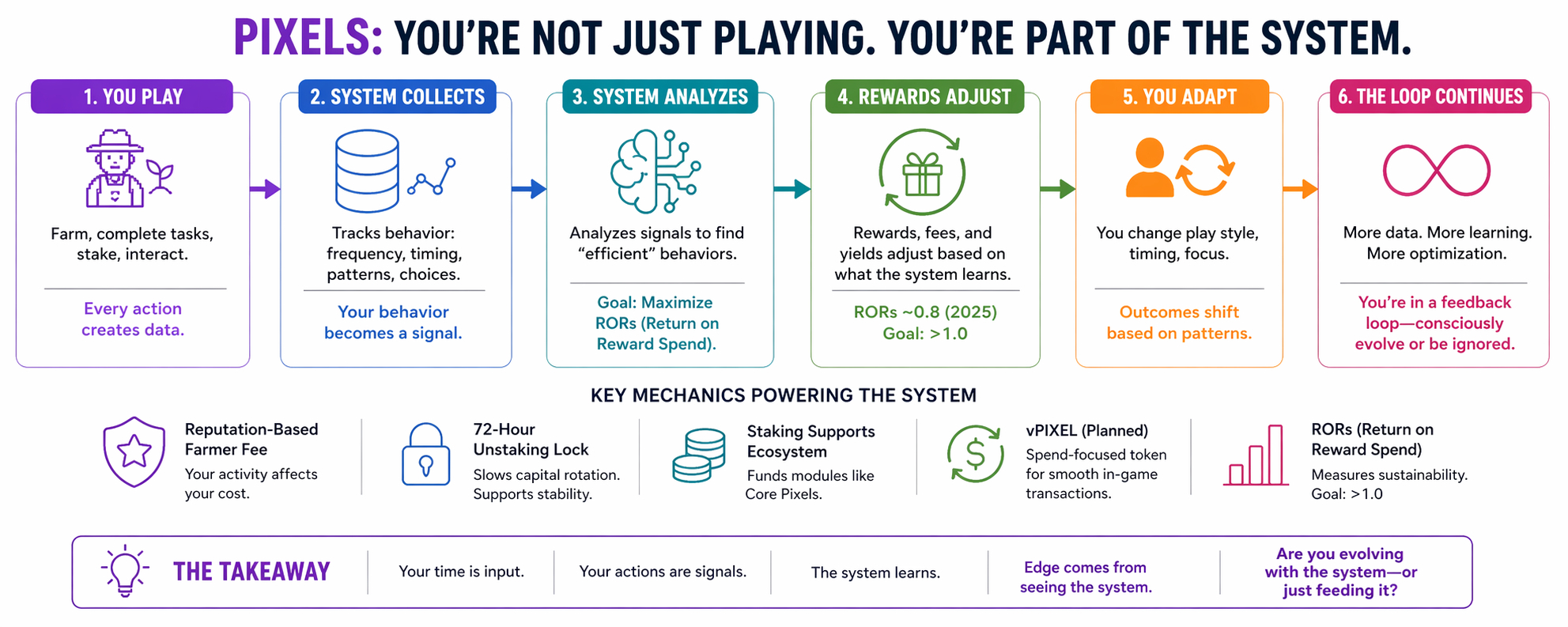
In 2025, Pixels expanded its staking system around . Staking wasn’t just about passive rewards. It connected directly to how the ecosystem grows. When players stake, they’re effectively supporting game modules like Core Pixels or other experiences inside the ecosystem. At the same time, the system tracks behavior what players do, how often they return, what actions they repeat.
Now, here’s where it gets interesting.
The whitepaper introduces a concept called RORS Return on Reward Spend. Simple idea, actually. For every unit of reward distributed, how much value does the system get back? If RORS is below 1.0, the system is spending more than it earns. If it’s above 1.0, it’s sustainable.
As of recent documentation, RORS is around 0.8. The stated goal is to push it above 1.0 over time.
So what does that mean for someone like me… just playing?
It means every action I take every farming loop, every task completed is part of a larger dataset. That data helps the system understand what kind of behavior is “efficient” to reward. Not emotionally rewarding. Not fun. Efficient.
At first, I resisted that idea. It sounded too mechanical. Too cold.
But then I looked at the structure again.
There’s a reputation-based Farmer Fee. If you interact more with the system, your fee changes. There’s a 72-hour unstaking lock, which naturally slows capital rotation. There are plans for vPIXEL, a spend-focused token designed to keep in-game transactions smooth without constant token sell pressure.
Step by step… you start seeing it.
This is not random design. This is controlled economic engineering.
Now, to be fair this is not a criticism. In fact, it’s probably one of the more honest attempts at sustainability in Web3 gaming. Most projects failed because they ignored this exact problem. They printed rewards without feedback loops. Pixels is trying to solve that.
But solving it changes the role of the player.
That’s the part many people miss.
When a system uses behavioral data to optimize reward distribution, your individual effort becomes less important than your pattern. Are you predictable? Are you consistent? Do you fit the model the system wants to scale this week?
I tested this myself. Changed play styles. Shifted timing. Focused on different loops.
And yes… outcomes shifted too.
Not drastically. But enough to notice.
So then the question becomes… am I playing the game, or am I adapting to it?
Maybe both.
That’s where the real insight sits.
This is why Pixels is trending again in 2026. Not just because of token mechanics or staking yields, but because it represents a shift. Web3 games are no longer just about ownership or earning. They are becoming adaptive systems. Systems that learn. Systems that adjust reward flows in real time based on collective behavior.
And that’s powerful.
But it’s also something you need to understand clearly as a trader or investor.
Because your time inside the game is not just time. It’s input.
Your actions are not just gameplay. They’re signals.
And those signals shape the economy you’re trying to extract value from.
So no, I don’t think this is a trap. And no, I’m not saying stop playing.
What I am saying is… don’t stay unconscious inside the loop.
Watch how rewards shift. Watch how systems respond. Track your own behavior like you would track a trade.
Because in systems like this, edge doesn’t come from grinding harder.
It comes from seeing the system clearly.
And once you see it… you can’t unsee it.
The game is evolving. Quietly. Intelligently.
The only real question is-
Are you evolving with it, or just feeding it without realizing?
