
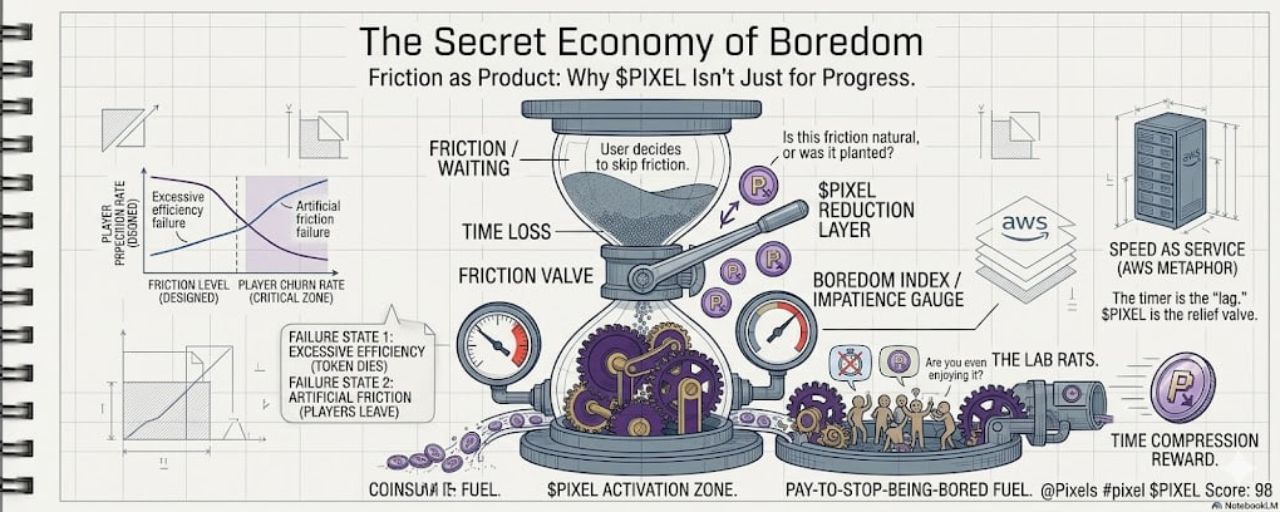
I've watched enough farming sims to know the rhythm. Plant. Wait. Harvest. Repeat.
Same loop. Same illusion of progress.
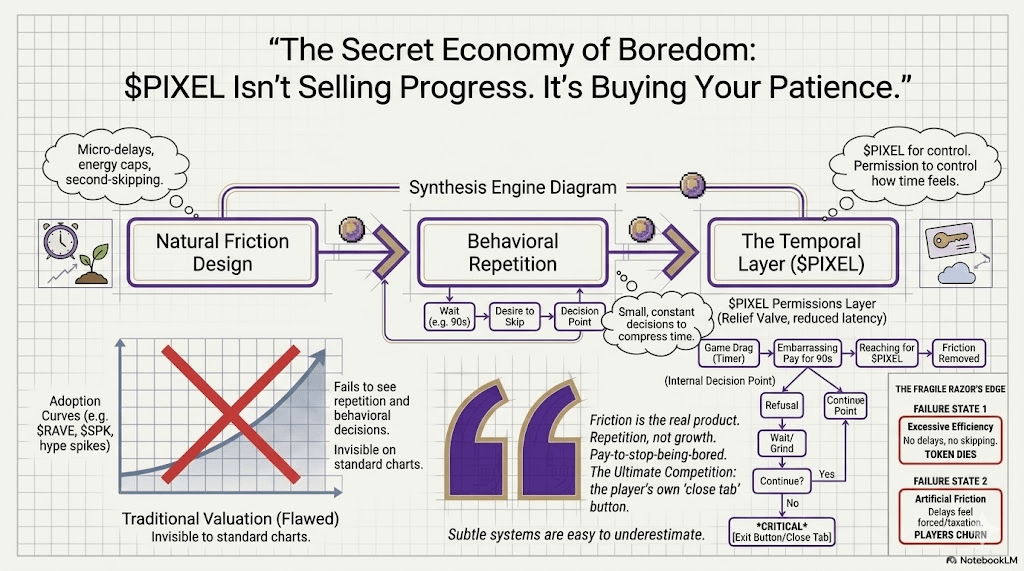
But Pixels felt different after a few weeks. Not because I was earning more. Because I kept reaching for $PIXEL to skip things. Not big things. Tiny waits. A growth timer. An energy refill. Seconds, not hours.
That's when it hit me.
The game isn't selling progress. It's selling the removal of friction. And friction is the real product.
Here's what most analysts miss.
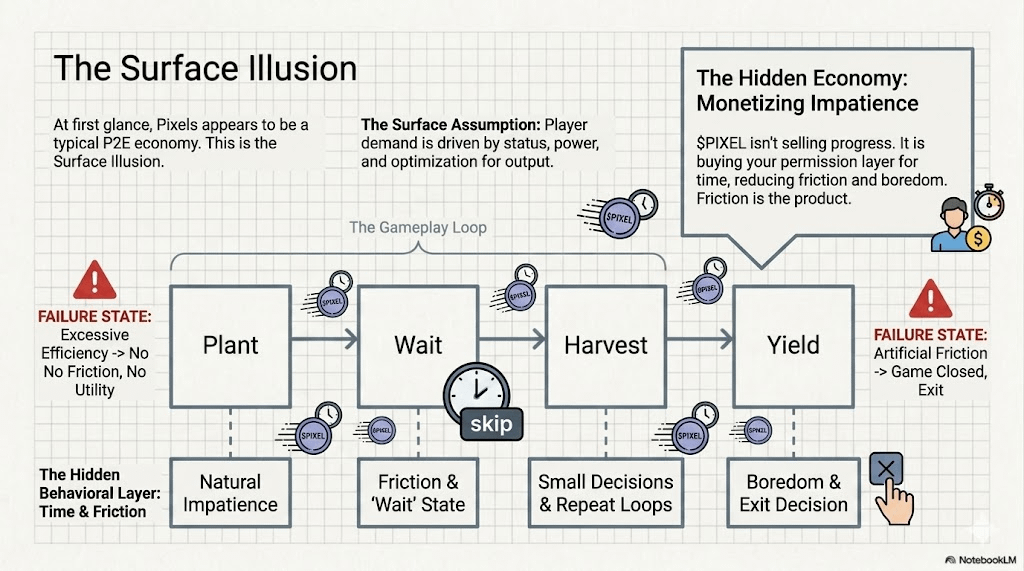
They look for adoption curves. User growth. The loud metrics. $APE had that. Hype spikes, then quiet. $KAT too. Ambitious, then forgettable.
But Pixels runs on something else. Repetition, not growth. An existing player base making small, constant decisions to compress time. That demand stays steady regardless of new users. It's invisible on a standard financial chart that only tracks supply and unlock schedules.
I started tracking my own behavior.
Every session, I'd hit maybe 3-4 moments where I thought, "I don't want to wait 90 seconds for this." Small friction. Almost embarrassing to pay for. But I paid anyway. Not for the reward. For the feeling of the game not dragging.
That's not pay-to-win. That's pay-to-stop-being-bored.
And I'm not alone. I watched guildmates do the same. Players who don't care about optimizing or "winning" still reach for PIXEL. They aren't buying power. They're deciding that waiting is no longer worth the cost.
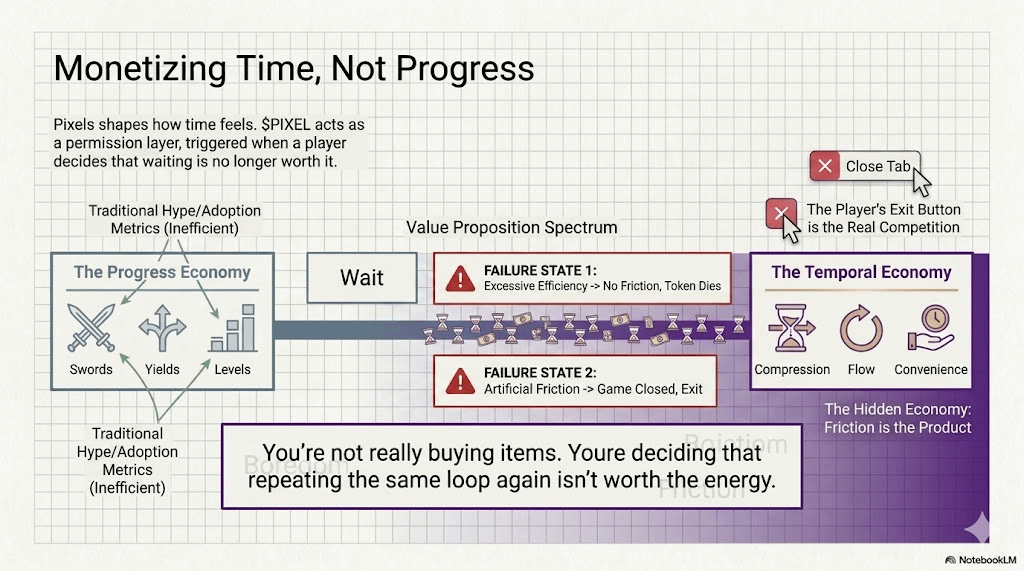
PIXEL isn't a reward token. It's a permission layer for time.
Think about the architecture. You have two layers.
Coins for basic participation. Keeping the world moving. Existing in the loop indefinitely. That's free, or close to it.
PIXEL for control. The moment you want to dictate the pace of your own experience, you cross into the PIXEL layer.
Free to exist. Not free to control how time feels.
I've seen this model before. Not in games. In cloud computing. You pay to reduce latency. AWS doesn't sell servers. It sells speed. Pixels does the same thing to human behavior. The timer is the "lag." PIXEL is the relief valve.
But here's the fragile part.
Friction has to feel natural. If the game becomes too streamlined—no waits, no delays—no one feels the need to skip. The token's utility evaporates. Nothing left to compress.
If delays feel forced, engineered purely to extract value, the illusion breaks. Players don't grind. They close the app.
The competition for PIXEL isn't other games. It's the player's own exit button.
I've seen this movie before. Usually ends badly.
Most Web3 games overdose on extraction. They turn every action into a cash grab. Pixels is walking a razor's edge. Too much friction, churn. Too little, irrelevance.
But the behavioral layer is real. Dozens of quiet, split-second decisions to skip a loop or speed up a timer. That's the engine. Not supply schedules. Not unlock charts.
The question isn't what PIXEL buys.
It's why players are so desperate to skip the very game they're playing.
That's the uncomfortable mirror. Because if you're paying to avoid gameplay… are you even enjoying it? Or are you trapped in a system that manufactured impatience and then sold you the cure?
I catch myself now. Every time I hover over the "speed up" button. I ask: is this friction natural, or was it planted?
Most of the time, I can't tell. Which means the design is working. Or I'm already inside the trap.
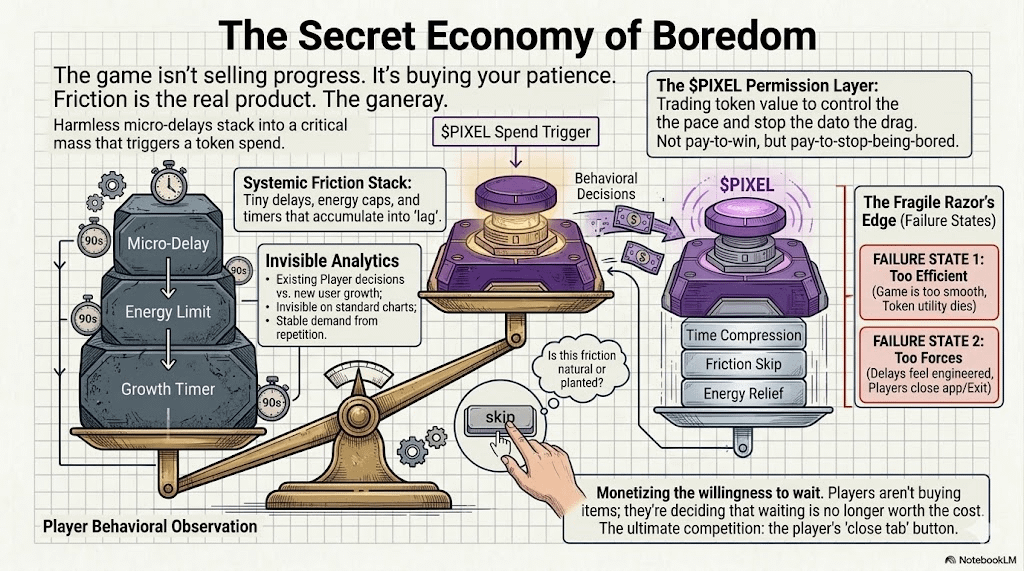
Two failure states.
First: excessive efficiency. If the game gets too smooth, no one waits. The token dies.
Second: artificial friction. If delays feel forced, players leave. Not slowly. All at once.
The devs are playing a dangerous game. Monetizing patience is brilliant until patience runs out.
What I'm actually watching for.
Not token price. Not user counts. I'm watching whether the friction stays subtle enough to feel like "nature" rather than "taxation."
If they get it right, Pixels unlocks a new way to monetize the one thing more valuable than digital assets: the player's willingness to wait.
If they get it wrong?
That exit button is right there. No loyalty. No brand love. Just a "close tab" and thirty seconds before you forget the game existed.
I'm not here to cheerlead. I'm here to observe.
And what I'm observing is an economy built on the quiet, repeated decision to trade currency for time. Not for victory. Not for status. Just to make the seconds pass faster.
That's not a game economy. That's a behavioral lab.
And the lab rats are us.
The question isn't whether PIXEL has utility. It does. The question is whether the utility survives the player waking up and realizing they're paying to skip the experience.
Once that realization hits…
Some people quit.
Some people laugh and keep clicking.
I'm still watching to see which one I am.