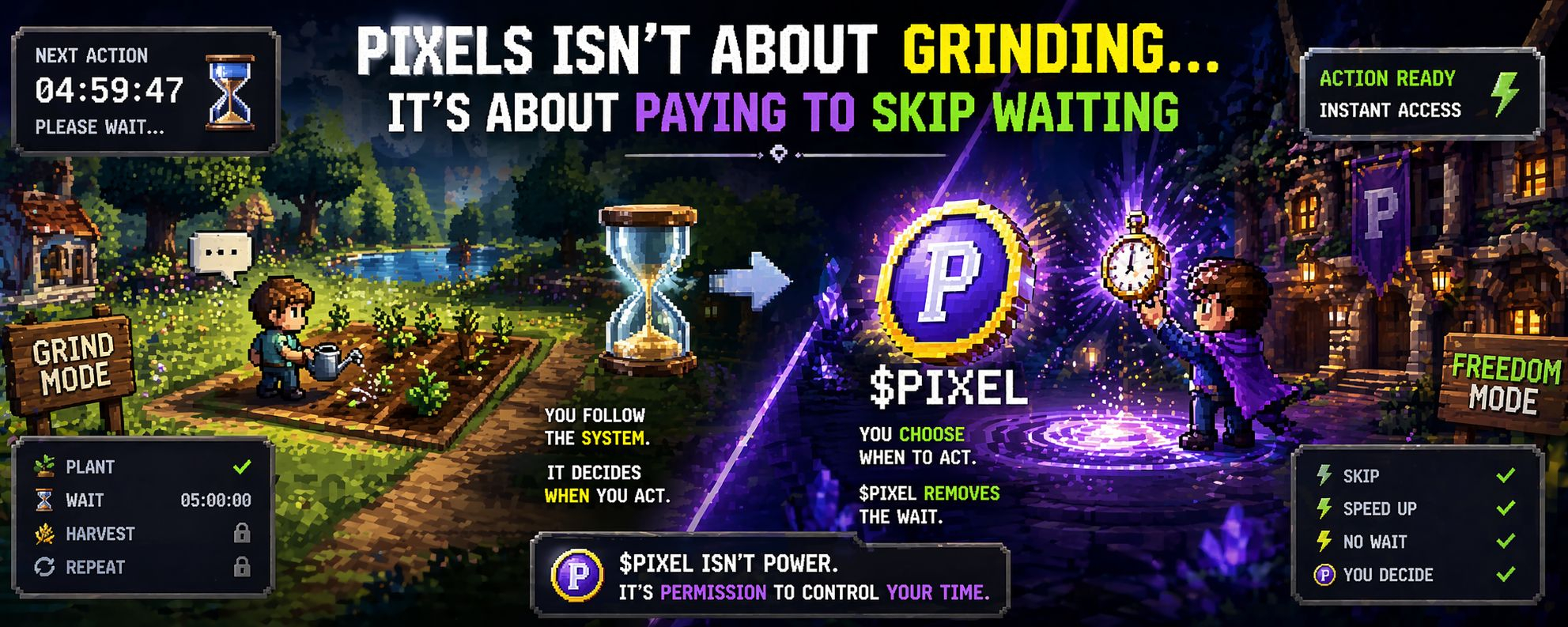
I used to think Pixels was just another free-to-play farming loop… but I didn’t realize I was actually watching how a system prices attention, not progress.
At first, everything feels normal. You log in, you play, you move forward. Plant, wait, harvest. Repeat. Nothing feels unusual.
But that’s exactly the design.
Pixels doesn’t block progress. It stretches the space between actions just enough for you to notice time itself.
A cooldown here. A delay there. A small pause before control returns. Individually, it means nothing. Together, it changes how the system feels.
Not faster. Not slower. Just less fully in your control.
And that’s where the shift begins.
Because at some point, you stop measuring rewards. You start noticing waiting.
And waiting is where Pixel quietly enters.
Not as a reward token. Not as a boost.
But as a way to remove hesitation.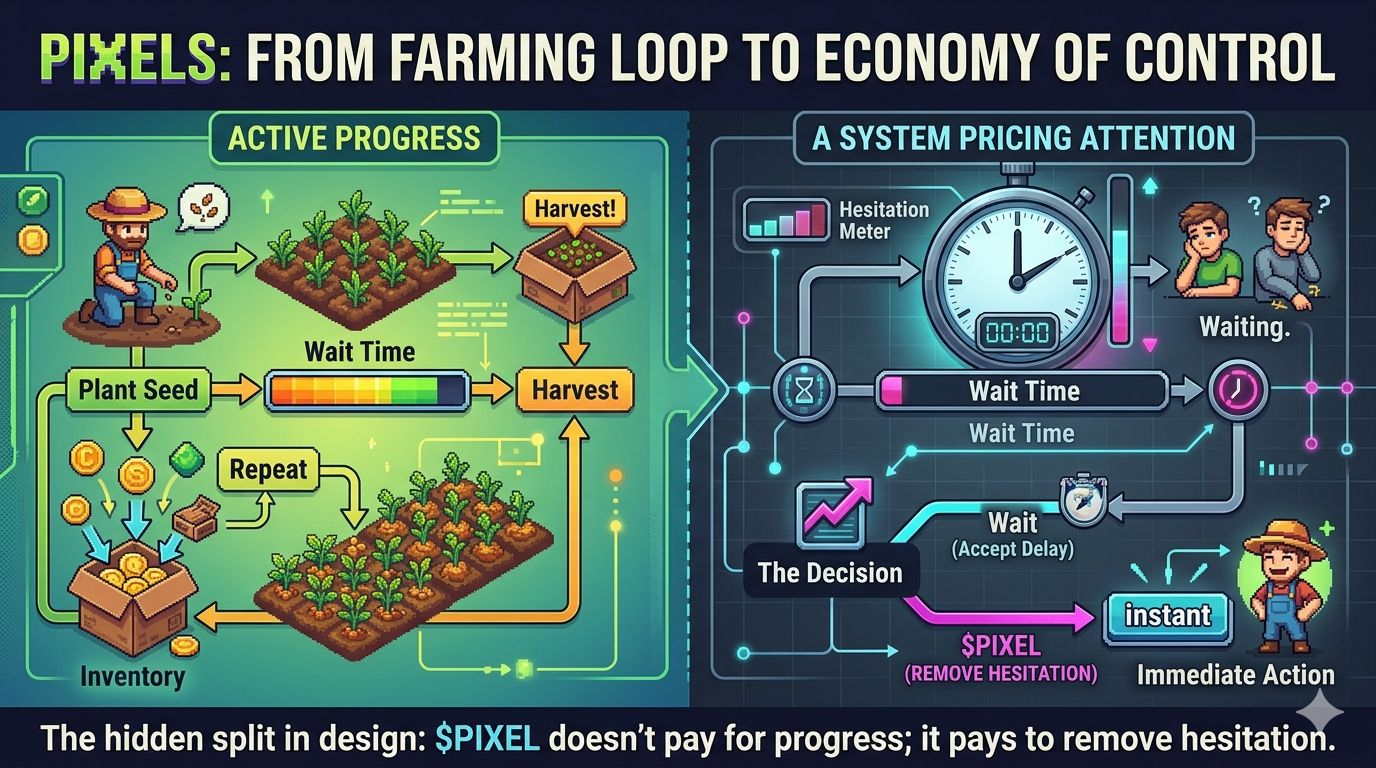
You don’t use it because you are stuck. You use it because you don’t want the system deciding when you can act.
That’s the part most people miss.
It’s not about progress speed. It’s about ownership of timing.
I’ve seen players who don’t care about optimization at all. No strategy, no efficiency.
But the moment the system creates a pause that feels unnecessary… they don’t adjust. They override it with $PIXEL.
Not to win more. Not to grow faster. Just to stop waiting.
And that behavior doesn’t look powerful at first. It doesn’t spike metrics. It doesn’t scream demand.
But it repeats.
And repetition is where systems become economies.
There is a hidden split inside the design.
One layer keeps everything running — coins, actions, routine gameplay. Stable and predictable.
But control doesn’t live there.
Control starts where timing becomes flexible.
That’s where Pixel sits.
Not as a shortcut, but as a permission override inside the loop.
And once you see that, the system changes meaning.
The question is no longer what you earn.
It becomes who controls when you act.
Most analysis misses this. They track users, supply, unlocks.
But not the smallest unit of value:
A player deciding they will not wait.
Skip this. Speed that up. Don’t repeat this loop again.
Individually, nothing.
Together, they form real demand.
But the system only works if this stays subtle.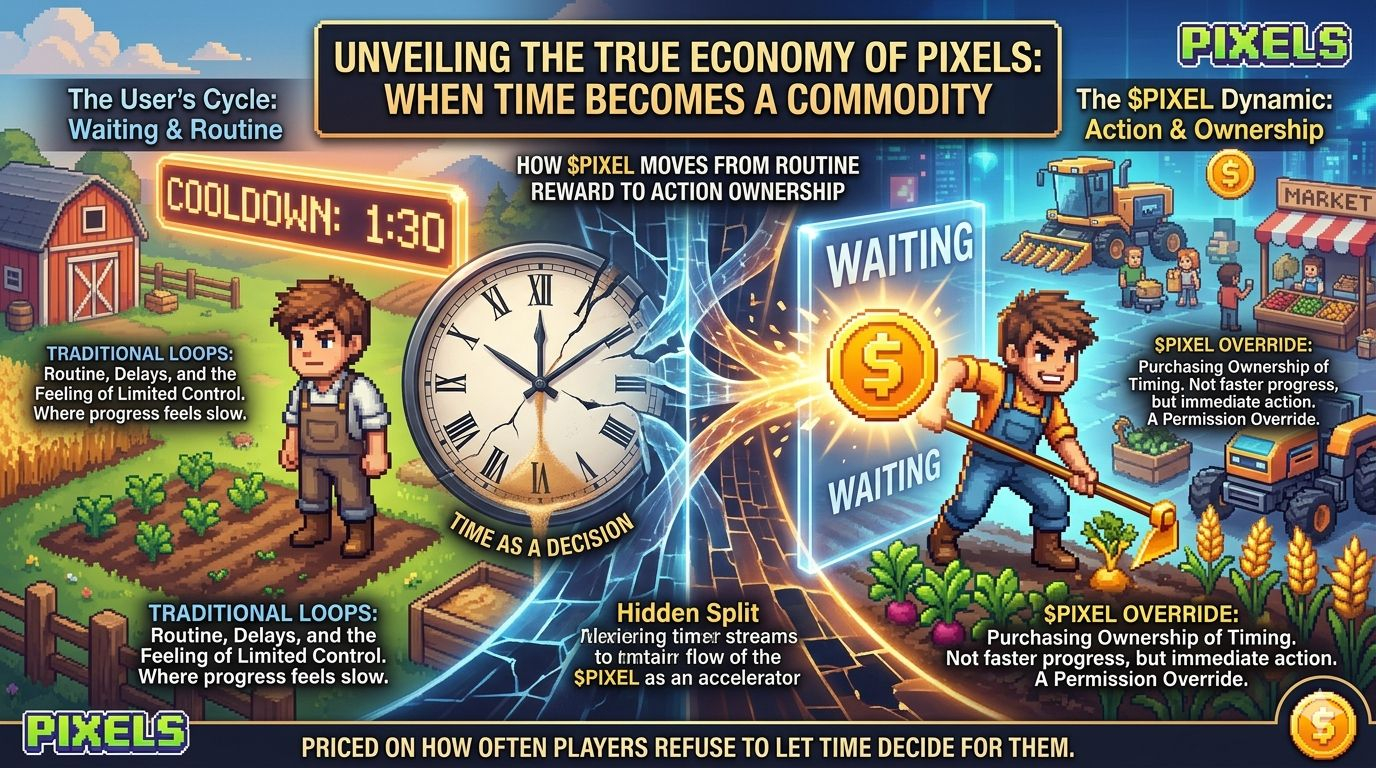
If waiting is obvious, it feels artificial. If waiting disappears, Pixel loses purpose.
So it has to stay in the middle — visible enough to matter, invisible enough to feel natural.
And players learn this over time.
They start recognizing the pattern.
And once that happens, waiting stops being passive.
It becomes a decision.
That’s why $PIXEL isn’t really priced on activity.
It’s priced on how often players refuse to let time decide for them.
And in every loop, there comes a moment where you realize you are not just playing anymore…
you are waiting inside a system that is watching how long you accept waiting.
That moment is where $PIXEL actually lives.@Pixels #pixel $PIXEL