
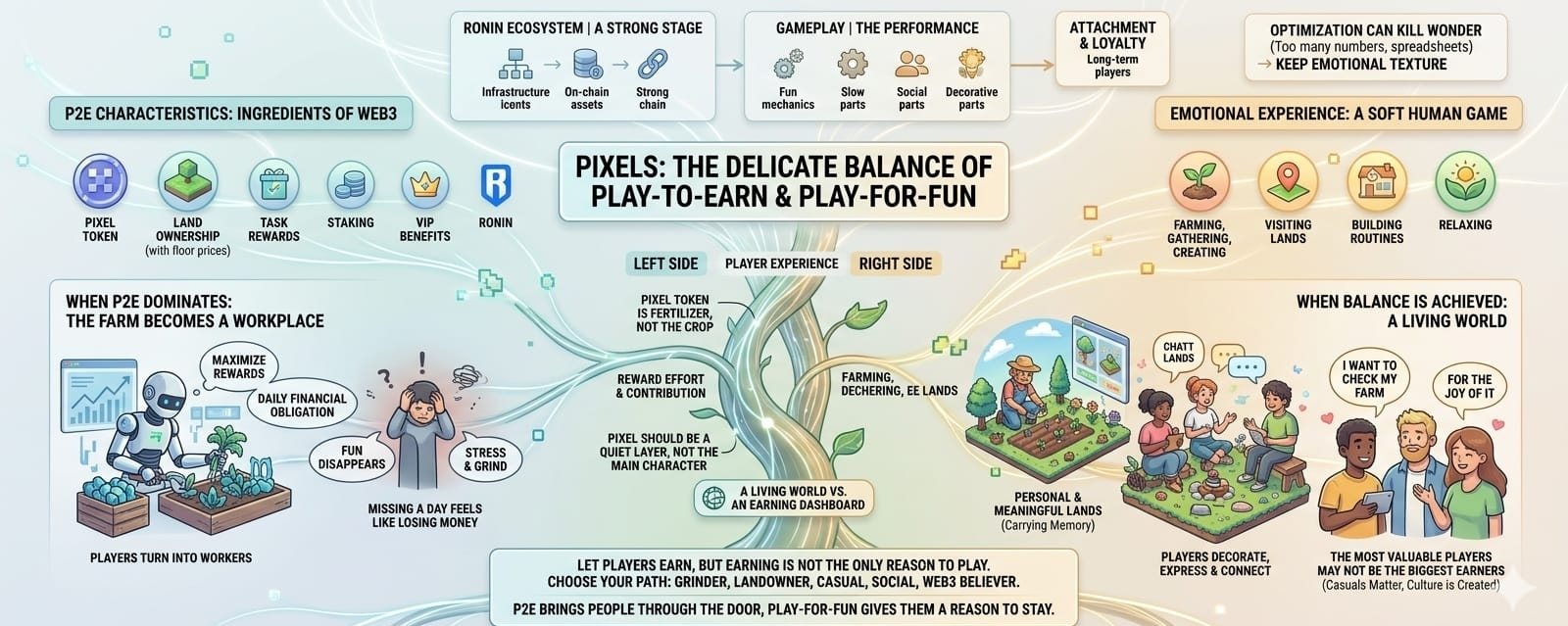
My personal view: Pixels should not become a farm where people only harvest money
When I look at Pixels, I do not see it only as a Web3 game. I see it as a small test of whether crypto gaming can finally become normal without losing what made crypto exciting in the first place.
That may sound simple, but it is not.
Pixels has all the ingredients that usually attract Web3 users: the PIXEL token, land ownership, task rewards, staking, VIP benefits, and a growing connection with the Ronin ecosystem. But at the same time, the game itself is built around something very soft and human: farming, gathering, creating, visiting lands, and slowly building a routine.
This is where Pixels becomes interesting to me.
It is trying to grow two crops in the same field. One crop is financial value. The other is emotional value.
If financial value grows too fast, it can cover everything like weeds. Players stop seeing the world and start seeing only profit. But if emotional value is ignored, the game becomes just another reward machine with cute graphics.
The real challenge for Pixels is not whether players can earn. The challenge is whether players can still enjoy playing when earning is not the main thing on their mind.
A game should not feel like a second job
The problem with many Play-to-Earn games is that they slowly turn players into workers.
At first, rewards feel exciting. You log in, complete tasks, collect tokens, and feel like your time has value. But after a while, something changes. You stop playing because the game is fun. You play because missing a day feels like losing money.
That is where fun begins to disappear.
For a casual game like Pixels, this is especially dangerous. Farming games are supposed to feel relaxing. They are built on small routines: plant, harvest, craft, upgrade, explore, repeat. These actions should feel calm and satisfying, not like a daily financial obligation.
In my opinion, Pixels should never chase the idea of making every player earn as much as possible. That sounds attractive in the short term, but it can damage the game’s soul.
A healthy Pixels player should be able to log in and think:
“I want to check my farm.”
Not only:
“I need to maximize today’s reward.”
That difference may look small, but it decides whether Pixels becomes a living world or just another earning dashboard.
PIXEL should be part of the story, not the whole story
The PIXEL token gives the game depth. It creates utility, rewards participation, supports staking, and connects the game to a bigger ecosystem. Without PIXEL, Pixels would lose a major part of its Web3 identity.
But PIXEL should not become the main character.
The main character should still be the player’s experience.
A token can make a game more meaningful when it rewards effort, ownership, and long-term participation. But it becomes dangerous when every conversation becomes about price, returns, and extraction. When that happens, players stop asking what they can build and start asking what they can take out.
That is not how a farming world should feel.
To me, the best version of PIXEL is not a token that screams for attention. It is a quiet layer underneath the game that makes actions feel more connected. It should reward players, yes, but it should also encourage them to stay, contribute, and care.
PIXEL should feel like fertilizer, not the crop itself.
It should help the world grow. It should not be the only thing people are farming.
Land should feel like memory, not just utility
One part of Pixels that I find especially important is land.
In Web3, land can easily become a cold asset. People talk about supply, rarity, yield, advantages, and floor prices. That is normal in crypto, but if that becomes the only meaning of land, something important is lost.
In a farming game, land should feel personal.
It should carry memory. It should show that someone spent time there. It should feel different from one player to another. A farm is not only a production space; it is a reflection of the person behind it.
That is where Pixels has real potential.
If players treat land only as a tool to increase rewards, the world becomes mechanical. But if land becomes a place where players decorate, organize, invite others, and express themselves, then Pixels becomes more than a game economy.
It becomes a social place.
And honestly, that is what Web3 gaming needs more of. Not just assets that can be traded, but spaces that people actually care about.
The most valuable players may not be the biggest earners
One mistake Web3 games often make is giving too much importance to the most financially active players.
Of course, whales, landowners, stakers, and serious grinders matter. They bring liquidity, activity, and attention. But they are not the only people who make a game healthy.
Casual players matter too.
The player who logs in for fun matters.
The player who decorates their farm matters.
The player who chats with others matters.
The player who does not optimize everything still matters.
In fact, these players may be the ones who make Pixels feel alive.
A world full of only reward hunters can become cold very quickly. Everyone is busy extracting. Nobody is really living there.
Pixels should reward serious participation, but it should not make casual players feel invisible. The game needs grinders, but it also needs people who simply enjoy being there.
That balance is what gives a game culture.
My personal concern: optimization can kill wonder
This is my biggest concern with Pixels and many Web3 games in general.
Crypto players are very good at optimizing. They study systems quickly. They calculate reward paths. They find the best strategies. They turn every mechanic into a spreadsheet.
That is not bad by itself. In fact, it can make the ecosystem smarter.
But too much optimization can kill wonder.
If every crop, task, land action, and reward becomes only a number, then the game loses its emotional texture. Players may still be active, but activity alone does not mean love. Sometimes it only means people are still extracting value.
Pixels needs to protect the parts of the game that are not perfectly efficient.
The slow parts.
The social parts.
The decorative parts.
The playful parts.
The parts that do not always produce the best return.
Because those are the parts that make the game feel human.
Ronin gives Pixels a strong stage, but the performance still matters
Being part of the Ronin ecosystem gives Pixels a major advantage. Ronin already has experience with Web3 gaming communities, on-chain assets, and player-owned economies. That gives Pixels a stronger foundation than many isolated crypto games.
But infrastructure alone cannot make people care.
A fast chain, active ecosystem, and strong token tools can bring players in. They can make transactions smoother and ownership easier. But they cannot create emotional attachment by themselves.
Pixels still has to earn that attachment through gameplay.
The game has to make people feel that their time inside the world has meaning beyond the token. If it can do that, then Ronin becomes a powerful support system. If it cannot, then even good infrastructure will not save the experience.
The balance I want to see
Personally, I think Pixels should follow one simple rule:
Let players earn, but never let earning become the only reason to play.
That means rewards should exist, but they should not dominate every decision. Land should have utility, but it should also feel personal. Staking should create long-term alignment, but gameplay should remain the heart. Token systems should be strong, but not so loud that they drown out the casual charm.
The ideal Pixels player should have choices.
A grinder can chase efficiency.
A landowner can build identity.
A casual player can relax.
A social player can connect.
A Web3 believer can stake and support the ecosystem.
No single type of player should control the entire atmosphere.
That is the only way Pixels can stay balanced.
Final thoughts
To me, Pixels is not just asking whether Play-to-Earn can work.
It is asking a better question:
Can a Web3 game reward players without turning them into employees?
That is the real test.
If Pixels becomes only about earning, it may attract attention for a while, but attention is not the same as loyalty. If Pixels protects the fun, the community, the land identity, and the simple joy of returning to a familiar world, then it has a chance to become something stronger than a reward cycle.
Play-to-Earn can bring people through the door.
Play-for-Fun gives them a reason to stay.
And in a farming game, staying is everything.