
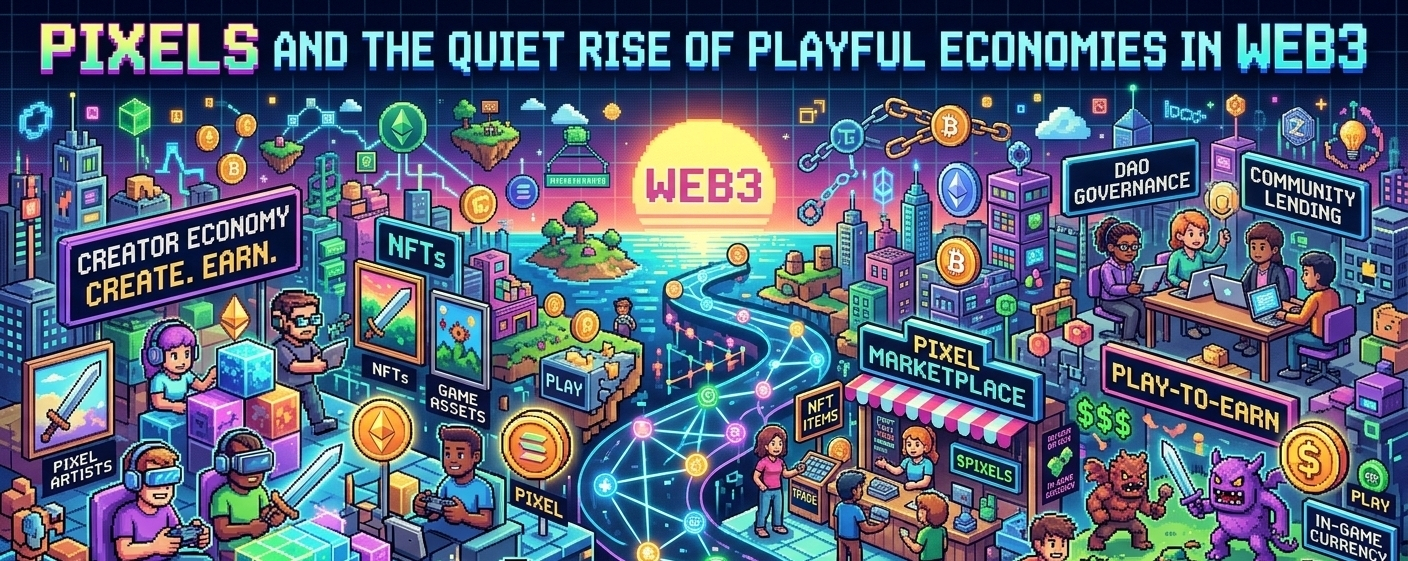
There is something disarmingly gentle about a world built on farming, wandering, and small acts of creation. In an industry often dominated by noise, speculation, and technical bravado, Pixels emerges with a different kind of voice. It does not rush to impress. Instead, it invites players to slow down, to plant seeds, to explore, and to build something that feels both personal and shared.
At first glance, Pixels appears simple. A colorful open world stretches out, filled with farms, resources, and quiet opportunities. Yet beneath this softness lies a carefully constructed digital economy, powered by blockchain infrastructure that subtly reshapes how players interact with value. The Ronin Network, known for enabling fast and low-cost transactions, provides the backbone, allowing in-game actions to carry real ownership and meaning beyond the screen.
What makes Pixels stand apart is not just its technology, but its tone. It understands that the future of Web3 gaming does not depend solely on financial incentives or token mechanics. It depends on emotion. The feeling of tending to a virtual field after a long day, the satisfaction of crafting something from gathered materials, the quiet pride in owning a piece of land that evolves over time. These are not new ideas in gaming, but when combined with blockchain ownership, they begin to carry a different weight.
The PIXEL token acts as both a utility and a symbol. It fuels transactions, rewards participation, and anchors the economy. Yet its true significance lies in how it integrates into the player’s journey. Instead of feeling like an external reward layered on top of gameplay, it becomes part of the world itself. This subtle integration is crucial. It prevents the experience from turning into a transactional grind and instead preserves the illusion of a living, breathing ecosystem.
There is also an interesting social dimension at play. Pixels is not a solitary experience. Players cross paths, collaborate, trade, and influence each other’s progress. In traditional games, these interactions are fleeting. In Pixels, they can leave lasting marks because assets and achievements exist on-chain. A farm is not just a temporary save file. It is a persistent identity, something that can be seen, valued, and remembered.
This persistence introduces a new kind of storytelling. Every player contributes to a shared narrative that evolves over time. A newcomer might arrive and see fields cultivated months ago, structures built by others, and an economy shaped by countless small decisions. It creates a sense of continuity that is often missing in digital spaces.
Yet, the path forward is not without challenges. Web3 gaming still struggles with accessibility. Wallets, tokens, and blockchain interactions can feel intimidating to those unfamiliar with the space. Pixels attempts to soften this barrier through design, but the broader ecosystem must continue to evolve if such experiences are to reach a mainstream audience.
There is also the delicate balance between play and profit. Too much emphasis on earning can erode the joy of the experience, turning it into labor. Too little, and the promise of ownership loses its appeal. Pixels walks this line carefully, leaning into gameplay first while allowing the economy to emerge naturally from player activity.
What is perhaps most compelling is how Pixels reflects a broader shift in digital culture. People are beginning to seek spaces that feel meaningful rather than overwhelming. They want environments where creativity, ownership, and community coexist without constant pressure. In this sense, Pixels is more than a game. It is an early glimpse into how digital worlds might feel in the years ahead.
The future of Web3 will not be defined solely by technological breakthroughs. It will be shaped by experiences that resonate on a human level. Pixels understands this in a quiet, almost understated way. It does not attempt to revolutionize everything at once. Instead, it builds slowly, thoughtfully, and with a clear sense of what makes a world worth returning to.
And perhaps that is its greatest strength. In a space that often moves too fast, Pixels reminds us that growth, whether in a field or an ecosystem, takes time.