

Most GameFi projects begin with the same assumption: if the rewards are strong enough, people will stay. That logic sounds solid on paper, but in practice it usually produces short bursts of attention followed by fast decay. Pixels doesn’t start there. It treats the game more like a behavioral system than a reward dispenser.
What stands out immediately is how little it tries to force your attention. There’s no constant urgency. No pressure to maximize every second. Instead, you end up in these small loops that feel almost understated: a crop that’s close to finishing, a crafting queue that’s just about done, a minor upgrade that feels like it can wait—but also not quite. You don’t feel pushed to stay. You just… don’t fully disconnect either.
That’s the part that’s harder to explain than it should be.
The “Fun First” idea sits underneath all of this. And it’s easy to misunderstand. It doesn’t mean flashy gameplay or high intensity mechanics. It means something more structural: if you stripped rewards out entirely, would the system still hold together as a repeatable experience?
In Pixels, it does.
The loop is simple—farming, crafting, upgrading, waiting—but the pacing is what changes the feeling. Nothing is overwhelming. Nothing is truly finished either. You’re constantly in that in-between state where progress exists, but completion is always slightly ahead of you. That design creates a kind of background awareness. Even when you’re not playing, the system doesn’t fully leave your mind.
Personally, that’s the part I didn’t expect. It’s not addictive in the loud sense people usually talk about. It’s quieter. More like you leave the tab mentally open even after you close it physically.
Then comes Smart Reward Targeting, which is where things get more interesting from a design perspective.
Most GameFi systems reward everything equally: time, clicks, activity. The result is predictable—people optimize for output, not meaning. The behavior becomes shallow because the incentive structure is flat.
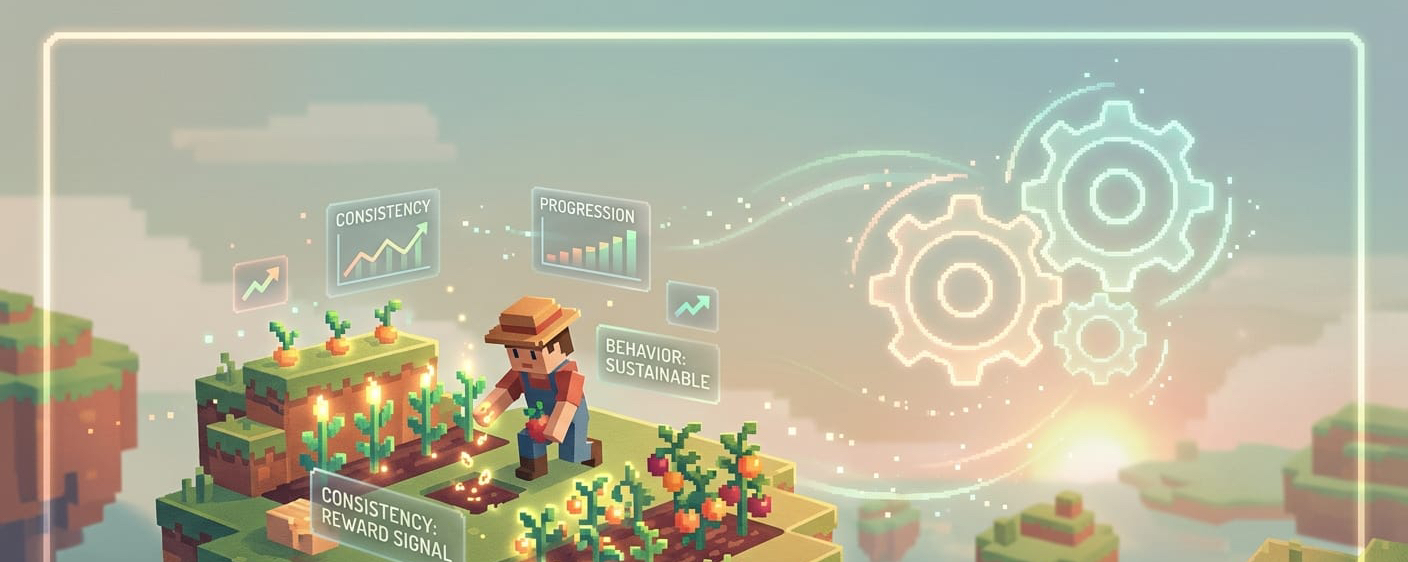
Pixels tries to avoid that by being more selective with its reinforcement. Rewards aren’t just tied to “doing more.” They’re shaped around what kind of doing matters. Consistency over bursts. Progression over repetition. Systems that strengthen long-term engagement instead of short-term extraction.
What that actually does is subtle: it starts shaping behavior without making it feel like it’s being shaped. You don’t think “I am optimizing for rewards.” You just naturally lean into patterns that feel more stable, more sustainable, less chaotic.
And over time, that changes how you interact with the game entirely. The reward stops being the goal and becomes more like feedback. A signal saying, “this direction makes sense.”
The Publishing Flywheel is the layer most people underestimate at first glance, because it doesn’t feel like gameplay. It’s more about how the game survives outside itself.
Instead of relying on constant marketing pushes or hype cycles, Pixels generates visibility through activity itself. When enough people are interacting with the system, the system produces patterns—data, actions, outputs—that naturally become observable. And those observations become the entry point for new players.
In other words, the game doesn’t just get played. It produces material by being played.
That creates a self-reinforcing loop: more players create more activity, more activity creates more visibility, and more visibility brings in more players. It sounds simple, but the key difference is that it doesn’t depend entirely on external narrative. It depends on internal density.
From a distance, that’s what makes it feel alive instead of just active.
What ties all of this together is how the three systems interact rather than exist independently.
Fun First makes sure the base loop doesn’t collapse without incentives. Smart Reward Targeting ensures behavior doesn’t degrade into pure extraction. The Publishing Flywheel ensures that sustained behavior doesn’t stay hidden—it becomes part of the growth engine.
When I look at it as a whole, what stands out is not complexity, but restraint. There’s a deliberate effort not to over-design for attention. Instead, the system is built to remain in motion with minimal pressure.
And that changes how you experience it day to day.
It doesn’t feel like a game you start and finish. It feels more like something that continues in the background of your attention. You step in, adjust a few things, step out—and the system keeps moving without you. But not in a way that disconnects you. More like it leaves a trace that you eventually come back to check.
That’s probably the most unusual part of it. Not that it keeps you playing longer. But that it changes what “playing” even feels like.
