
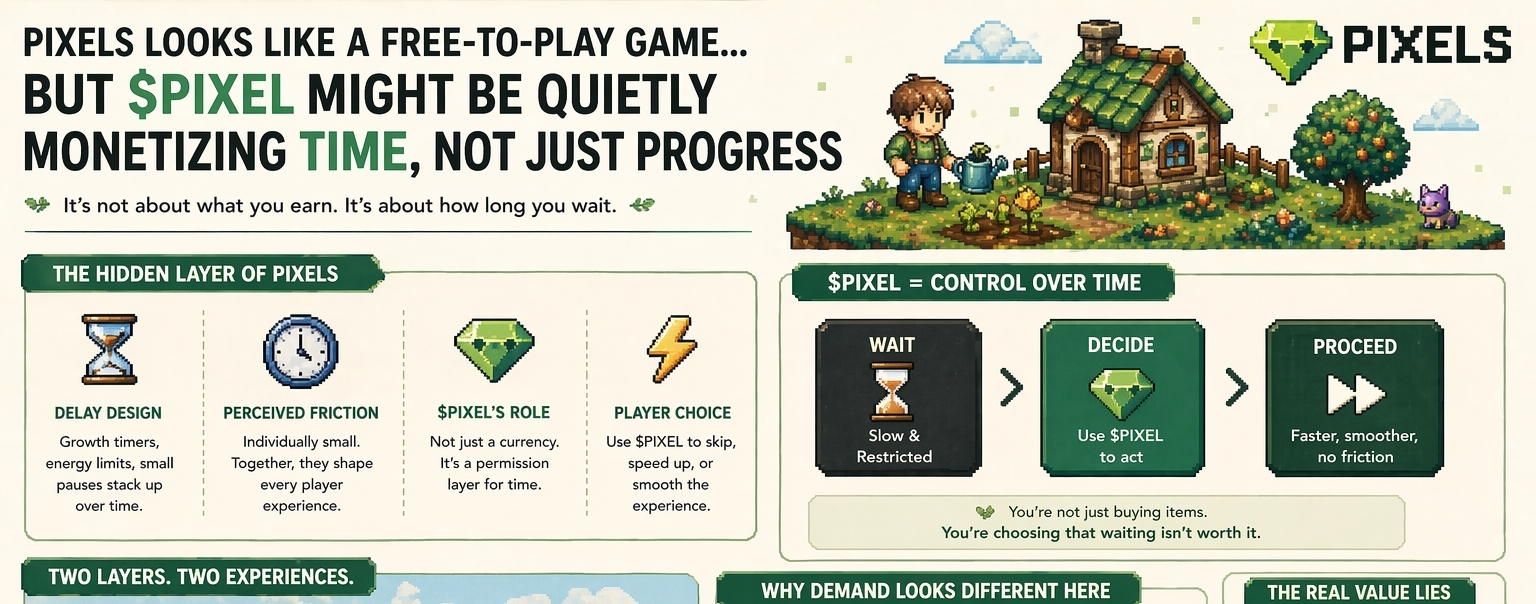
At first glance, Pixels looks familiar. A lightweight farming loop layered on top of a token. Plant, wait, harvest, repeat. It’s a structure that has played out many times across GameFi, so it’s easy to assume you already understand how it works.
But after spending more time observing how players actually behave inside the system, that assumption starts to break down.
What stands out is not what players earn.
It’s how long everything takes.
A Subtle Shift: From Progress to Time
Most GameFi economies are built around selling progression. Better tools, higher yields, faster scaling. The incentive is clear increase output, increase rewards.
Pixels operates differently.
Progress still exists, but the real pressure point sits around timing. Growth cycles, energy constraints, cooldowns these aren’t just background mechanics. They define the pace of the entire experience.
Individually, each delay feels minor. But combined, they create a constant layer of friction that shapes how players interact with the game.
And that’s where it enters the equation.
$PIXEL as a Time-Control Layer
Rather than functioning purely as a transactional currency, it behaves more like a control mechanism over time.
Using it doesn’t just mean acquiring something.
It means deciding that waiting is no longer acceptable.
It means choosing to skip repetition, accelerate a process, or smooth out inefficiencies in the gameplay loop. That decision appears more frequently than expected and often without much deliberation.
Interestingly, many players aren’t using it to maximize profit. They use it to reduce friction.
Not to win faster, but to make the experience feel better.
That distinction matters.
Two Layers of Participation
There’s a structural split within the ecosystem that becomes more visible over time.
Basic in-game currencies support day-to-day activity. Farming, crafting, and general participation can continue indefinitely within that layer. It keeps the system active and accessible.
But the moment a player seeks more control over pacing and efficiency, they move toward $PIXEL.
This creates a boundary between participation and optimization.
And that boundary feels intentional.
It resembles models seen in broader digital platforms where access is free, but control and convenience come at a cost. The system remains the same, but the experience changes depending on how much control the user wants over their time.
Rethinking Demand in GameFi
This dynamic also challenges how demand is typically evaluated.
Most analyses focus on metrics like user growth, token supply, or unlock schedules. While important, they don’t fully capture what’s happening at the behavioral level.
In Pixels, demand may not be driven primarily by expansion.
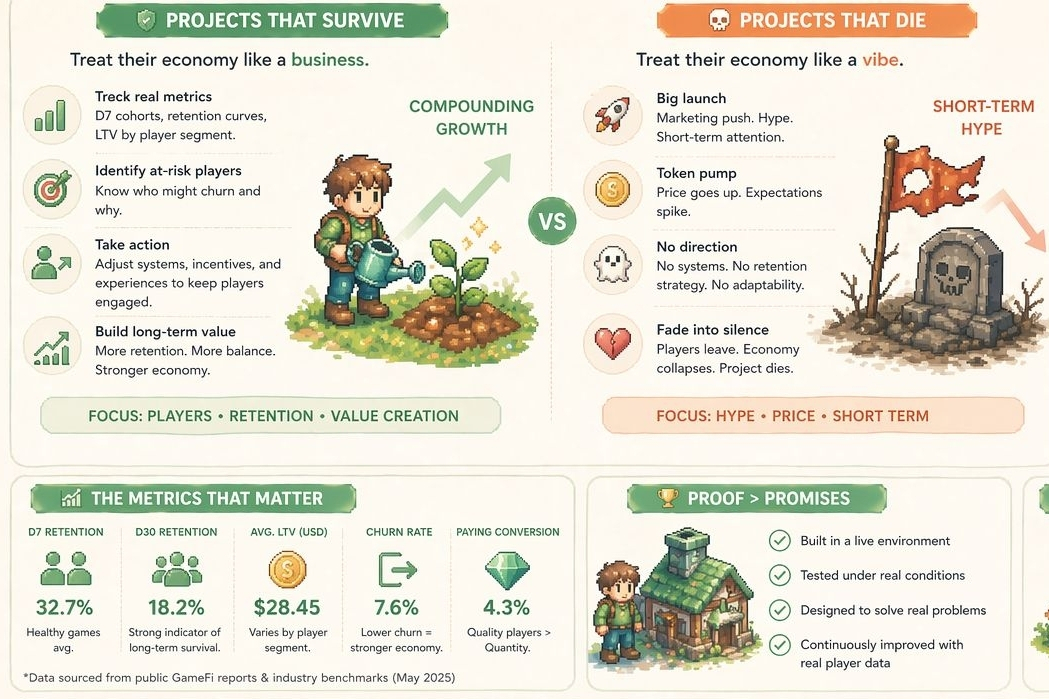
It may be driven by repetition.
If players consistently encounter small inefficiencies that feel worth bypassing, demand can form through repeated micro-decisions rather than large inflows of new users.
It’s not explosive demand.
It’s persistent demand.
And it’s far less visible on charts.
A Fragile Balance
This model, however, is highly sensitive.
If the system becomes too efficient, the need to accelerate disappears. There’s nothing left for $PIXEL to optimize.
On the other hand, if delays feel artificial or overly engineered, players recognize the friction as forced. When that happens, trust erodes and engagement drops.
Maintaining that balance requires precision.
Friction must feel organic. Integrated into the experience rather than imposed on top of it.
That’s difficult to sustain, especially as the ecosystem scales.
What the Market Might Be Missing
Current market perspectives tend to emphasize measurable variables supply distribution, holder count, trading activity.
But those indicators overlook a more subtle layer.
The real signal lies in behavior.
The quiet, repeated decisions players make:
skip this step
speed up that process
avoid another cycle
This is where $PIXEL derives its functional relevance.
Not from one-time usage, but from recurring interaction.
Final Thought
There’s no certainty that this model will hold long-term.
Players may choose to tolerate delays, optimize within constraints, or simply disengage instead of paying to reduce friction. That alternative always exists.
But what Pixels is experimenting with is structurally different.
It’s not just monetizing progress.
It’s shaping how time is experienced within the system and positioning it at the point where that experience can be adjusted.
If executed well, that creates a subtle but durable form of demand.
If not, it becomes just another temporary mechanic.
Either way, it’s a layer that is easy to overlook and potentially costly to underestimate.