
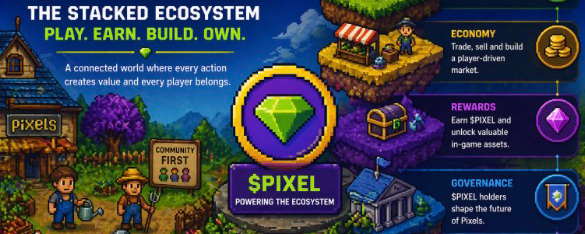
The rise of @Pixels highlights a new direction for Web3 gaming—one that focuses on sustainability, player ownership, and interconnected systems rather than short-lived hype. At the core of this vision lies the Stacked ecosystem, a model designed to create multiple layers of value that reinforce each other over time.
In Pixels, players don’t just play—they participate in a circular economy. Farming, crafting, trading, and social interaction all contribute to a system where effort translates into meaningful rewards. What makes this powerful is how these activities are “stacked,” meaning each action feeds into another layer of opportunity within the ecosystem.
The role of $PIXEL is central to this structure. It acts as both a utility and incentive mechanism, connecting gameplay with economic outcomes. Instead of being a passive reward, $PIXEL is actively used across upgrades, transactions, and future developments, making it a key driver of engagement.
Another standout aspect of @Pixels is its community-first approach. The ecosystem grows stronger as more players contribute, collaborate, and build within it. This transforms the game into a living environment where users are stakeholders, not just participants.
As the Web3 space matures, models like the Stacked ecosystem could become the standard. Pixels is already demonstrating how layered design, combined with strong token utility, can create a more balanced and engaging digital economy. If this momentum continues, $PIXEL may play a significant role in shaping the future of blockchain gaming.
