
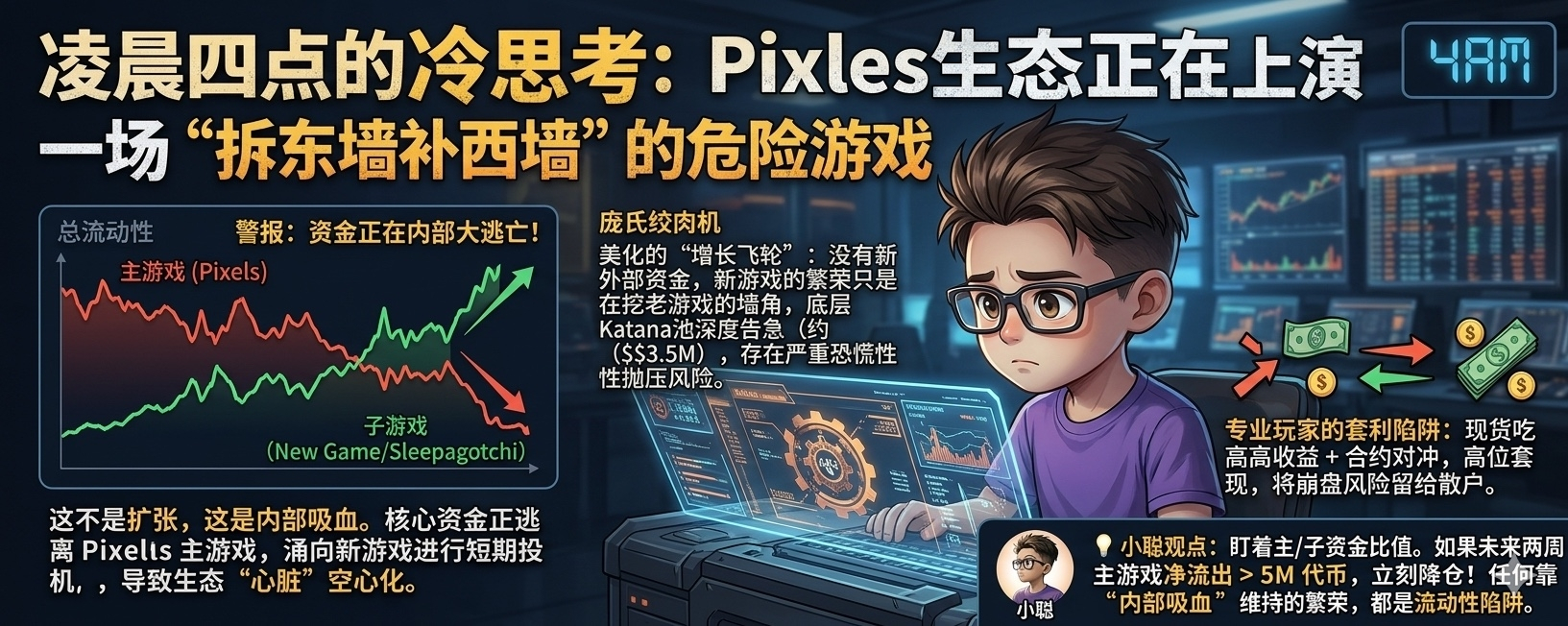
Many are still cheering for the Pixels ecosystem as it integrates new games, thinking this is the start of a boom. But early this morning, while I was staring at the monitoring scripts on my Beijing trading terminal, what I saw was an extremely ruthless 'capital siphoning'.
The current technical panel data is extremely distorted @Pixels
1. Main Game (Pixels): As the big brother, the yield is tightly constrained at 22.97%.
2. Sub Dungeon (Pixel Dungeons): barely holding at 28.95%
3. New Member (Sleepagotchi): surprisingly offering a whopping 31.75% yield.
To the average person, this is called 'newbie bonuses'; but for those of us in quant and data, this is known as 'liquidation of existing positions'.
1. This isn't expansion; it's internal bleeding.
Capital's sense is sharper than a shark's. When the yield difference between two places in the same ecosystem approaches 10%, so-called 'game faith' becomes worthless in the face of the spread.
Currently, about 168.7 million $PIXEL is locked in the total pool. Looks stable, right? But if you check the on-chain records from the last two weeks, you'll find that the main game's funds have stopped growing and even started flowing out. Meanwhile, the new arrival Sleepagotchi is seeing a surge in capital.
The truth is simple: there isn't much new money coming in; it's all 'old money' from the main game getting unlocked, crossing the cooldown period, and heading to the new pool to farm some yield. It's like a city center going dark while the power is rerouted to the suburbs for development. The result: the city center bleeds out, while the suburbs are flooded with speculative hot money #pixel .
2. The beautified 'growth flywheel.'
The grand vision painted in the official white paper is: integrate with the new game ➡️ attract new players ➡️ generate data value ➡️ attract more big projects.
But the premise for this logic to hold is that the new game must bring in fresh outside capital. If the new game's 'prosperity' relies solely on poaching from the old game, then this flywheel turns into a 'Ponzi meat grinder.'
What's more dangerous is that the underlying Katana trading pool is currently thin, with only about $3.5 million. Once the 12.3 million stakers in the main game panic, even if just one-tenth want to exit, this depth won't hold, and the price could plunge into a big pit.
3. How do the pros harvest?
Let's not forget, big money doesn't bet on price fluctuations. They play 'risk-free arbitrage.'
Spot side: deposit coins into the new game to earn that 31% high yield.
Contract side: open the same number of short positions on the exchange to hedge.
This way, no matter how the coin price fluctuates, they can steadily pocket the spread. Once the spread is eliminated, when they retreat, both spot and short positions will simultaneously hit the market. By that time, retail investors left in the game, talking about 'faith,' will be the only buyers.
💡 Xiao Cong's perspective.
I'm Xiao Cong, and my trading discipline is never emotional.
In this cyber farm, I don't focus on what the project team is promising; I only watch the fund ratio between the main game and the sub-games.
Alert line: If the net outflow from the main game exceeds 5 million tokens in the next two weeks, it indicates that the ecosystem's 'heart' has become hollow.
Strategy: I never bet on the so-called 'big players to save the day.' If the core defenses can't hold, I will immediately reduce my base position to below 10%.
Xiao Cong's summary: Any prosperity maintained by 'internal bleeding' is a trap set to attract liquidity. Don't forget to check if the foundation beneath you has already been hollowed out while everyone else is celebrating.
(The above content is personal opinion for reference only.)