
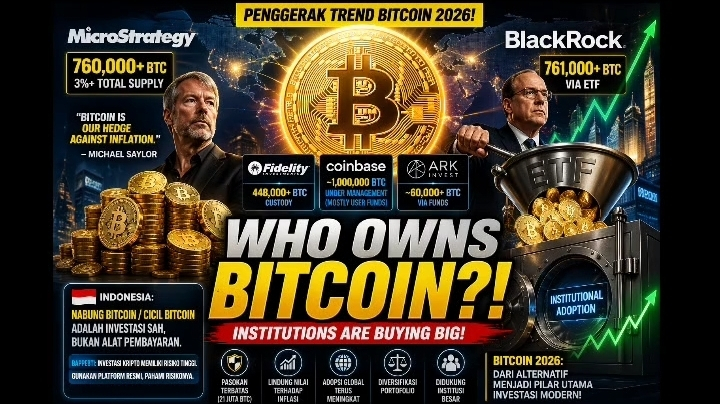
The Bitcoin buying phenomenon in 2026 isn't just driven by retail investors anymore. Behind the global interest surge, there's a significant role played by financial institutions and public companies now holding millions of Bitcoins. This raises questions like where to buy Bitcoin and how to buy Bitcoin, as this trend has entered the mainstream of global finance.
The latest data shows that public companies now collectively hold over 1.16 million BTC. One of the biggest players is Strategy (formerly MicroStrategy), which holds over 760,000 BTC—equivalent to more than 3% of the total Bitcoin supply. Their CEO, Michael Saylor, has consistently stated that Bitcoin is a "hedge against inflation" and the best way to preserve the long-term value of the company.
Moreover, giant financial institutions like BlackRock and Fidelity also have significant exposure. BlackRock, through its ETF products, controls around 761,000 BTC, while Fidelity holds about 448,000 BTC through custodial services. Coinbase even manages nearly 1 million BTC, although most of it belongs to users. This phenomenon shows that institutions are not only buying Bitcoin but also providing the infrastructure for global investors to enter the market. (INDODAX)
The main reasons they are relatively similar: Bitcoin is seen as an asset with a limited supply (maximum 21 million coins), thus able to preserve purchasing power amidst global inflation. Many companies now view traditional cash as suboptimal due to its erosion by inflation, while Bitcoin offers growth potential along with value protection. (KuCoin)
But what about Indonesia? The Indonesian government, through regulators like Bappebti, essentially recognizes crypto as an investment asset (commodity), not a payment tool. Trends like 'saving bitcoin' or 'installment bitcoin' that are popular among the youth are seen as legitimate forms of investment, as long as they are conducted through official and registered platforms. The government also keeps reminding that crypto carries high risks and significant volatility, so the public must understand how to buy bitcoin wisely and not just follow the trend.
This approach shows a pretty clear divergence. If global institutions see Bitcoin as a long-term strategic asset on a large scale, the Indonesian government tends to view it as an alternative investment instrument that needs close supervision. Education and investor protection are the main focus, especially amidst the rising public interest in buying crypto.
In conclusion, 2026 marks a crucial turning point in the evolution of Bitcoin. From being initially seen as speculative, Bitcoin has now become an asset adopted by giant companies and global financial institutions. On the flip side, the government continues to play a role in balancing innovation and investor protection. For individuals, understanding this trend can be the first step before deciding to buy bitcoin as part of a long-term investment strategy.