

This time, I approached the analysis of @Pixels with a somewhat 'contrarian' mindset. I’m not focused on how much it rewards or whether the ROI looks pretty; I'm laser-focused on one thing: what is it actually changing? The more I looked, the more off it seemed—this thing is no longer just optimizing behavior; it’s actually 'changing people.'

Let's make it clear first. What was the logic behind the previous games? You come in, how you play is up to you; some farm, some trade, some just chill. The system might give you a bit of guidance, but it won't dictate your path. Players are active, while the system is passive. But now it's different, and that's where I really started to get wary—Stacked is pushing you to 'voluntarily walk the path it wants you to take.'
You might say, isn't this just about optimizing the experience? Sounds right, but the issue lies in the next step. Once the system starts to 'guide choices', the boundaries shift. You’re making a lot of decisions not for fun, but because 'this is more profitable'. At first, you think you're getting smarter, but over time you'll realize you're actually being trained. Yep, trained—like a silent tutorial nudging you towards behaviors that are 'most beneficial to the system'.
But the problem doesn’t end there; this is just the surface. Looking deeper, it gets a bit colder. As more players are guided towards the same 'optimal solution', paths begin to converge. It seems like everyone is playing, but they’re actually doing pretty much the same thing. Free exploration? Slowly fading away. Individual differences? Flattened. So what’s left? Not a game, but a production line calculated by algorithms.
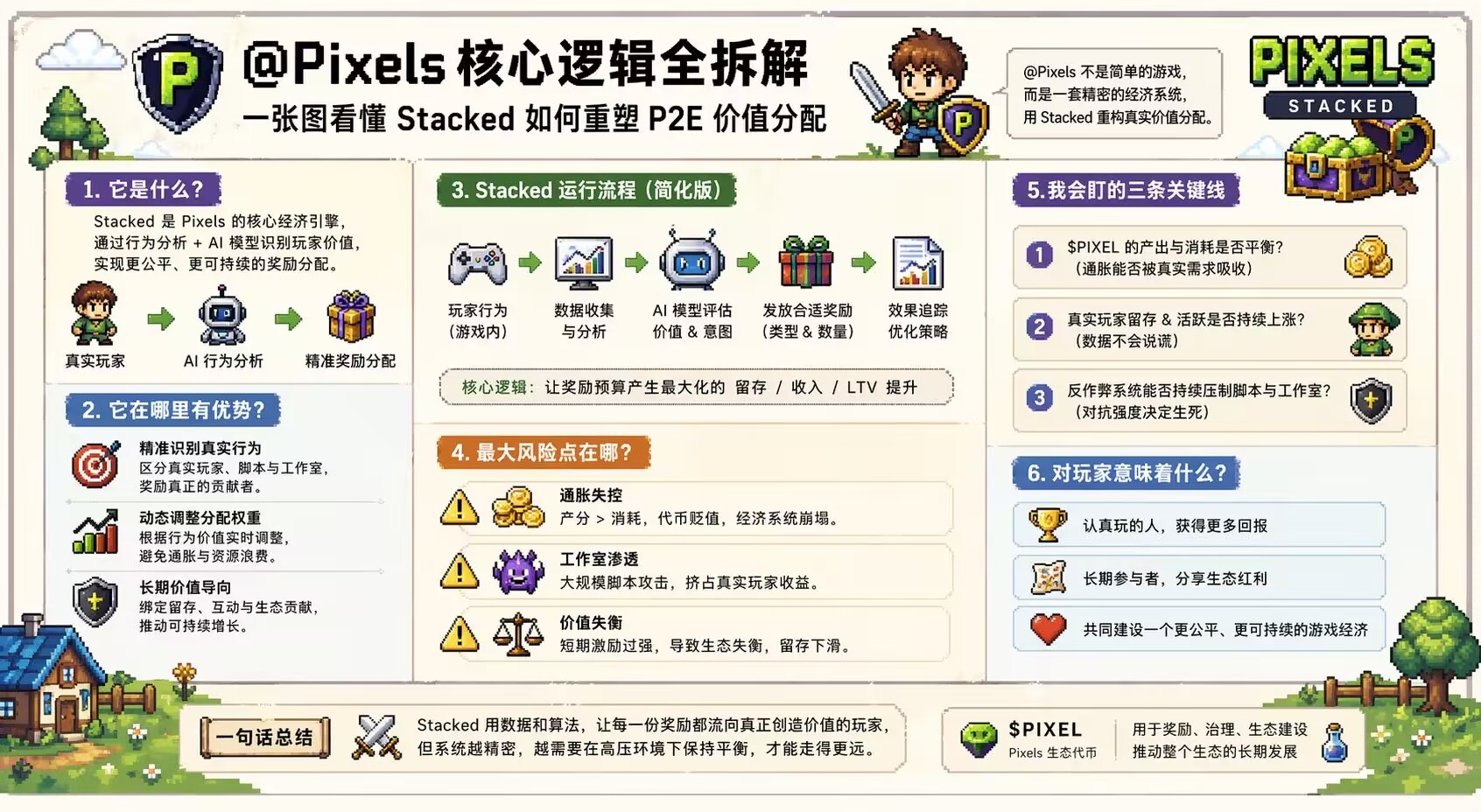
At this point, you should be sensing where the problem lies. But we have to face the truth: why does this happen? Because the environment has pushed us to this point. AI scripts, studios, industrialized farming have completely obliterated the era where 'playing casually meant survival'. If you don’t guide, you get sheared; if you don’t filter, you crash. So @Pixels hasn’t gone bad; it’s just accepted reality sooner than others.
Accepting reality doesn’t mean there’s no cost. Because this logic, while commercially sound, feels increasingly cold from a player's experience perspective. Games used to let you choose; now they make you 'be chosen'; you used to adapt to the game, now the game is quietly reshaping you.

So now I actually care less about whether it’s making money and more about three things: first, are player behaviors becoming more template-like; second, are those 'inefficient but fun' play styles being marginalized; third, when new players come in, are they quickly 'corrected' into the same type of person.
If all three points hold true, I’d say this: this isn’t about making games anymore; this is about creating a behavior filtering system. And once the system starts filtering players, you need to think clearly—are you playing, or are you being transformed? $PIXEL #pixel