Stop-loss: the safety belt in the trading world 🛑
If you've entered the trading game, the first phrase you should memorize is: "A successful trader plans for their losses before their gains." A stop-loss is the tool that protects you from market volatility and emotional decisions.
1. What does a stop-loss mean?
In short: It's an automatic order you set on the platform to sell your asset if the price drops to a predetermined level.
Imagine you bought $ETH$ at $3000 and set on the platform: "If the price drops to $2850, sell immediately." That's the concept of a stop-loss. You set the maximum loss you're willing to take before the trade starts.
2. Why do 90% of beginners avoid using it?
The reasons are mostly psychological:
Unrealistic hope: "The price will definitely go back up; why sell at a loss?" Then they end up losing 70%.
Inability to accept mistakes: Acknowledging a loss means admitting that the analysis was wrong, and the human mind prefers to avoid that.
Misunderstanding: Some believe that a stop-loss causes loss, while it's actually the only factor that keeps you in the market.
The result? One losing trade can wipe out the profits of ten successful trades.
3. How do you determine the correct stop-loss level? 3 practical methods.
Don't place it at a random number. It should be at a point where if the price reaches it, your fundamental analysis of the trade is no longer valid.
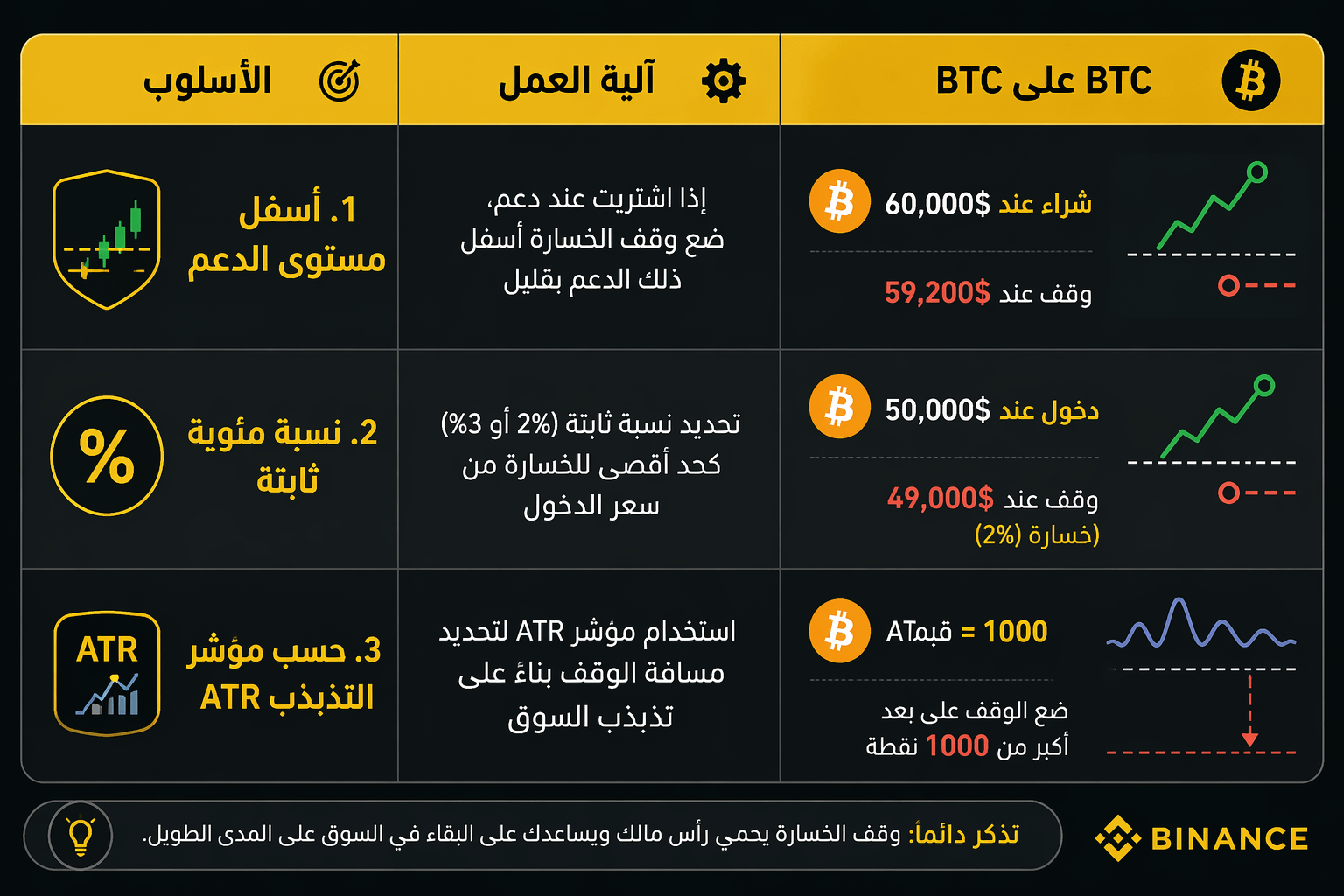
A basic principle: You should place the stop-loss where it invalidates your analysis, not where it just causes you slight discomfort.
4. The top 3 common mistakes when using stop-losses.
Widening the stop level: After entering the trade and it moves against you, you pull the stop back to give it an "extra chance." This is a highly risky move.
Too tight of a stop-loss: You place it too close to the entry price, causing any normal movement to trigger it, and then the price moves towards your target.
Trading without a stop-loss: This is not considered disciplined trading. You're relying on the assumption that the market will never reverse against you.
5. The equation that changes your way of thinking: Risk-to-reward ratio R:R
Before entering any trade, ask yourself: What is the expected profit compared to the potential loss?
Entry price: $100
Stop-loss: $95 = potential loss of $5
Profit target: $115 = potential profit of $15
R:R ratio is 1:3, meaning you're risking $1 to gain $3.
If your ratio is 1:3, even if you only succeed in 4 trades out of 10, you'll still end up with a profit. Without using a stop-loss, it's impossible to calculate this equation.
In conclusion: A stop-loss is essential.
The market doesn’t cut anyone slack. All professional traders use stop-loss orders. The difference between a trader who remains in the market and one who loses their entire portfolio is respecting small losses.
A stop-loss doesn't prevent losses, but it prevents big losses that could take you out of the market entirely.
Trading without a stop-loss is like driving at high speed without brakes. You might reach your destination quickly, but one accident could end everything.
Educational content only. Trading involves high risks and can lead to the loss of your entire capital. This is not financial advice. Do your own research DYOR.

Article

Stop-loss: the safety belt in the trading world 🛑
--