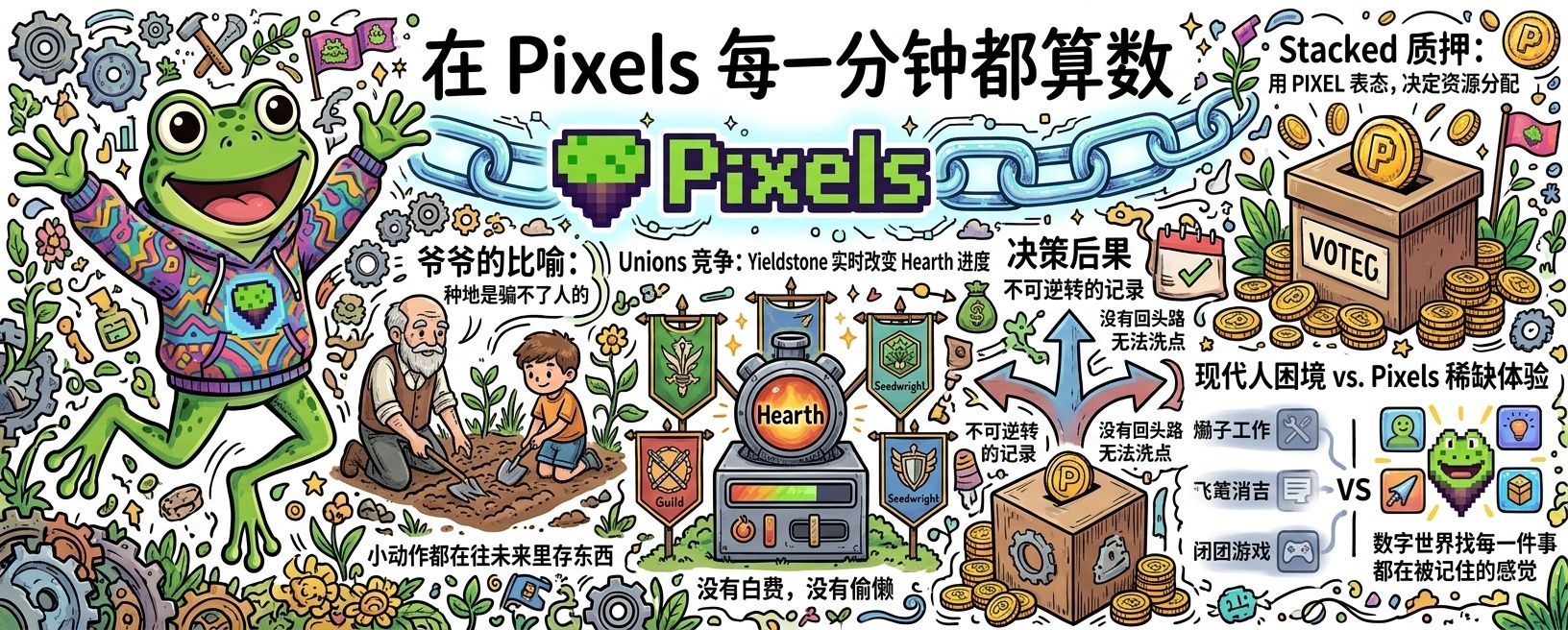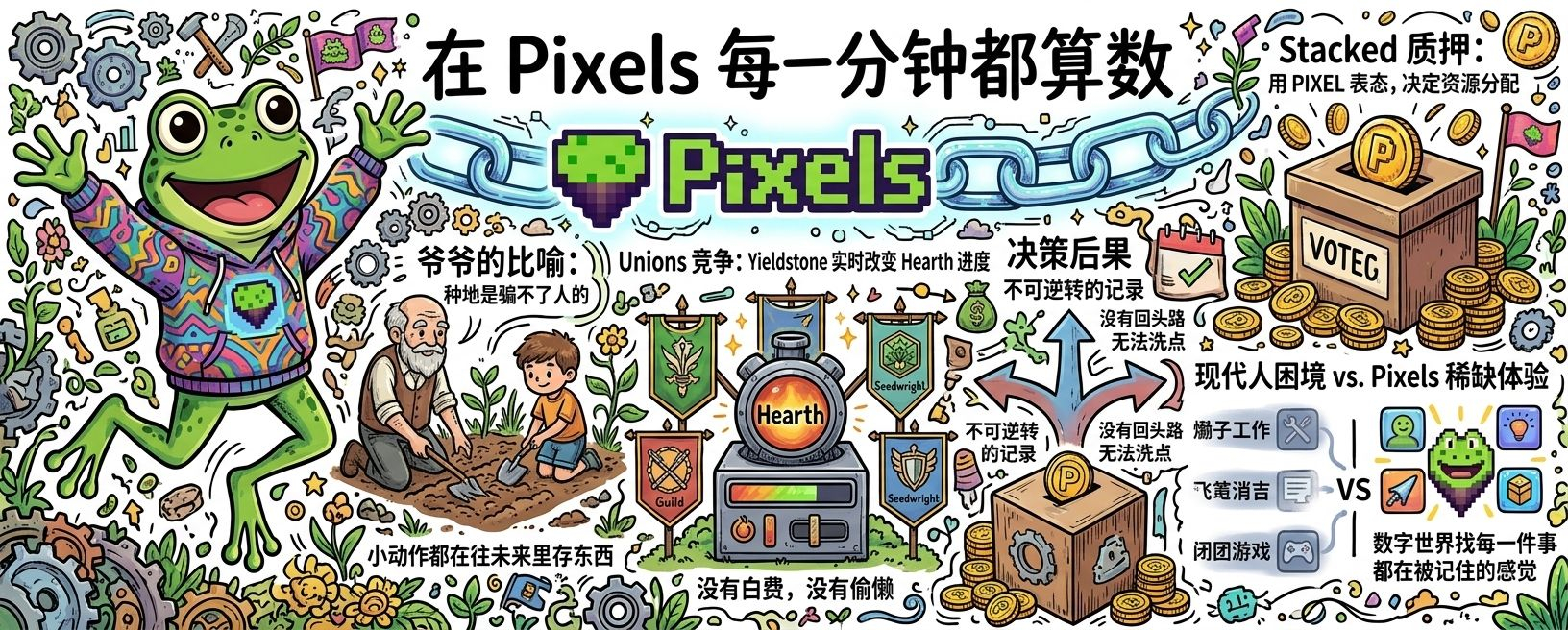
When I was a kid, I helped my grandpa farm for a year back home. At that time, I didn't understand anything; I just did whatever he told me—watering, weeding, fertilizing—mechanically repeating it every day. I asked him why he worked so hard, and he said, "Do you think this is all for nothing? If you water this plant a little more today, it will grow an extra two centimeters next month. If you slack off today, it'll grow a bit slower. Farming doesn't lie." I didn't get it back then, but as I grew up, I understood what he meant. Every seemingly insignificant little action is saving up for the future; you just can't see it at the time.
@Pixels The design of this game reminds me of something my grandpa used to say.
In most traditional online games, most actions have no real consequences. You might run a dungeon today and grab some gear, but that gear will be obsolete by the next patch. If you team up with strangers to grind through levels, once you disband, everyone goes their separate ways. The data gets logged in the background, but it has no lasting relationship with you; it’s all inconsequential since tomorrow, the world will still be the same.
That’s not how Pixels rolls. If you plant a crop on a piece of land, that record stays on the chain, and you can check it anytime. Using $PIXEL to swap for a tool means that transaction is logged on-chain, and you have your share in the official economic data. If you toss a few Yieldstones into the Seedwright guild, that contribution will impact the guild's final ranking for the season; your fate is now tied to all other Seedwright players. Staking PIXEL in a game in Stacked means that game will get a share of resources from the Ecosystem Rewards pool, and your choice counts—it’s not just about you, it affects others too.
This design, where every little decision leaves a mark, makes players subconsciously pay more attention to every step they take because they know what they do won’t be wiped clean or reset. An old player I met in Pixels told me he studies the output data seriously before buying land because he knows that a wrong purchase will haunt all his future operations. Unlike other games where you can just reset with one click, this sense of no return makes you treat every step seriously.
The Unions design in Chapter 3 adds another layer of meaning. The competition between the three guilds is constantly evolving; every Yieldstone you invest today changes Hearth's progress bar in real time. If you leave for a week and come back, the situation will have already shifted, and what others have invested will affect you too. Not investing is like scoring negative points; investing leaves a trace in the big pot—there's no wasted effort and no room for slacking. The staking vote system in Stacked works on the same principle; where you stake your PIXEL shows which game you’re bullish on, and these votes collectively decide how resources are distributed across the platform, with every holder participating in an ongoing silent vote.
Looking deeper into this, it touches on a common dilemma for modern folks: most things we do daily seem to have no real consequences. Efforts at work can be wiped away by a single comment from the boss, social media posts are quickly buried, and games just vanish when the servers shut down. #pixel Pixels gives players a sense that every step counts in a small game world, a feeling that's becoming rarer in real life. Perhaps because it's scarce, players are willing to stick around for the long haul.
Every decision has its weight sounds great, but it also means the pressure on players is way higher than in regular games. In typical games, you can just mess around without much consequence, but in Pixels, the cost of a mistake sticks with you. This pressure is a draw for some players, while it can deter others. During the AMA in January 2026, some players mentioned that the sheer volume and significance of choices in the game were starting to affect their experience.
I revisited my grandpa's vegetable plot; he doesn't farm it anymore, but the soil remembers how many times he turned it over. Pixels aims to give players a similar experience, just moving it from land to the chain, allowing players to rediscover that every little thing they do is remembered in a digital world. Whether this appeals to everyone is another question, but it truly embodies a product quality that’s quite rare in this era.