
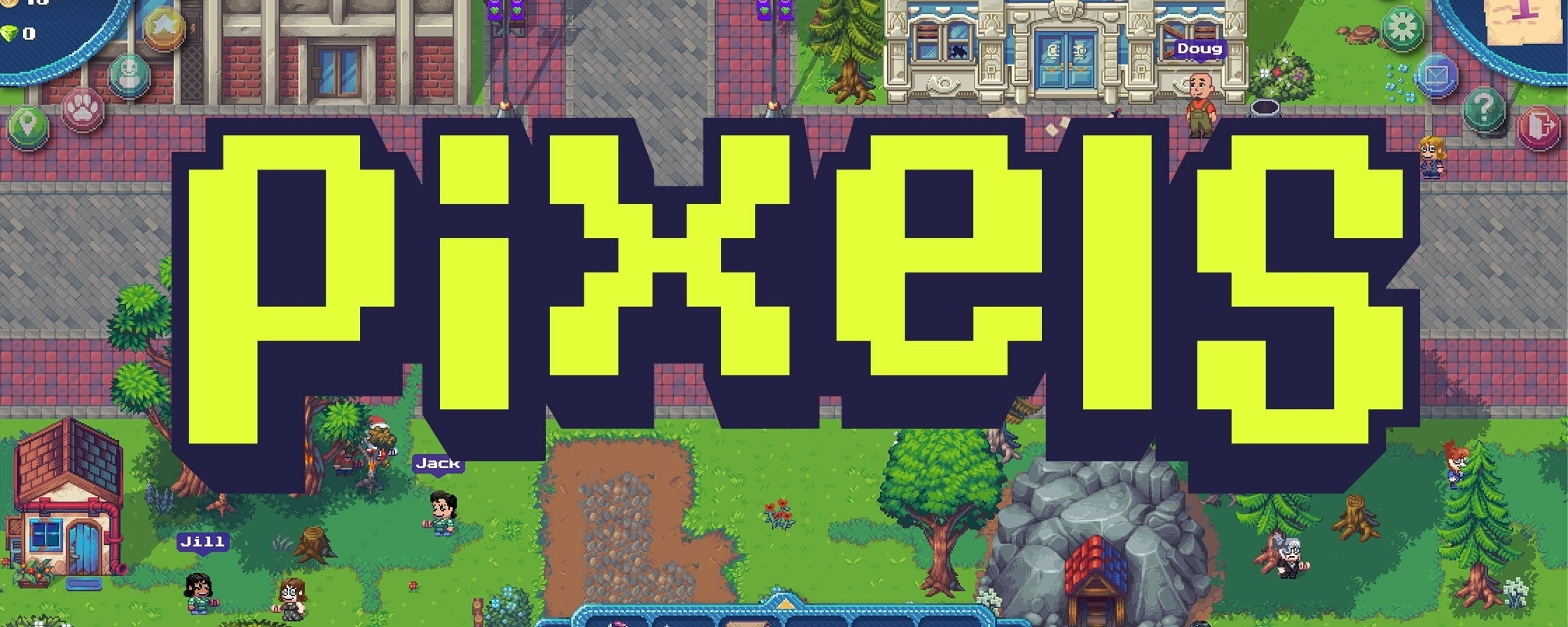
In the late autumn of 2023, Pixels made a nail-biting decision that had the whole chain gaming community sweating: they packed up and left Polygon, relocating to Ronin. Honestly, I was puzzled at the time—why would you move a solid project from a top-tier chain like Polygon? What was the point of all that turmoil? Looking back over two years later, I can only say this move wasn’t about tech; it was a strategic play.
Let me throw some data your way to highlight the stark contrast before and after the migration: @Pixels Just settled in on Ronin, and two months later, daily active addresses skyrocketed to 119,000, achieving a 20x growth. The on-chain activity across Ronin saw a massive surge in November 2023, with daily active addresses jumping from 17,400 to 88,400, peaking at 152,800. When Pixels left Polygon, they were around 4,000 daily active users, but after the move, they shot up to 180,000, over a 40x increase. By the end of 2025, Pixels' DAU even crossed the 1 million mark, becoming one of the largest products in the entire Web3 gaming space.
The data is laid out here, but what I really want to discuss is: where does the underlying logic of this decision truly lie?
The first layer of logic: wherever the users are, that’s where I go.
Founder Luke Barwikowski said something after the migration that I believe all chain game entrepreneurs should engrave on their desks. He remarked, "Polygon is a fantastic ecosystem, but Ronin has what Polygon lacks: users who are already engaged in Web3 gaming."
In layman's terms: you built an amusement park, and no matter how upscale or bustling the location, if no one wants to play your project, what’s the point? Ronin has millions of Axie Infinity players who don’t need to be ‘educated’ on what a wallet is, what gas fees are, or what NFTs are. They’ve already navigated countless pitfalls in Web3 gaming, and they can jump right in with almost zero operational cost.
In contrast, the Polygon ecosystem has a wealth of DeFi projects, NFT art projects, and various RWA applications beyond gaming, leading to much more complex user motivations. Pixels doesn’t want generic traffic that’s just 'here for the ride'; it needs targeted traffic that's 'here to play games.' This difference in user acquisition efficiency can't be bridged with ad spend.
The second layer of logic: collaborate with practitioners, not theorists.
Sky Mavis has a mixed reputation in the crypto space. Some criticize them for centralization issues, while others praise them for successfully scaling Web3 gaming. Luke once said, "Sky Mavis is the only company that has achieved scalable development in the Web3 gaming field, and collaborating with a team based on practice and experience rather than assumptions is a wise choice."
This hits the nail on the head. Writing a hundred pages of intricate economic models in a whitepaper is less concrete than the pitfalls and lessons learned by others. Ronin has endured significant security incidents in 2022, and the whole team has weathered extreme pressure, relying on operational resilience.
After migrating to Ronin, Pixels received direct support from Sky Mavis on the operations side. The user-friendliness of the Ronin wallet, seamless cross-chain bridges, and high liquidity on Katana DEX—these aren’t just features on a PowerPoint; they are mature systems that have been in action for a year or two. When you’re developing a game, what’s the worst fear? It's players not being able to log in, assets failing to transfer, or trades not going through. Ronin has reduced these underlying frictions to almost zero.
A chain reaction sparked by the migration.
After Pixels left Polygon, Apeiron followed suit, announcing its departure to join Ronin in December 2023. Over at Polygon, the MapleStory Universe IP project and the Delabs team behind KartRider's Rumble Racing Star also exited, diversifying into Avalanche and Arbitrum. Multiple projects are scattered, and Polygon's market share in chain gaming is being rapidly eroded, feeling a bit like 'Huangpu Military Academy' vibes.
Pixels on Ronin is charging ahead: in February 2024, Binance Launchpool listed the PIXEL token, and RON surged 23.7% within a week; Pixels accounted for about 40% of the trading volume on the Ronin chain at one point. That ambitious farming game from back in the day has now grown into a lifeline for the Ronin ecosystem.
Looking back at this migration three years later, it's less about 'leaving' and more about 'precision matching.' It’s not that Polygon is bad; it’s just that Pixels and its target users are not on the same wavelength. The chain your game is built on determines who you leverage for traffic, which community you inherit, and whose operational experience you draw from.
The results of this strategic gamble are slowly unfolding: by March 2026, Pixels’ daily active users have expanded to over a million, evolving from a single game into a multi-game publishing platform integrated with Stacked. Starting as a farming game, it has gradually become a cornerstone of the Ronin chain—this is probably what finding 'home' is all about.