
A true fact about me: Land in Pixels is the first NFT I owned and also the thing that kept me in GameFi the longest. It gave me the feeling that I now have 'my own territory.' I thought straightforwardly that if I own it, there must be some form of power, at least on a small scale. But after about 3-4 days of logging in almost continuously, that feeling started to shift. I still use the land every day, still build, still optimize, but the more I do, the clearer it becomes that I don't really control anything that truly matters.
I used to think ownership in crypto was a form of power. Having assets means having a voice. Having more gives an advantage. It's a pretty natural logic, almost needs no verification.
But Pixels has started to make me question that logic.
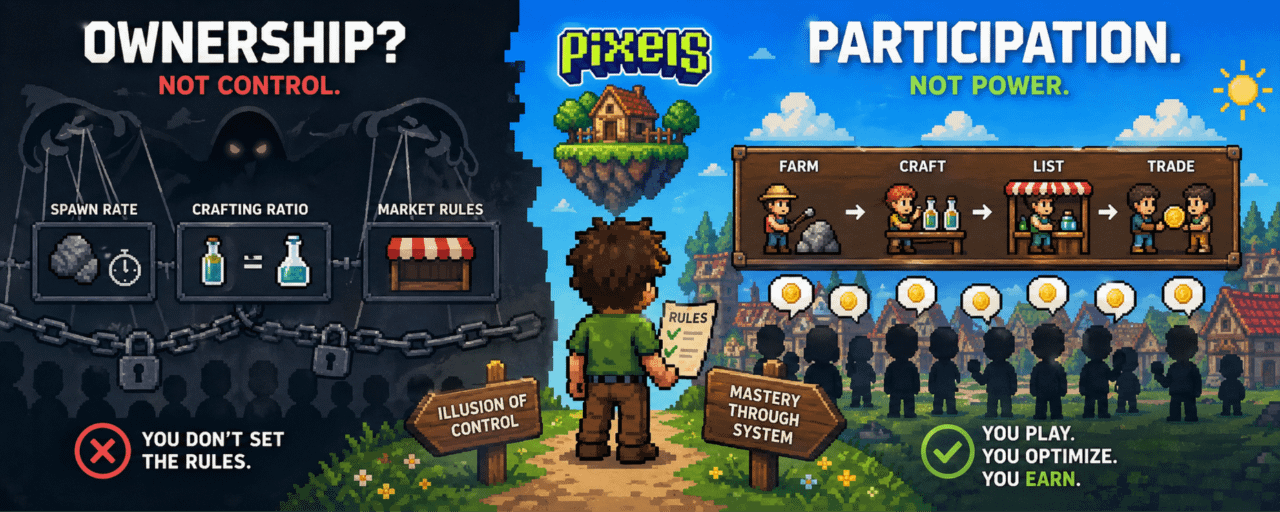
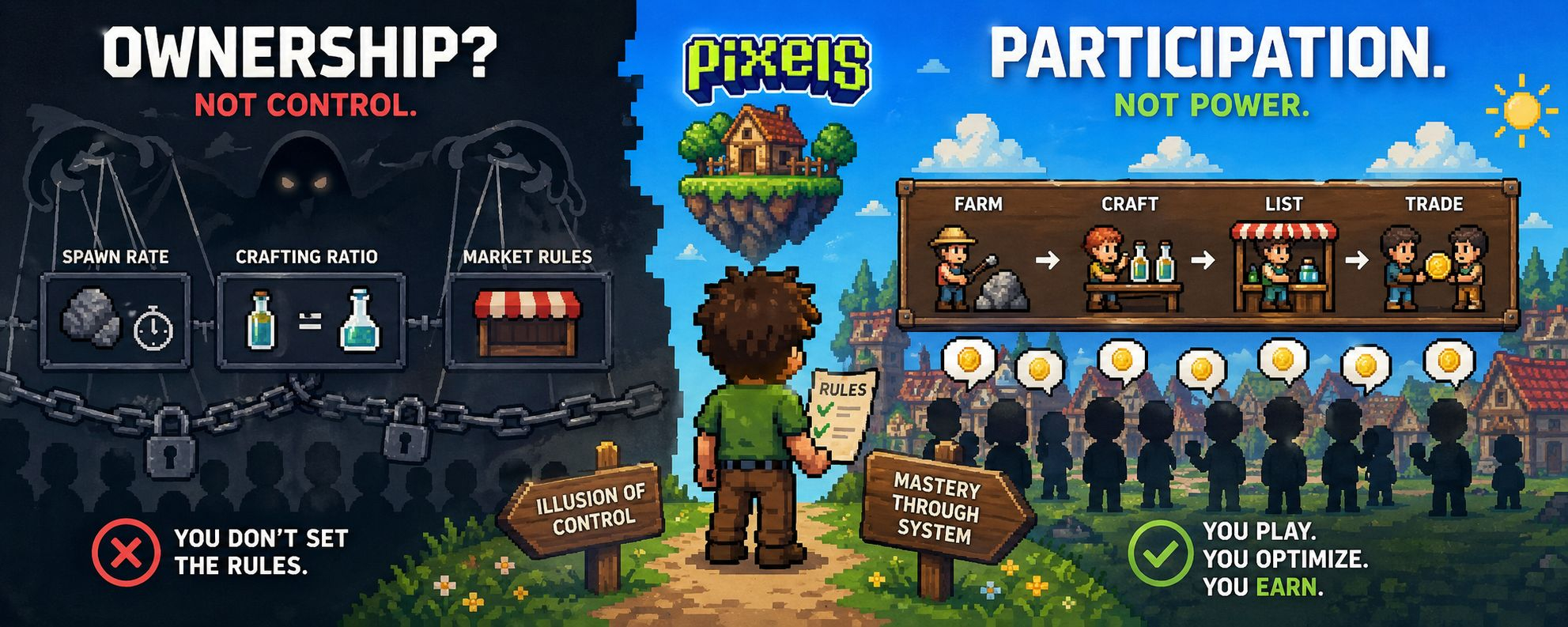
You have land, resources, items. But you can't access the layer that creates value for them. The spawn rate isn't something you decide. The crafting ratio isn't something you change. The marketplace isn't where you set prices; it's where you react to prices. The most important variables are all out of reach.
I realized this most clearly during an attempt to change my coin-earning strategy.
One day I spent nearly 3 hours just farming Stone. In total, about 200 Stone, priced around 3-4 coins, which adds up to less than 900 coins. The next day I didn't farm anymore. I hit the market, bought Stone at around 3 coins, crafted it into Glass Bottles, and then relisted them. The entire process took less than 45 minutes, and after deducting costs, I kept over 1.2k coins.
There was nothing I 'owned additionally' between those two days. No extra land, no new tools, no unlocks. But the results were completely different.
There was a small detail I noticed afterward. Once, I tried to list Glass Bottles about 0.3-0.5 coins higher than the average, just when I saw many folks continuously listing in the market, thinking if I held the price, others would follow. But there were almost no transactions. Conversely, as soon as I lowered the price to match or slightly below, the items flew off the shelves. No one was 'following my price'; they only reacted to what was most efficient for them.
That’s when I realized that what I was missing wasn’t assets, but a way to view the system.
At least for me, this is the point where ownership starts to lose its original meaning. It’s no longer about control; it resembles a form of conditional participation rights. You're allowed to enter the system, but according to the rules that have already been written. You don’t change the rules; you just learn to play better within those rules.
Looking closer, Pixels resembles a system where all the power lies in the design. Players don’t hold power; they just optimize their behavior to adapt to that power.
Once, I stood observing a pretty busy farm area for over 2 hours. Almost no one spoke. Each person had a very clear role. One group just farmed continuously. Another group crafted non-stop. A third group focused solely on listing and relisting in the market. The flow ran very smoothly, almost without any wasted steps.
After a while, I realized it resembles more of a chain than a game. And in that chain, no one is 'in control' at all. They simply do their part in a system that's been locked down beforehand.
If I had to simplify it, it's like you have a stall in a market. You own the goods, you choose how to sell. But you don't control the number of people in the market, you can't set the trading rules, and you can't change the hours of operation. You don't control the market; you just find the best way to thrive within it.
Interestingly, the feeling of ownership still feels very real. You still build, still accumulate, still feel like you're making progress. But if you look closely, what you 'own' isn't the system; it's your position within that system.
And this is where I find it a bit uncomfortable.
That feeling of control isn't something that naturally appears. It's like a layer of design. You're given enough rights to feel like you're in charge, but not enough to change anything core. It's an illusion of control.
If you look at it this way, what players are doing isn't exactly 'building assets.'
They're solving an optimization problem.
You don't earn more just because you have more. You earn more because you understand the rules faster, align with the right flow better, and repeat it more effectively than others. The top earners aren't those who hold the most, but those who operate the most efficiently.
And when a flow is found that's good enough, it gets copied. Once it's copied enough, it becomes the standard. At that point, everyone starts to mirror each other. Not because they want to, but because the system rewards only those behaviors.
At that point, ownership almost no longer creates long-term differences. It's just a ticket for you to participate in an already optimized chain.
Maybe I'm looking too far ahead, but Pixels made me rethink something that I previously considered a given. In crypto, there are systems where you don't own to control. You own to participate.
And if you follow that logic to its conclusion, then in Pixels, what you call 'ownership' isn't really power. It's just a condition to participate in a system that you can never truly control.
