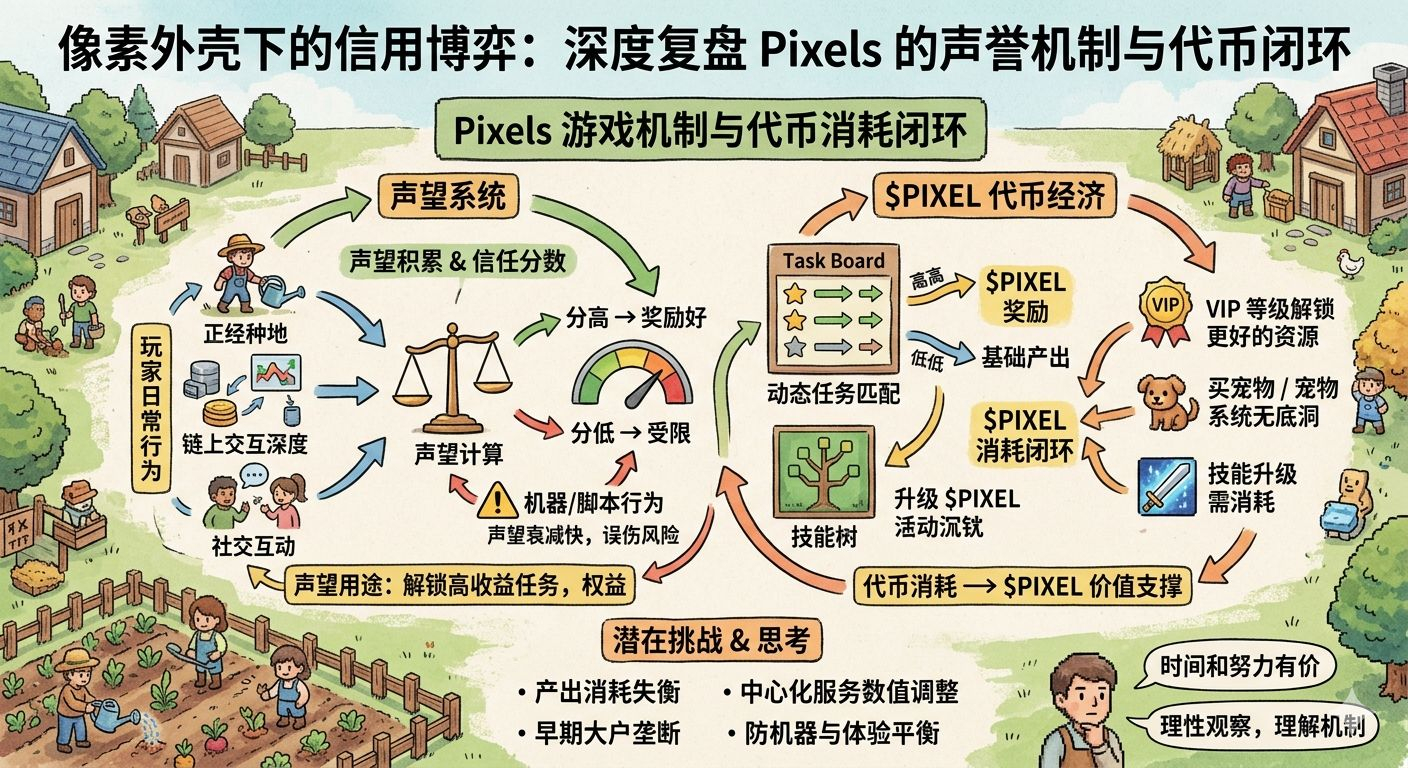
Hey guys, do you ever feel like when you jump into a blockchain game, it’s just all about mining pools, tokens, and ROI cycles? After a couple of days, it makes you want to hurl. But @Pixels is actually a bit different. It's running on the Ronin chain, and the vibe is that retro pixel-style farming game. At first glance, it’s all about farming, raising pets, doing quests, and leveling up skills—classic MMO stuff. But its design in the Web3 gaming scene is pretty interesting. Unlike a lot of blockchain games where everyone’s crammed into one mining pool, they’ve got this Task Board that matches you with tasks based on different levels of labor, dynamically assigning work. For example, if you’ve got high output, you get high-reward tasks, while newbies handle the basic stuff. It’s way more flexible. The Skill Tree lets you level up vertically, and you unlock better resources with VIP levels using $PIXEL, which also turns the pet system into a token-sink bottomless pit. All these elements come together to create a consumption loop. The later versions even piled the core expenses like skill upgrades, buying pets, and subscribing to VIP onto $PIXEL , forcing you into passive consumption. The design really has some clever thought behind it.
Let's talk about its reputation system (Reputation/Trust Score) that many folks overlook. It's not about KYC, but rather gauging your on-chain interactions and daily activities to score you dynamically. If your score is low, you won't get access to high-reward tasks or perks. Plus, there's a decay mechanism: if you're farming or trading genuinely, your score stays stable; but if you operate too mechanically like a script, your score drops fast. This system is designed to differentiate between humans and bots, preventing botting, which serves as a safeguard for regular players.
Of course, don’t think it’s all sunshine and rainbows; there are flaws too. Higher-level areas can easily be monopolized by early players or whales, and if low-tier players aren’t seeing good returns, they’ll definitely bounce to grab other projects, which could lead to supply issues. Many P2E projects have demonstrated this scenario before. No matter how good the reputation system is, it can still mistakenly hurt real players. Your interaction costs go up, and the project has to walk a tightrope between preventing bots and maintaining user experience. Many bottom-tier players need instant liquidity; no matter how slick your consumption design is, if they can't stay, they just can't. Once the coin price fluctuates, sell pressure can easily create a death spiral—classic storyline in early chain games. Additionally, Pixels relies heavily on centralized services for its core gameplay, while the Ronin chain only handles final asset accounting. This is common in GameFi, but you must understand that they can adjust the numbers at any time, and ultimately, asset ownership still depends on platform records. Ronin has had bridge hacks before, and although they've strengthened security since, the balance between safety, costs, and user experience is always a factor. These issues aren't isolated; imbalance in output and consumption leads to decreased activity, and when activity drops, liquidity pressure increases. Currently, Pixels' daily activity and model design are considered rigorous among peers, but any economic system needs to be tested in the real world to see if it holds up. Overall, this project deserves your attention. It combines labor records, credit accumulation, and virtual worlds, attempting to make 'time and effort valuable', and there are community members willing to participate long-term and stake. Compared to those projects that only draw pretty pictures, at least it has grounded its economic principles.
But don't get too hyped. Balancing output and consumption is always tricky; manage it well and you can last long, mess it up and you're in for a crash. Outsiders will just focus on the $PIXEL price, either trash-talking or hyping it up, but the design regarding the reputation mechanism and reward constraints is genuinely thoughtful. I've seen too many projects go from takeoff to correction in this space. What makes Pixels special is that it doesn’t just talk the talk. The design can create a closed loop, but in the end, it all comes down to real user behavior and market feedback. Observing its performance through different cycles rationally is way more reliable than just FOMO-ing in now. If you're still in the game, keeping a solid understanding of the mechanism will keep you grounded, knowing you're participating in a centralized service + on-chain asset system, at least giving you some peace of mind. In this space, rationality is always the most practical tool. (This article is a platform task and does not constitute investment advice.)