

These days, everyone’s buzzing about blockchain trends, and most folks still kick things off by checking out two key indicators: first, whether the coin price is poised for a short-term pump, and second, if there’s a fresh narrative driving the project. But I’m starting to believe that the next wave of projects that actually stick around won’t be the loudest ones shouting slogans or the best at stirring up short-term hype; rather, it’ll be those that can genuinely connect the dots between "users, content, rewards, and economic models" within their ecosystem. The biggest issue with past blockchain games has been that many projects only focused on "how to attract people in" but completely dropped the ball on "how to keep them around." When the hype hits, rewards flow, and the data looks fantastic; but when the hype fades, players bail, tokens get pressured, and the community goes silent. We've seen that cycle way too many times. So, when I revisit the ecosystem design of @Pixels , I’m less concerned about whether it’s just a farming game and more interested in whether it’s trying to shift the underlying rules of blockchain gaming.
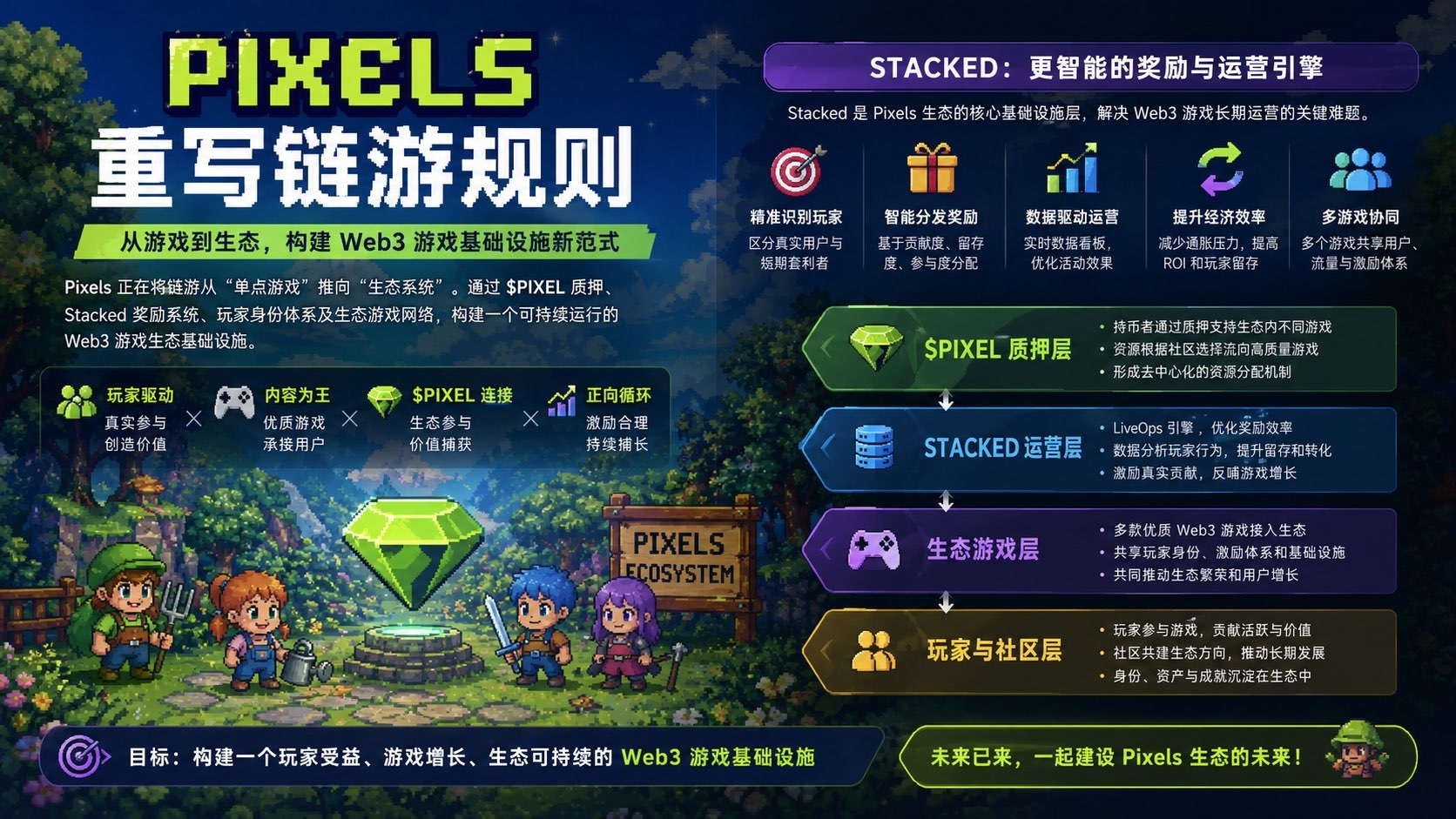
The real talking point for Pixels isn't about how many veteran players it has or how hot it once was; it's about how it's pushing blockchain games from 'single-point games' toward an 'ecosystem.' In the past, many blockchain game projects resembled closed islands: players completed tasks, earned rewards, sold tokens, and then left. To maintain activity, project teams had to keep adding tasks, events, and rewards. It looked lively, but it was actually a high-consumption model. What sets Pixels apart is that it places $PIXEL in a broader ecological context, making the token not just a reward outlet, but a part of ecosystem participation, game support, resource distribution, and long-term incentives. This change is crucial because once a token is solely responsible for 'distributing rewards,' it can easily be consumed by short-term behaviors. But if the token can transform into a tool for ecosystem coordination, its logic changes completely.
Stacked is a crucial layer within this ecosystem. Many people hear 'reward system' and think it's just an extra task panel or more activities to claim rewards. But Stacked is more like a suite of LiveOps tools designed around player behavior, retention, reward efficiency, and game growth. The problem it addresses isn't 'how to issue more rewards,' but 'who should receive those rewards, when they should be issued, how much to give, and whether it truly improves the ecosystem afterwards.' This is actually a capability that Web3 games have been lacking. Previously, project teams often only knew how to distribute rewards but struggled to determine if they reached truly valuable players. The result was a lot of resources flowing to short-term arbitrageurs, while genuine players didn’t receive a satisfactory experience or incentives. If Stacked can keep running smoothly, it's essentially equipping blockchain games with a smarter reward engine.
From this perspective, Pixels isn't simply upgrading the 'play-to-earn' model; it's trying to transform rewards from broad subsidies into refined operations. I think this direction is significant because for blockchain games to truly enter the next stage, they can't rely solely on token incentives or emotional marketing. A genuinely healthy model should allow players to stick around for the content, continue participating for social reasons, create a foundation through assets and identities, and have the reward mechanism recognize contributions, ultimately forming a positive cycle for the entire ecosystem. The player data, game experiences, and community foundations that Pixels has accumulated in the past are precisely the fertile soil for Stacked's experimentation. In other words, Stacked is not a concept born out of thin air; it’s a tool that has grown out of Pixels’ long-term operation.
What's really worth paying attention to is how Pixels' ecosystem changes are shifting the positioning of $PIXEL. In the past, many viewed game tokens primarily through the lens of 'how much they produce, how much they consume, and whether there's inflation.' While those questions are certainly important, we should now be asking: Can $PIXEL become the connective layer of the entire ecosystem? If staking can influence the distribution of game resources, if stacking can enhance reward efficiency, and if more games can integrate to share player identities and incentive systems, then $PIXEL won't just be a token in one game; it could become a core participation certificate within the Pixels ecosystem. This potential is far greater than merely discussing short-term price fluctuations.
I think the most interesting thing about Pixels is that it doesn't simplify the issue of blockchain game failures to 'a bad market' or 'players not understanding long-term value.' Instead, it addresses a more pragmatic question: If rewards are to exist, how can we ensure they don't harm the ecosystem? If tokens are to participate in games, how can we ensure they aren't just mined and sold? If players want to both play and earn, how can we make the balance between real contributions and rewards fairer? These questions may seem basic, but they are key to whether blockchain games can reach the mainstream. Stacked consolidates these issues into one system, which is its biggest differentiator from ordinary task platforms.
So, I don't see Pixels as just an old-school blockchain game project. More accurately, it’s transforming from a game into a methodology for Web3 game ecosystems. The game is just the entry point, $PIXEL is the connective layer, Stacked is the reward and operations layer, and the staking mechanism allows players and token holders to engage in the ecosystem's direction. Once this structure gets into full swing, it will be entirely different from the past model where 'project teams unilaterally issued rewards, and players received them unilaterally.' It’s more like letting every participant in the ecosystem start to take on roles: players provide genuine activity, games provide content support, stakers express choices, Stacked optimizes incentive efficiency, and $PIXEL captures system value.
Currently, the blockchain trend is shifting from pure narratives back to real applications, and blockchain games will undergo the same filtering. Projects that rely solely on short-term rewards will ultimately be seen through by the market; only those that can retain users, ensure effective rewards, give tokens roles, and allow ecosystems to expand will likely enter the next round. @Pixels is right on the pulse of this shift. It's not repeating the old stories of the last round of blockchain games but is attempting to build a more sustainable ecosystem of rewards and gameplay. As for the value of $PIXEL, it shouldn't just be dictated by short-term sentiments; it should depend on whether this ecosystem machine can keep running, continuously attract games, retain players, and transform rewards into growth. #pixel $PIXEL
