I didn’t walk into Pixels expecting anything meaningful. If I’m being honest, I thought it would be just another Web3 game trying to hold attention with rewards and numbers. But the longer I stayed, the more I realized it wasn’t trying to impress me at all. It was doing something much quieter, something that doesn’t hit you immediately but settles in over time.
Pixels doesn’t feel like a game you rush through. It feels like something you return to without pressure. I’m logging in, not because I have to, but because I want to check on something small I left behind. A crop growing. A piece of land changing. A routine forming without me even noticing.
That’s the strange thing about it. It builds a rhythm around you.
Most games try to push you forward constantly. They want progress, competition, action. Pixels does the opposite. It slows you down. You plant something, you wait. You explore, but there’s no urgency. You gather, but not because someone is forcing you. And in that slowness, something starts to shift. You stop thinking about winning and start thinking about staying.
It’s built on the Ronin Network, which already has its place in blockchain gaming, but Pixels doesn’t lean too hard on that. It doesn’t try to prove anything through complexity. Instead, it creates a simple space where things grow at their own pace, including you as a player.
Farming is the center of everything, but it’s not just a mechanic. It’s a feeling. You’re planting, harvesting, repeating, but it never feels completely empty. There’s always a small sense of progress, even if it’s just one more crop or one small improvement to your land. And that land starts to matter more than you expect.
Because when you own something in Pixels, it changes how you look at it.
Your land isn’t just part of the game. It becomes a place you shape slowly. You decide what it becomes. You decide how it grows. And even though it’s all digital, it starts to feel personal in a way that’s hard to explain. Like a quiet corner that belongs to you.
Then there’s the world around you. Other players moving, building, doing their own routines. You don’t always interact, and that’s what makes it feel real. Not everything is forced. Sometimes you just exist in the same space, and that’s enough.
The crafting system ties everything together in a natural way. You collect things, you use them, you build something new. Nothing feels completely disconnected. Every action leads into another, and over time, those small actions start forming a bigger picture.
And somewhere in the middle of all this, the PIXEL token exists.
It’s part of the system, part of the reward, part of the structure holding everything together. You earn it as you play, and you can use it within the game or look at its value outside. That’s where people start thinking about exchanges like Binance, watching prices, trying to understand what their time is worth.
But here’s where things get complicated.
If you focus only on the token, Pixels might feel like just another system of numbers. Something to optimize, something to calculate. And if that’s all you see, you might miss what makes it different.
Because Pixels isn’t built around urgency. It’s built around continuity.
The tokenomics try to reflect that. There’s an effort to balance rewards so the system doesn’t collapse under its own weight. Too many tokens, and everything loses value. Too few, and players lose interest. It’s a delicate balance, and like every Web3 project, it’s not guaranteed to work perfectly.
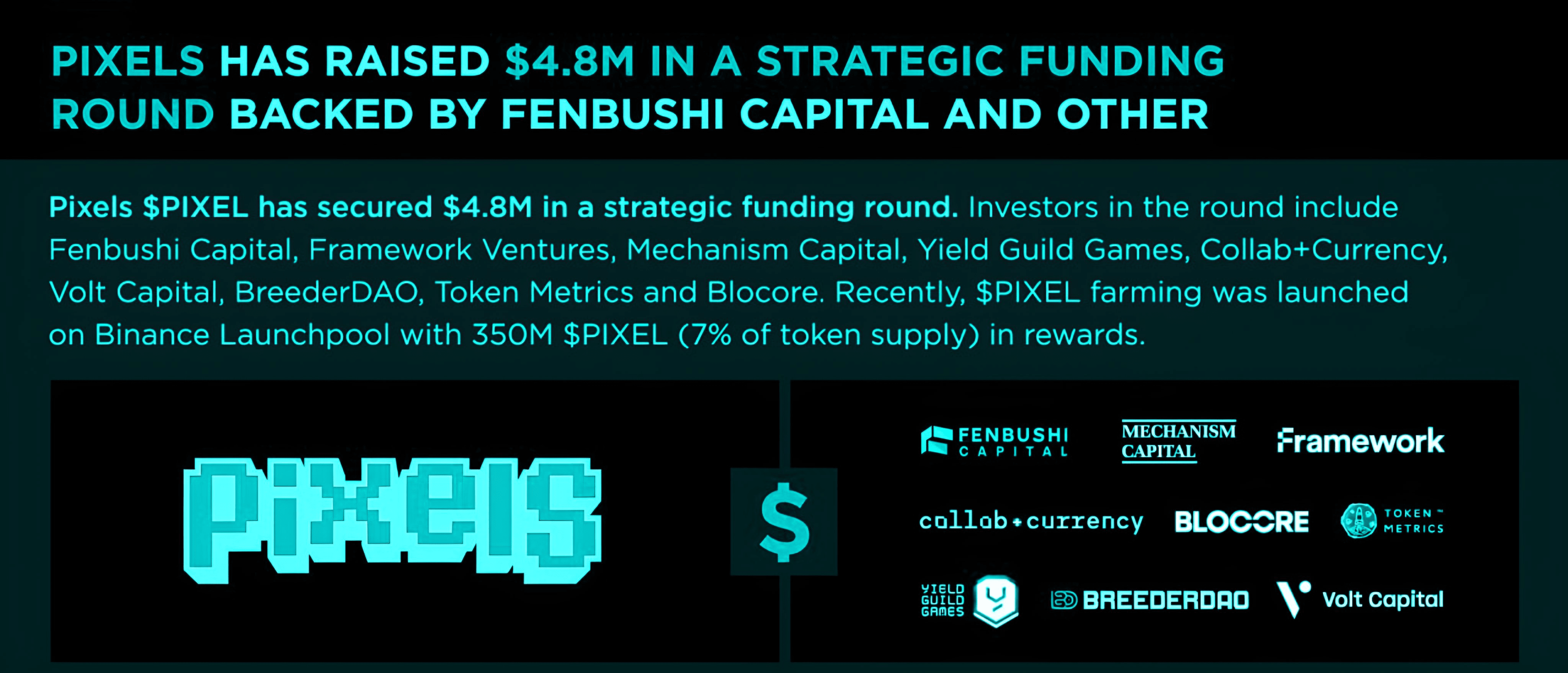
The roadmap shows a similar kind of patience. Features aren’t thrown in all at once. They’re added slowly, carefully. More depth to farming, better social layers, new ways to interact with the world. It feels less like a race to expand and more like a gradual unfolding.
But patience can be risky too.
Because if things move too slowly, people might drift away. The same calm routine that feels comforting can start to feel repetitive. And in a space where attention is always shifting, holding that attention without forcing it is one of the hardest things to do.
There’s also the reality of the market. If the token loses value, it changes how players feel, even if they don’t admit it. Time starts to feel different when it’s connected to something that can rise or fall overnight.
And beyond that, there’s the uncertainty of Web3 itself. Trends change fast. New projects appear, old ones fade. Pixels isn’t separate from that reality. It’s part of it.
Still, when I think about Pixels, I don’t think about charts or strategies first.
I think about how it feels to log in and see something I left behind still there, still growing.
I think about how rare it is to find something that doesn’t demand constant attention but still manages to stay in your mind.
And I think about how, in a space full of noise, Pixels chooses to be quiet.
It doesn’t promise a perfect future. It doesn’t try to convince you it will change everything. It just gives you a place where small things matter again. Where progress is slow but real. Where you’re not rushing toward an end, but simply continuing.
And maybe that’s why it stays with you.
Not because it’s the biggest or the most exciting.
But because it feels like something you can live inside, even if just for a little while.