
I keep noticing this slow tension when I spend time in Pixels.
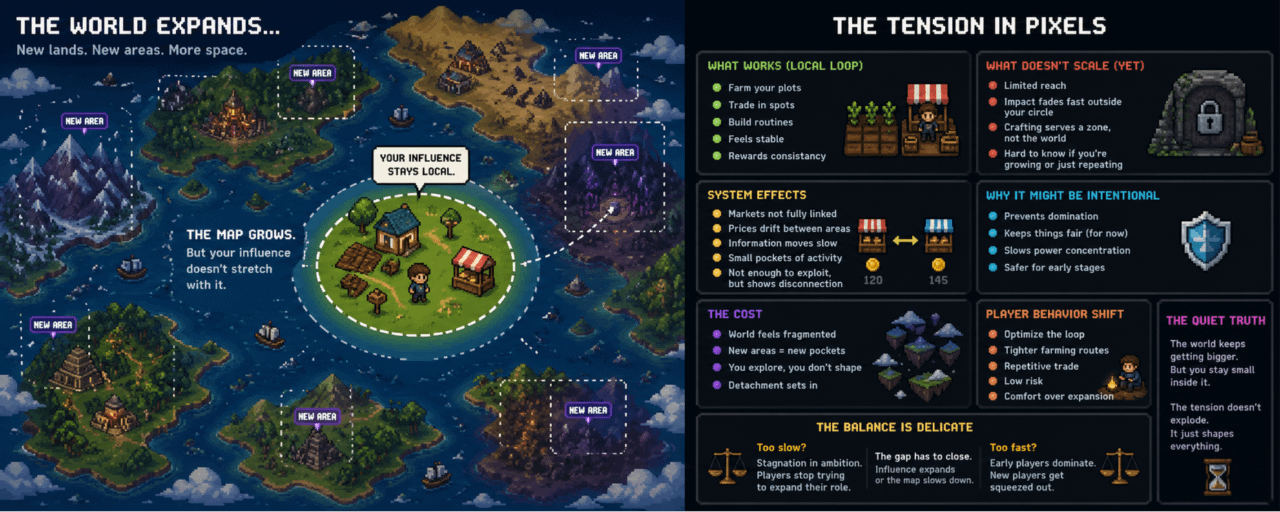
The world expands. New land shows up. New areas open. More space to move. It gives the feeling of growth. Like the system is getting bigger around me.
But my own influence does not stretch with it.
It stays close. Tight. Almost fixed.
I can farm my plots. I can trade in familiar spots. I can build small routines. That part works. It feels stable. But when I step outside that loop the effect fades fast. It is like I exist strongly in a small circle and barely exist outside it.
At first this feels normal. Early stage systems often limit reach. They want players to build from the ground up. But here the map is not waiting. It keeps expanding anyway. That creates a mismatch.
Usually in these systems expansion comes after influence. Players grow power first. Then the world opens to match it. Here it feels reversed. The world moves first. The player lags behind.
That shift matters.
Because it changes how value forms.
If my influence is local then my decisions only matter locally. Even if the map is wide the impact is narrow. So the system ends up with many small pockets of activity instead of strong connected flows.
You can see it in how trading feels. Markets exist but they do not fully link. Prices can drift between areas. Information moves slower than the map expands. That creates small inefficiencies. Not big enough to exploit deeply. But enough to show that the system is not fully connected.
Crafting has a similar feel. You can build something useful. But its reach is limited. It serves a zone not the whole world. So scaling becomes unclear. You are not sure if you are growing or just repeating inside a box.
This is where the design gets interesting.
It almost feels intentional.
By keeping influence local the system avoids early domination. No single player or group can stretch across the whole map too fast. That keeps things fair on the surface. It also slows down power concentration which is a common problem in open economies.
But there is a cost.
When influence stays local for too long the world starts to feel fragmented. Expansion loses meaning. New areas are just new pockets not part of a larger system. You explore them but you do not shape them.
That creates a strange kind of detachment.
You move through space but you do not leave a mark.
In stronger systems expansion usually comes with tools. Faster movement. Wider trade reach. Better information flow. Some form of leverage that lets players project influence outward. That is how the world starts to feel alive. Actions in one area ripple into another.
Here those tools feel limited or delayed.
So the map grows but the connective tissue stays thin.
There is also a behavioral effect.
Players start optimizing for their local loop instead of thinking globally. Farming routes get tighter. Trade becomes repetitive. Risk stays low because stepping out does not give enough upside yet. The system quietly encourages comfort over expansion even while visually promoting growth.
That is a subtle contradiction.
It does not break the system but it shapes how people play it.
What feels solid is the base loop. Local activity works. It is predictable. It rewards consistency. You can settle into it and feel progress.
What feels less clear is the long term structure. How does a player move from local to global influence. What unlock actually changes that. And when.
If that transition is too slow the system risks stagnation. Not in activity but in ambition. Players keep playing but stop trying to expand their role.
If it comes too fast the opposite problem appears. Early players take over large parts of the map and new players get squeezed out.
So the balance here is delicate.
Right now it feels like the system is still leaning toward safety. Keep influence small. Let the map grow. Watch how players behave.
That is fine for early phases.
But at some point the gap has to close.
Either influence expands or the map slows down.
Otherwise the world keeps getting bigger while each player stays small inside it.
And that tension does not explode. It just sits there quietly shaping everything.