

I’ll be honest, I wasn’t actively looking for another Web3 game when Pixels showed up on my radar. If anything, I’ve become a bit cautious with anything labeled “crypto gaming.” We’ve all seen how that cycle played out before. Big promises, short-lived hype, and economies that couldn’t survive once the initial wave of users slowed down. So when I first heard about a pixel-style farming game running on Ronin, my instinct wasn’t excitement. It was curiosity mixed with a little skepticism.
But the more I looked into Pixels, the more I realized this isn’t really about farming at all. It’s about timing. And right now, timing in crypto feels like everything.
From what I’m seeing, the market has been quietly shifting again. Not in the loud, chaotic way like previous bull runs, but in a more subtle rotation of narratives. Infrastructure had its moment, then AI integrations started grabbing attention, and now there’s this quiet re-emergence of consumer-focused applications. Things people can actually use, not just speculate on. That’s where Pixels caught my attention. It doesn’t try to position itself as revolutionary tech. It just tries to be something people actually want to spend time on.
And honestly, that’s a much harder problem to solve than most people think.
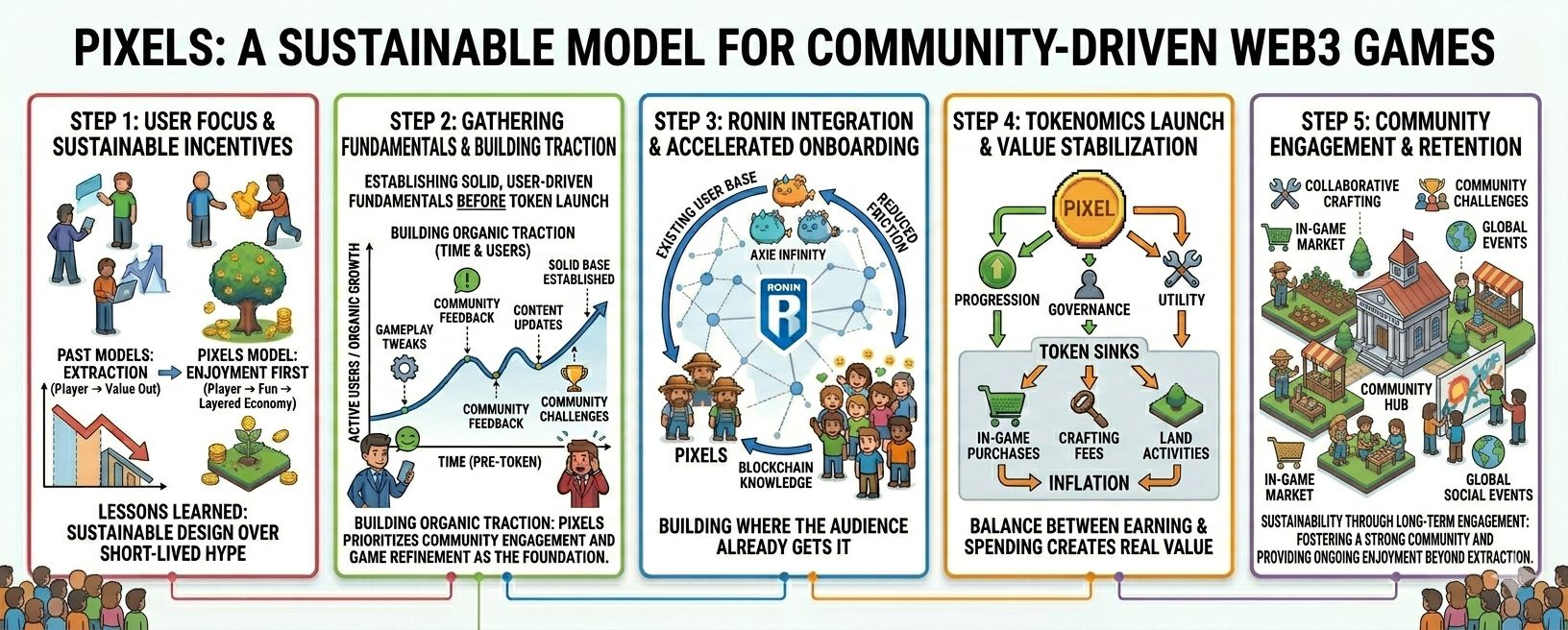
The core issue with most Web3 games hasn’t been graphics or even gameplay mechanics. It’s been incentives. Too many projects built economies where players showed up for extraction, not enjoyment. The moment rewards slowed down, users disappeared. It created this loop where developers had to constantly inject value just to keep things alive. That’s not sustainable, and I think most of the market has learned that lesson the hard way.
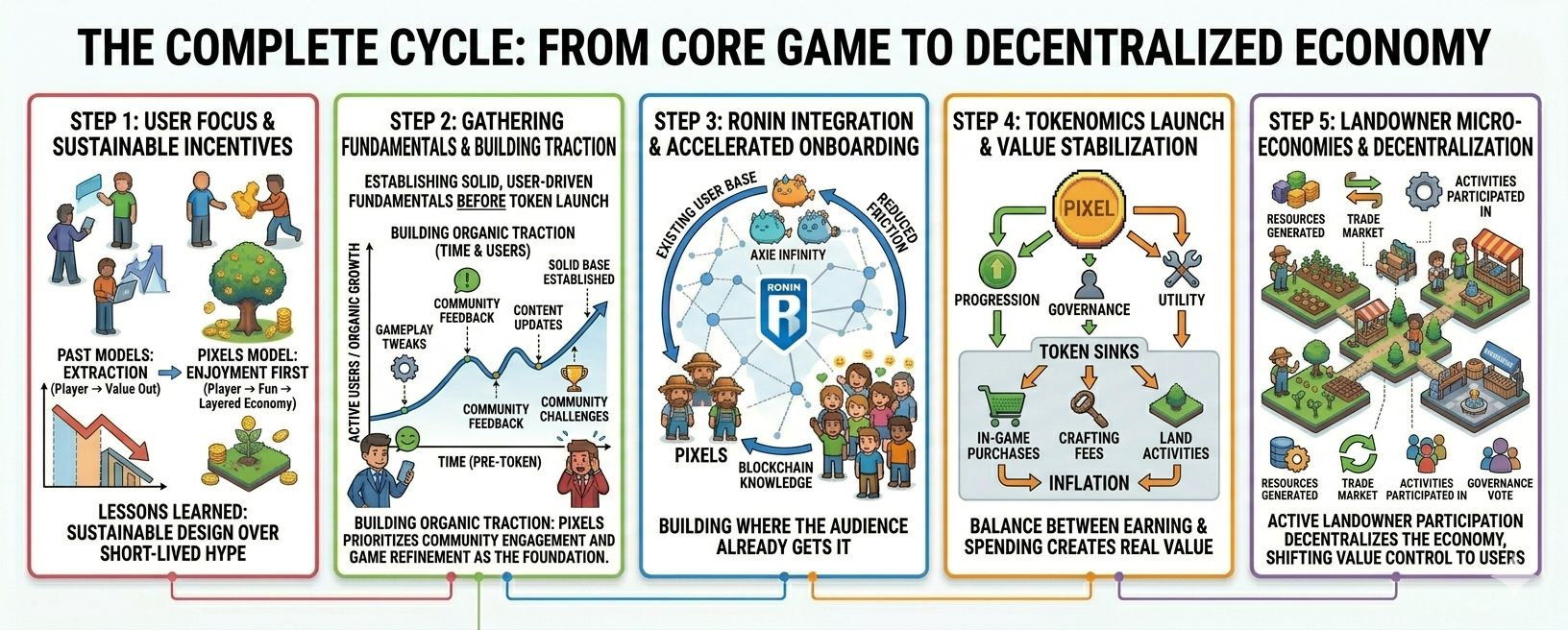
Pixels seems to be approaching this differently. Instead of building a game around token rewards, it feels like they’re trying to build an actual game first, then layering the economy on top of it. That distinction sounds small, but it changes everything.
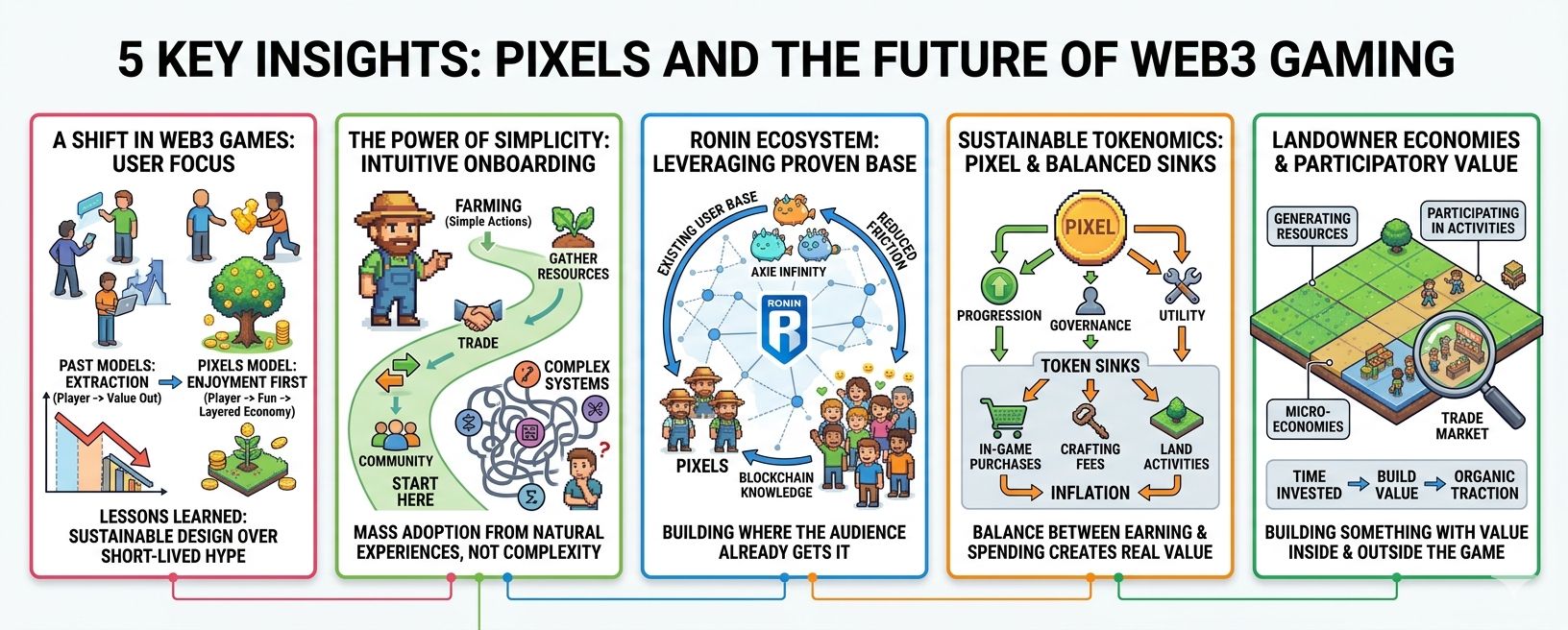
When I spent time understanding how Pixels works, it felt surprisingly simple in a good way. You’ve got an open-world environment where players can farm, gather resources, trade, and interact with others. Nothing groundbreaking on the surface. But the way ownership is structured through land, assets, and progression adds a deeper layer. You’re not just playing for points. You’re building something that has value both inside and outside the game.
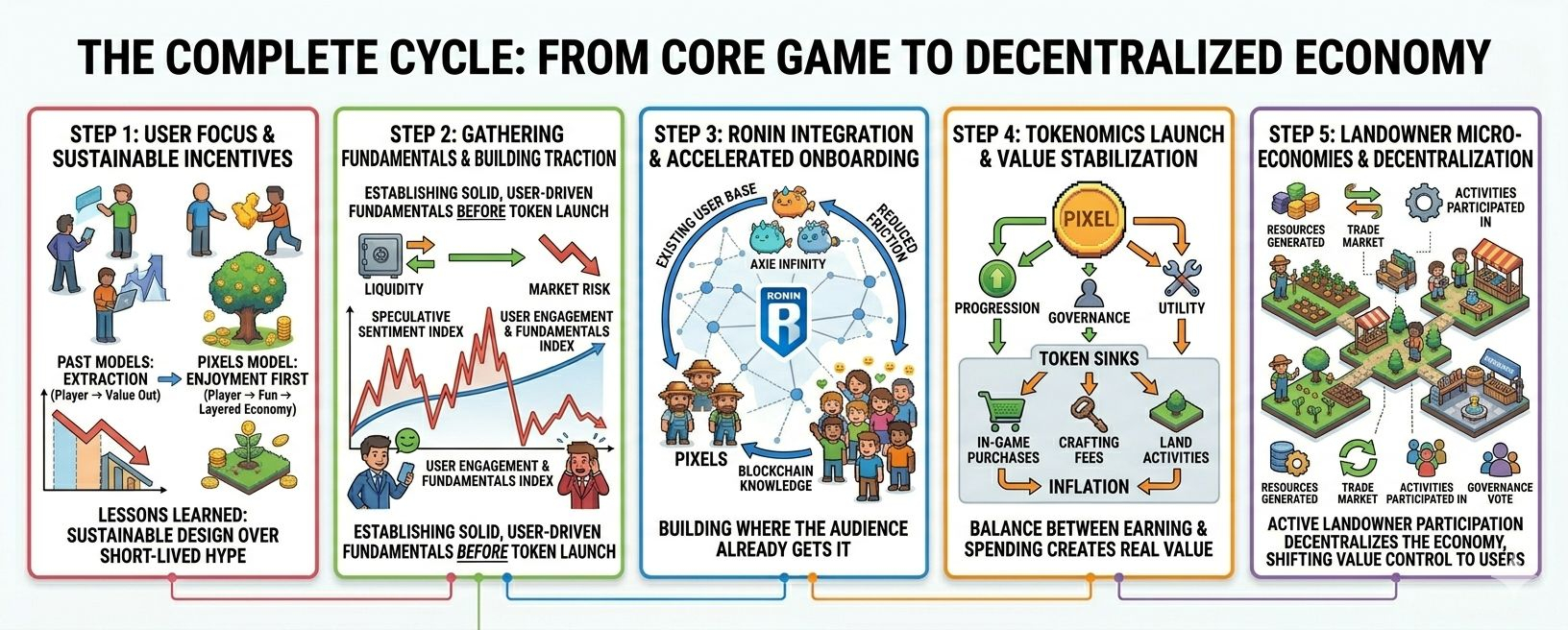
The move to Ronin also feels intentional. Ronin already has a proven user base from Axie Infinity, and more importantly, it has users who understand blockchain gaming mechanics. That reduces friction. It’s not starting from zero. It’s building in an environment where the audience already gets it.
What I found interesting is how Pixels handles its token dynamics. The PIXEL token isn’t just thrown around as a reward for every action. It’s integrated into progression, governance, and utility within the ecosystem. There are sinks built into the system, which is something a lot of earlier projects ignored. Without sinks, tokens just inflate until they lose meaning. Here, there’s at least an attempt to create balance between earning and spending.
I’ve noticed that the land system also plays a big role in how the economy functions. Landowners can generate resources, participate in different activities, and essentially create micro-economies within the game. It reminds me a bit of early metaverse concepts, but in a much more grounded and usable form. Instead of selling a vision of a digital world that might exist someday, Pixels is already functioning as one, even if on a smaller scale.
But what really made me pause wasn’t the mechanics. It was the traction.
There’s something different about a project when you see actual user activity instead of just token price movement. Pixels has been quietly building a user base that logs in consistently. Not because they’re chasing airdrops, but because they’re actually playing. That’s rare. In crypto, “active users” can sometimes be misleading. But when you see organic engagement in a game environment, it tells you something deeper is working.
At the same time, I don’t think it’s fair to ignore the risks here. Web3 gaming is still one of the hardest sectors to get right. Even with better design, there’s always the challenge of balancing fun with financial incentives. Lean too much into rewards, and you attract extractive behavior. Focus too much on gameplay, and you risk losing the crypto-native audience that expects some form of earning.
There’s also the broader market risk. If liquidity tightens or sentiment shifts again, gaming tokens tend to feel it quickly. They’re often seen as higher risk compared to infrastructure plays. That’s just the reality of how capital flows in this space.
Another thing I’ve been thinking about is competition. Pixels isn’t alone in trying to fix Web3 gaming. There are other projects experimenting with similar ideas, some with bigger budgets or more advanced tech. The difference, at least from what I can tell, is execution speed and simplicity. Pixels doesn’t try to overcomplicate things. It leans into a familiar style, keeps onboarding relatively smooth, and focuses on retention.
And maybe that’s the underrated part here.
I think a lot of people underestimate how powerful simplicity can be in crypto. We’ve spent years building complex systems that only a small percentage of users fully understand. But mass adoption probably won’t come from complexity. It’ll come from experiences that feel natural, even if the underlying tech is sophisticated.
Pixels feels closer to that direction than most projects I’ve looked at recently.
One thing I didn’t expect, but now can’t stop thinking about, is how Pixels might be tapping into something beyond just gaming. It’s creating a digital environment where time spent actually matters. Not in a speculative way, but in a participatory way. That’s a subtle shift. Instead of asking users to invest money first and hope for returns, it allows them to invest time and gradually build value.
That changes the entry point completely.
For someone new to crypto, buying tokens and navigating wallets can still feel intimidating. But logging into a game and starting to farm? That’s intuitive. If Pixels can keep that experience smooth while gradually introducing Web3 elements, it might onboard a different kind of user than we’ve seen before.
Of course, the big question is sustainability. Can this model hold up over time? Can the economy remain balanced as more users join? Can it avoid the boom-and-bust cycles that defined earlier Web3 games?
I don’t think anyone has a definitive answer yet. And that’s part of what makes it interesting.
From where I’m sitting, Pixels feels less like a finished product and more like an ongoing experiment. But it’s an experiment happening at the right time, in the right environment, with lessons learned from previous cycles. That doesn’t guarantee success, but it definitely improves the odds.
I’ve also been thinking about how narratives evolve in crypto. Sometimes it’s not the most advanced project that wins. It’s the one that aligns best with what the market is ready for. Right now, the market seems to be looking for real usage, not just theoretical potential. Projects that can show actual engagement tend to stand out more.
Pixels seems to be leaning into that.
Still, I can’t shake the feeling that we’re watching something early take shape. Not necessarily the final version of what Web3 gaming will become, but a step in that direction. Maybe even a test case for how economies and gameplay can coexist without one destroying the other.
And that leaves me with a question I keep coming back to.
Is Pixels the beginning of a more sustainable model for Web3 games, or is it just another phase in a longer cycle of experimentation that hasn’t fully figured itself out yet?
I don’t have a clean answer. But I do know this. For the first time in a while, I’m looking at a crypto game and thinking less about token charts and more about user behavior. And that shift alone feels worth paying attention to.
