

There is a specific moment in the evolution of a game token that is worth paying attention to, and it tends to arrive quietly rather than through a formal announcement. It is the moment when the token stops being the thing you spend inside the game and starts being the thing you hold in order to earn something else. In PIXEL, that moment appears to be either arriving or already behind us, depending on how you read the recent directional signals around reward structure. The shift toward USDC and stablecoin rails for reward distribution, while PIXEL moves toward a staking role, is not a minor operational adjustment. It is a reclassification of what the asset actually is, and the utility framing that has surrounded PIXEL since its launch does not quite fit the shape of the thing being described anymore.
I want to think through what this reclassification means in concrete terms, because the word utility covers a wide range of asset behaviours and it is worth being precise about which of them are still present and which have quietly departed.
To trace the shift at each stage, the original design logic ran roughly as follows. PIXEL was the native currency of the Pixels ecosystem. Players earned it through gameplay, spent it on in-game assets, used it to access features, and held it as a representation of their participation in the economy. The token's value was at least partially grounded in the activity happening inside the game because the game was the primary source of demand for the token. Studios integrating Stacked distributed PIXEL to players as rewards, which created a flow from platform emissions to player wallets and back into the ecosystem through spending. The circuit was imperfect and subject to the usual pressures of token economies, but the general shape of it was recognisable as a game currency with utility attached to a specific product.
#pixel The new shape looks different. If rewards to players shift to USDC, the demand driver that came from players needing to acquire PIXEL in order to participate, or valuing it because it represented earnings from participation, is substantially weakened. Players receiving USDC do not need to touch PIXEL at all. They receive a stable asset, spend or hold it, and their relationship to the game's native token is at most secondary. The question of whether PIXEL goes up or down becomes less relevant to their experience because they are no longer denominated in it.
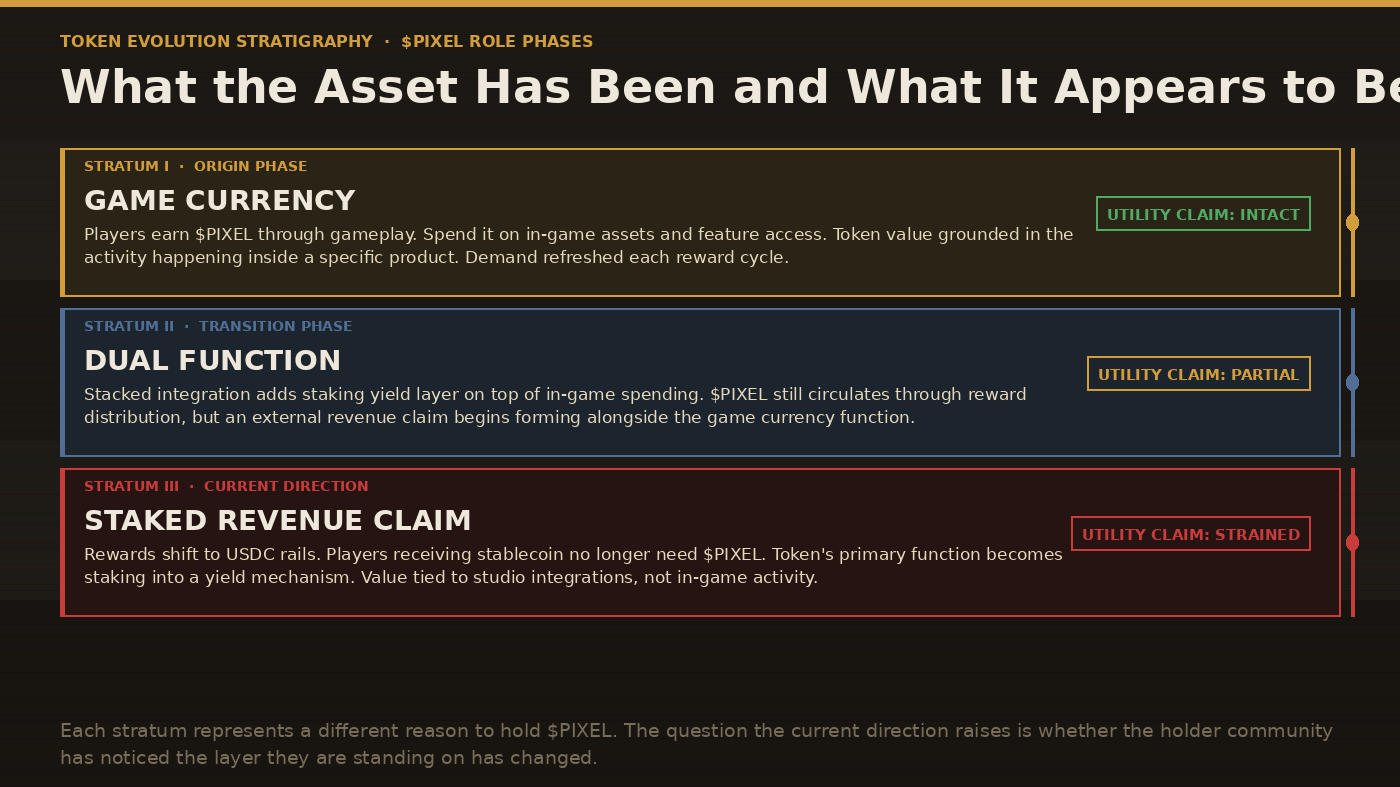
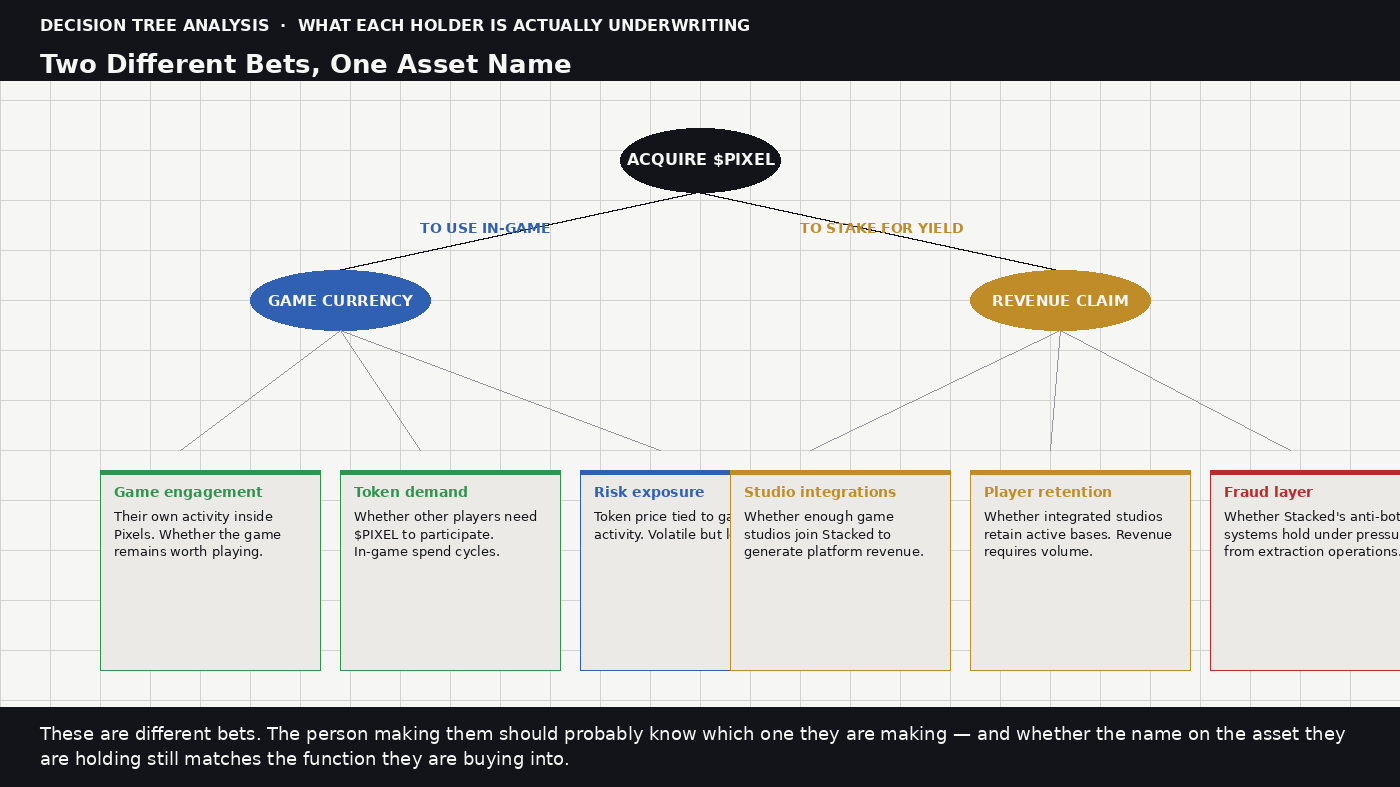
What remains for PIXEL in this structure is the staking role. Holders of PIXEL stake the token in order to earn a share of the platform's revenue, which is now flowing partly through USDC rails. This is a recognisable financial instrument. A token that entitles the holder to a proportional share of platform revenue in exchange for locking capital is structurally closer to a revenue-share certificate than to a currency. What the holder is actually doing at that point is something closer to placing capital into a revenue-sharing arrangement with a platform business. The game itself sits somewhere in the background of that arrangement, but the token's performance no longer depends on whether anyone is actively playing it. It depends on whether Stacked continues to attract studio integrations, whether those studios retain active player bases, and whether the fraud layer holds well enough to keep the reward economy credible. Those are legitimate things to underwrite. They are just not what a game currency does.
That is where I find the utility label beginning to slip. The standard account of a utility token is that its value comes from people needing it to do something inside the system it belongs to. Access, payment, progression, reward eligibility the specific mechanism varies, but the general idea is that demand for the token is generated by the activity happening inside the product. When the primary use case becomes staking into a yield mechanism that distributes a different asset entirely, that account stops describing what is actually happening. The token is still technically inside the ecosystem. But the reason to hold it has changed considerably from the reason that was originally given.
That distinction is not merely semantic. It changes who the natural holder of the asset is, what they are underwriting when they acquire it, and what risks they are actually exposed to. A player buying $PIXEL in order to participate in the game is underwriting the game's continued engagement and their own activity within it. A holder buying PIXEL in order to stake it and earn USDC yield from Stacked's platform revenue is underwriting the platform's ability to generate that revenue consistently, which is a function of how many studios integrate, how active the player bases of those studios are, and how well the fraud resistance holds across the network. These are different bets, and the person making them should probably know which one they are making.
The further complication is that the shift to USDC rewards, while it introduces stability for the players receiving them, also removes a structural source of demand for PIXEL that the earlier design relied on. Every reward distribution in PIXEL was, in some sense, a demonstration of the token's function. Players received it, held it, spent it, or converted it, and each of those actions was part of the token's economic life cycle. A reward distribution in USDC bypasses that life cycle entirely. The token is still staked, the yield still accrues, but the evidence that PIXEL is a currency with active use inside a game economy is no longer being refreshed with each reward cycle.
None of this is straightforwardly negative. A stablecoin reward model is, for many players, a more honest and useful system than one denominated in a volatile native token. USDC-denominated rewards do not lose purchasing power between distribution and conversion. They do not require players to make implicit bets on token performance in order to realise the value of their participation. The shift is arguably better for the players receiving rewards. The question is what it does to the coherence of the PIXEL asset's identity, and whether the people holding it have updated their understanding of what they are holding to match what it has become.
What I keep returning to is a fairly narrow question. At the point where PIXEL's primary function is staking into a revenue share mechanism that distributes USDC, the asset is behaving like a claim on an external business rather than a currency inside a game. Whether the people who originally acquired it as a game currency have noticed that the thing they are holding has changed shape is something I genuinely cannot determine from the outside. But the utility framing that was used to describe its initial function and the staked revenue claim it appears to be becoming are not the same description of the same asset.