
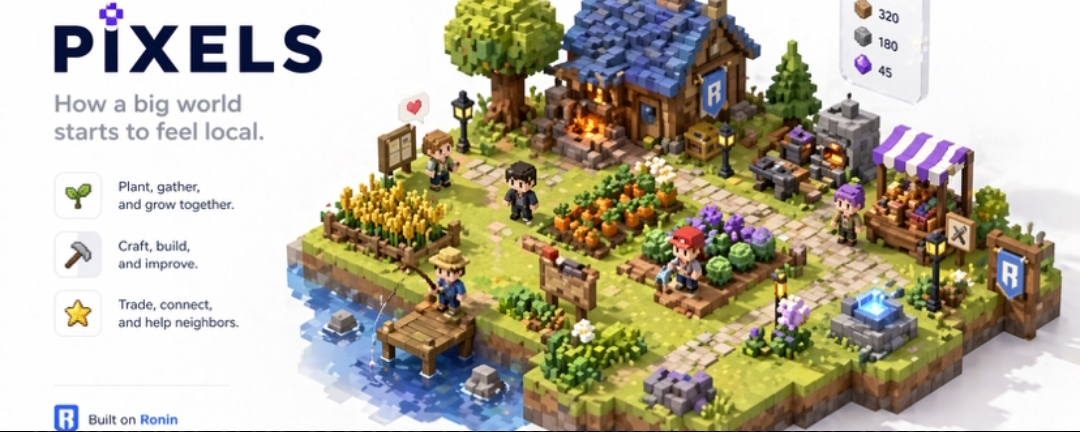
@Pixels doesn’t try to impress you right away.
That’s actually the first thing that makes it interesting.
A lot of Web3 games arrive like they’re giving a speech. They talk about ownership, rewards, tokens, economies, roadmaps, and the “future of gaming” before you even know whether the game itself is fun.
Pixels feels different.
It starts smaller.
You see a little field. A tiny character. Some crops. A few tasks. Maybe a pet. Maybe a piece of land someone owns. Nothing looks dramatic. Nothing screams for attention. It almost feels too quiet for crypto.
But that quietness is the point.
Pixels is not trying to win people over with noise. It’s trying to build a habit.
You log in. You do a few things. You collect something. You improve something. You check what changed. Then you leave, and maybe later, you come back.
That sounds simple, but simple routines are powerful. Most lasting online games are not built only on hype. They are built on the small reasons people return on an ordinary day.
Not for a big announcement.
Not for a reward campaign.
Just because the world feels like it still has something waiting for them.
Pixels understands that better than many Web3 games.
At its heart, Pixels is a farming and social game built around land, resources, crafting, quests, pets, guilds, and the PIXEL token. It runs on Ronin, a blockchain network already known for gaming. That gives it a stronger foundation than games that launch on chains with no real gaming culture.
But the more interesting part is not the chain.
It’s the feeling.
Pixels looks like a cozy farming game, but underneath it, there’s a real economy trying to breathe.
That is where the tension begins.
In a normal farming game, you plant crops because the game tells you to. You harvest them, sell them, upgrade your tools, and enjoy the slow progress. The reward is emotional. You feel like your little world is growing.
In Pixels, that same action can carry extra weight.
Land can matter. Resources can matter. Tokens can matter. Guilds can matter. Pets can matter. The things you do inside the game may connect to access, value, utility, and status.
So a simple question appears:
Are people playing because they enjoy the world, or because they see something to gain from it?
The honest answer is probably both.
And that’s not a bad thing.
Games have always had economies. Players have always cared about rare items, better gear, status, rankings, land, skins, and social power. Web3 simply makes some of those things more visible and more tradable.
Pixels is interesting because its economy doesn’t feel completely random. It fits the theme.
A farming world naturally understands ownership. Land makes sense. Resources make sense. Crafting makes sense. Markets make sense. Guilds make sense. If any kind of game can make Web3 mechanics feel normal, a farming game has a real chance.
That doesn’t mean it’s easy.
Actually, this is where Pixels has to be very careful.
The PIXEL token can help the game feel deeper. It can give players more ways to participate. It can support upgrades, access, memberships, guild features, and other parts of the ecosystem.
But if the token becomes too loud, the game changes.
Suddenly, players stop seeing a field.
They see a calculation.
They stop asking, “What should I do next?”
They start asking, “What gives the best return?”
That shift can be dangerous.
Because once every action feels financial, the softness disappears. The game becomes less like a place and more like a job.
Pixels has to avoid that.
It needs PIXEL to matter, but not dominate. It needs ownership to feel useful, but not unfair. It needs rewards, but not a system where only grinders, bots, or early players feel ahead.
That balance is the whole game.
The move to Ronin helped because Ronin already has a community that understands blockchain gaming. Players there are more used to wallets, assets, and digital economies. That makes onboarding easier than it would be somewhere completely unfamiliar.
But even with a good network, the game still has to stand on its own.
No blockchain can make people care.
Only the world can do that.
This is why Pixels’ quiet style matters. The pixel art is not just decoration. It lowers the pressure. It makes the game feel friendly. It reminds people of older browser games, cozy farming games, and simple online spaces where the goal wasn’t always to win.
Sometimes, the goal was just to be there.
That kind of feeling is rare in Web3.
A lot of crypto games feel like products first and games second. Pixels has a better chance because it begins with something people already understand.
Planting.
Collecting.
Building.
Returning.
Those are human actions. They don’t need a long explanation.
But Pixels becomes more layered when guilds enter the picture.
A solo player farms for personal progress. A guild thinks differently. A guild asks who should gather what, who controls which resources, who gets access, who contributes, who benefits, and who can be trusted.
That turns the game into something more social.
And more political.
Every online world eventually develops little social classes. Some players are early. Some are late. Some own land. Some rent access. Some lead guilds. Some quietly grind. Some know the system. Some are still learning.
Pixels has all of that.
The cute visuals make it feel light, but the structure underneath can become serious.
That’s not a flaw. It’s part of what makes online worlds feel alive.
A game with no social tension can become boring. But a game with too much hierarchy can become exhausting. Pixels needs guilds to create belonging, not just efficiency.
That difference matters.
A good guild makes players feel like they are part of something.
A bad guild turns the game into unpaid work with a group logo.
Pixels has to keep that human side alive.
The updates around skills, crafting, industries, and land progression also show that Pixels is still trying to grow beyond a basic farming loop. That is important because simple gameplay can attract people, but it needs depth to keep them.
If all you can do is repeat the same tasks forever, people leave.
But if the world keeps opening slowly, players start to form plans.
Maybe they focus on crafting.
Maybe they care about land.
Maybe they join a guild.
Maybe they chase better resources.
Maybe they just play casually and ignore the deeper economy.
The best version of Pixels allows all of those players to exist together.
That is harder than it sounds.
Too much complexity, and casual players feel lost.
Too little depth, and serious players get bored.
Too many rewards, and bots arrive.
Too few rewards, and the Web3 crowd loses interest.
Too much focus on token value, and the game loses its soul.
Too little focus on token utility, and the economy feels pointless.
Pixels is walking through all of that at once.
That’s why it still feels like a system deciding what it wants to become.
It could become a lasting social farming world.
It could become a guild-driven economy.
It could become a broader Web3 gaming platform.
It could also become just another token game if the economy becomes louder than the experience.
Nothing is guaranteed.
But there is something honest about where Pixels stands right now.
It doesn’t feel finished. It feels active. Changing. Testing. Adjusting. Trying to figure out how much economy a cozy game can carry before the cozy part starts to crack.
That question is bigger than Pixels.
It’s one of the biggest questions in Web3 gaming.
Can a game include real ownership without turning every player into a trader?
Can it reward time without attracting only farmers and bots?
Can it give value to assets without locking new players out?
Can it build a market without losing the feeling of a world?
Pixels is one of the few games where that question feels natural, because farming already teaches patience, ownership, and production. A farm is not built in a day. Neither is a game economy.
The strongest thing Pixels has is not just PIXEL.
It is not just Ronin.
It is not even land.
The strongest thing is that people can understand it quickly.
You don’t need to explain farming for twenty minutes. You don’t need to sell someone on the idea of a small world that grows over time. People get it.
That gives Pixels a doorway.
The challenge is what happens after people walk through it.
Do they find a real game?
Do they find a fair system?
Do they find a community?
Do they find reasons to return when rewards are not the main headline?
That last question matters most.
Because hype can bring people in, but only attachment keeps them around.
Pixels needs players who remember their land, their guild, their routine, their goals, and the small progress they made yesterday.
That is how a digital world becomes more than a product.
It becomes a place.
And maybe that is the real story of Pixels.
Not that it is the biggest Web3 game.
Not that PIXEL will solve everything.
Not that blockchain gaming has finally found its perfect formula.
The real story is quieter.
Pixels is trying to keep a little field alive while an economy grows underneath it.
That is a difficult thing to do.
Money changes the way people behave. Rewards change the way people play. Ownership changes the way people think. Once those things enter a game, the design has to work harder to protect the fun.
Pixels is still learning how to do that.
And that’s why it’s worth watching.
Because if it can keep players caring about the field, not just the value underneath it, then it has something rare.
A Web3 game that doesn’t only want attention.
A world that wants to be lived in.