
I Will Be Honest?
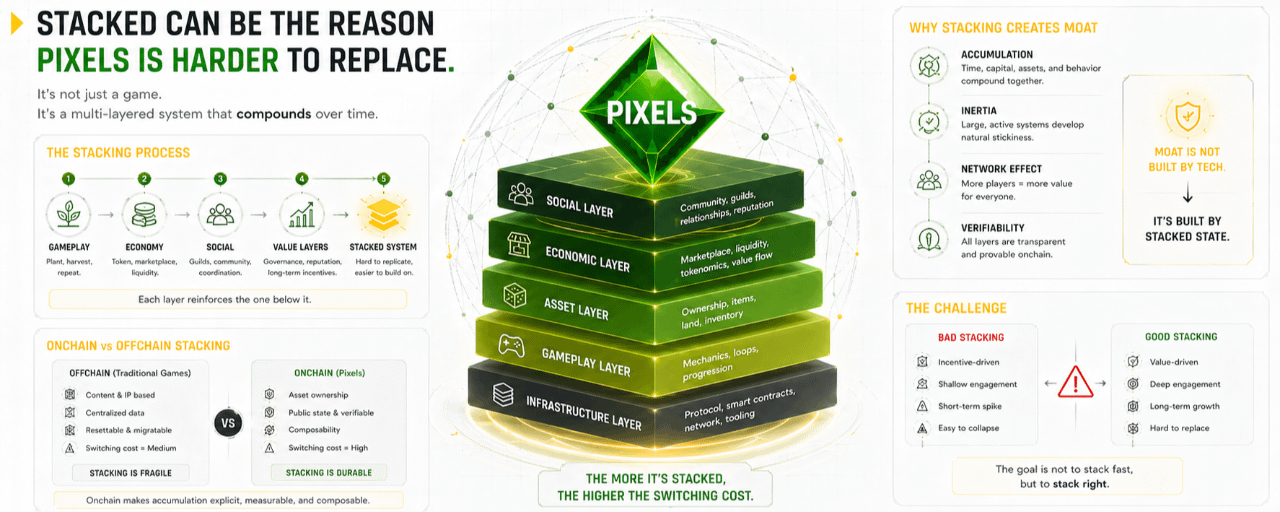
I think the easiest way to frame this is through the idea of “stacking.” Not stacking in the technical sense, but stacking as accumulated behavior, habits, capital, relationships, and shared history. In crypto, what becomes hardest to replace usually isn’t the product alone, but the system of things that have been built around it. Looking at Pixels this way shifts the conversation from “it’s just a farming game” to “it’s a system that keeps compounding across multiple layers.”
At the beginning, the gameplay is simple—plant, harvest, repeat. Very basic. But then the economy layer appears: tokens, marketplaces, trading loops. After that comes the social layer: guilds, coordination, community identity, shared routines. These layers don’t exist separately—they reinforce one another. Over time, they create a stacked system where replacing the game means replacing the entire structure around it.
At that stage, competition is no longer about features. It becomes a competition of accumulated state.
This is where the difference between onchain and offchain becomes interesting. Traditional games also build stacking, but mostly around content, IP, and brand. Players stay because of gameplay, nostalgia, or social attachment, while most of their assets and behavioral history remain inside a closed system that can eventually be reset or controlled by the platform.
With Pixels, the stacking extends beyond content. It includes ownership, transaction history, liquidity, and even social coordination that exists in a more visible and verifiable form. The system becomes a kind of public state. As more people participate, that state gains inertia—and inertia itself becomes a moat.
That same logic exists in offchain systems too. Large MMOs and social platforms survive because of years of accumulated habits and switching costs. But onchain makes that accumulation more transparent. You don’t just assume the system is strong—you can actually see the assets, liquidity, and participation that support it.
That’s why evaluating Pixels only by gameplay misses the bigger picture. The game itself may be simple and technically easy to copy, but copying code is not the same as copying a system. Rebuilding the economy, the liquidity, the player habits, and the social coordination from scratch is a completely different challenge.
Maybe the better question isn’t “what makes this game unique?” but “how much meaningful stacking has actually happened, and can it last?”
Because not all stacking has the same depth. If users are only farming short-term rewards and leaving, that stack is fragile. But if players are building relationships, holding assets, coordinating socially, and treating the system as part of their routine, then the stacking becomes much harder to unwind.
Still, stacking alone doesn’t guarantee sustainability. A project can stack quickly through aggressive incentives, but if those incentives don’t create real value, then the system is only building inflated weight, not real resilience.
The challenge is not stacking faster, but stacking correctly.
Each new layer should strengthen the previous one. The economy should support gameplay. Social systems should connect to value creation. Incentives should deepen retention rather than attract temporary extraction. If those layers don’t align, stacking becomes noise instead of strength.
This is where I think Pixels is still being tested. It has already built meaningful layers—users, economy, recognition, liquidity. But the real question is whether those layers form a durable structure or just reflect a temporary cycle.
Once a system becomes deeply stacked, its advantage often stops coming from innovation and starts coming from inertia. People stay not because there are no better alternatives, but because leaving becomes expensive—financially, socially, and psychologically.
That could also change how Pixels should evolve. Maybe the goal isn’t constantly chasing the next narrative, but strengthening the coherence of what already exists. Not more layers—better alignment between them.
Still, I remain cautious. Crypto has shown many times that systems that looked deeply entrenched could still be replaced when a new paradigm arrived. Entire forms of accumulated value can become irrelevant if the axis of the market shifts.
So maybe the final question isn’t how much Pixels has stacked, but whether what it has stacked is aligned with where the future is actually going—or whether it’s just deeply invested in a narrative that won’t last.