
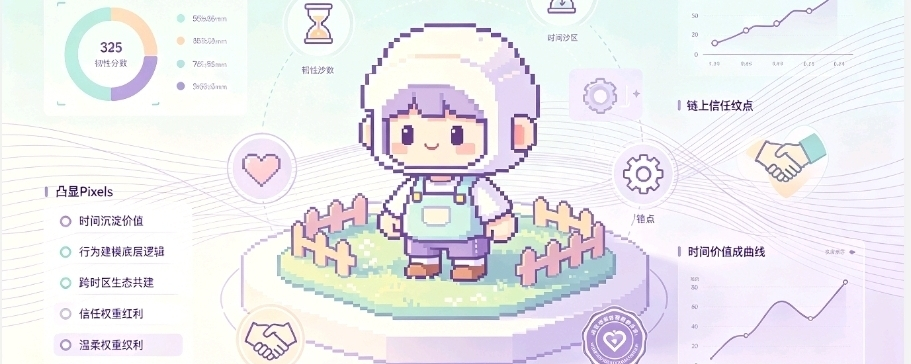
I've got a buddy who's been in the game for three years, starting with just a few plots of land and now collaborating across time zones in ecosystem building. Through all the pixel ups and downs, he's never considered exiting. Others don't get it, thinking it's a pointless grind, until the fundamental logic of Stacked started to emerge. I finally understood: he's not just playing a game; he's engaging in a trust arbitrage where time is the currency.
The brilliance of Stacked's design isn’t in a straightforward reward mechanism, but in a system of 'behavioral lifecycle modeling.' It doesn’t use complex jargon, yet subtly transforms users' login frequency, social interactions, and resource investments into quantifiable 'retention resilience scores.' The system doesn’t predict when you might exit; it senses subtle shifts in your status—like if you half-heartedly complete tasks for three days in a row, you might receive a rare item that aligns with your playstyle; or if your social interactions drop, you'll be matched with collaborators who share your interests.
This isn't just a simple retention strategy; it's treating players' 'time investment' as an asset that can accumulate. That veteran player’s 'hands-off' approach perfectly aligned with the algorithm's core: compared to short-term high-frequency trades, long-term stable behaviors can accumulate trust weight, which will eventually translate into implicit dividends within the ecosystem.
Most blockchain games are fixated on 'synchronized competition,' making players stay up late to grab rewards, while Pixels takes the opposite approach. It has built a cross-timezone collaboration network that allows outputs from players in the East 8 timezone to connect with the needs of players in the West Coast through an on-chain credit system. Transactions don't need to be instant, but trust can still accumulate; $PIXEL is no longer just a gaming token, but has become a 'trust anchor' for cross-regional value flow.
This system certainly contains insights into human nature — it leverages our reluctance to let go of 'long-term investment' and our desire for 'mutual recognition,' but the remarkable thing is that it doesn't treat players as passive victims of extraction. Stacked's semi-transparent design allows you to see your resilience score and even adjust your behavior to optimize your returns. This 'sense of being respected and involved' is far more effective in retaining people than one-way manipulation.
Now that Stacked is open to the public, $PIXEL has long surpassed the role of just a 'gaming currency.' It resembles a 'trust token' for cross-ecosystem collaboration, where connected projects use it to reduce collaboration costs, and players use it to realize the value of their time. Risks still exist, such as the economic balance across game ecosystems and the potential for external project abuse, which are challenges to be addressed. However, the team's confidence lies in the fact that trust is never built through coercive binding, but rather through the slow accumulation of time.
That veteran player hasn't sold a single piece of land or chased after high returns. He said: 'In the pixelated world, the most valuable thing isn't the tokens, but the confidence you have in spending time to cultivate your assets.' Perhaps this is the most unique aspect of #pixel : Stacked has algorithmically stitched together time and value, while players validate the weight of trust through their commitment. $PIXEL Whether it can become a universal currency across ecosystems remains uncertain, but it has already proven that in the digital world, what can withstand the test of time is the real connections that endure through cycles. #PİXEL
