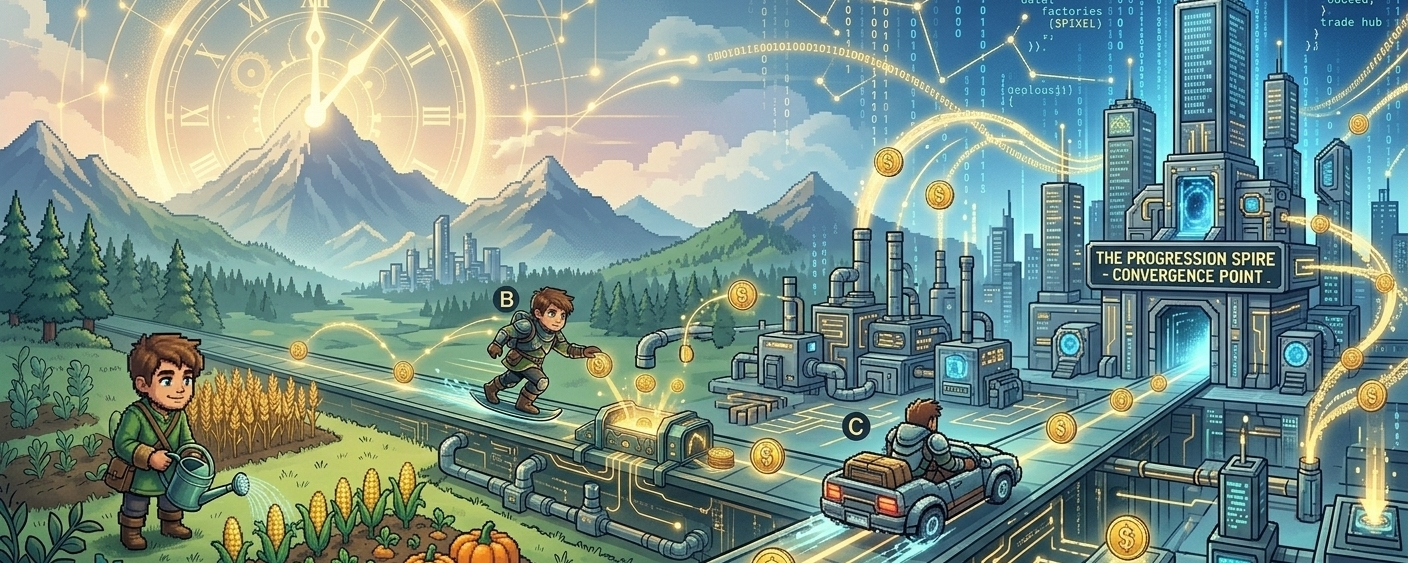
There’s a subtle pattern I’ve noticed across games—not just Pixels. Whenever something feels “relaxed,” it usually isn’t. It just hides where the real pressure exists. Farming-style games are especially good at this. You log in, water crops, wait, repeat. Nothing feels forced. But once you start noticing who progresses faster, that calm surface begins to crack.
Pixels gives off that same first impression. It feels soft, almost intentionally slow. You can drift through it without pressure. At first, I thought that was the whole idea—a cleaner, quieter version of play-to-earn. But after observing how players actually move through the system, it doesn’t feel evenly paced.
Some players stay in that slow loop. Others move past it fairly quickly.
And the difference isn’t always about skill or time. It often comes down to how they interact with $PIXEL—just not in an obvious way. That’s what makes it easy to overlook. The token doesn’t demand attention. It doesn’t dominate every action. It simply appears at certain moments… and those moments matter more than they seem.
That’s where most people misread it. On the surface, it’s just a premium currency—used for upgrades, convenience, maybe small boosts. That’s true, but incomplete. Because $PIXEL doesn’t just make things faster—it quietly determines which parts of the experience can be sped up at all.
That’s a very different role.
I remember watching a new player go through early tasks the long way—manual, slow, exactly how the game presents itself. Then compare that to someone making small, selective uses of $PIXEL. Not big spending—just tiny adjustments. A shortcut here, a faster step there. The gap doesn’t appear instantly. It stretches gradually… then stays. And once it stays, it compounds.
At that point, it feels less like traditional game design and more like system design. It’s not just about rewarding effort anymore—it’s about shaping how effort translates into progress. The same actions can lead to different outcomes over time. Not because one player is better, but because one moves through friction differently.
It’s similar to how some online systems handle priority. Everyone technically has access, but not everyone moves at the same speed. You don’t notice it right away because the baseline still works. But once you compare experiences, the difference becomes clear.
Pixels seems to follow that idea—just in a softer form. It doesn’t block you or restrict access. It simply raises a quiet question: how long are you willing to take?
That question changes behavior more than most reward systems.
Because now it’s not just “do I play?” It becomes “do I stay in this slower loop, or adjust it?” And once players start adjusting—even slightly—they tend to continue. Not aggressively, just enough to smooth inefficiencies. That’s likely where the real demand comes from—not large purchases, but small, repeated choices.
Still, there’s something slightly unresolved about it.
If a system starts subtly filtering who gets smoother progression, it also shapes who feels comfortable staying long-term. Some players won’t notice. Others will feel the gap, even if they can’t explain it. And over time, that feeling matters. It impacts retention in ways that aren’t immediately visible.
There’s also a balance issue. If too much of the experience starts leaning on PIXEL for efficiency, it shifts from optional acceleration to expected behavior. And that’s a thin line.
At the same time, it’s clear why this model exists. Fully equal systems often stall. Fully pay-driven ones collapse. So what you get is something in between—a layered structure where the core experience stays intact, but progression paths quietly diverge.
Whether that holds up long-term is still uncertain.
What stands out most is how subtle the system is. There’s no obvious signal pointing to an “advantage layer.” You just start noticing patterns. Certain players are consistently ahead. Certain loops feel slower unless adjusted. It’s quiet—but consistent.
And once you notice it, it’s hard to ignore.
So maybe the real question isn’t whether $PIXEL speeds things up—that’s clear. The deeper question is what it means when a game begins to quietly influence whose time moves faster.