
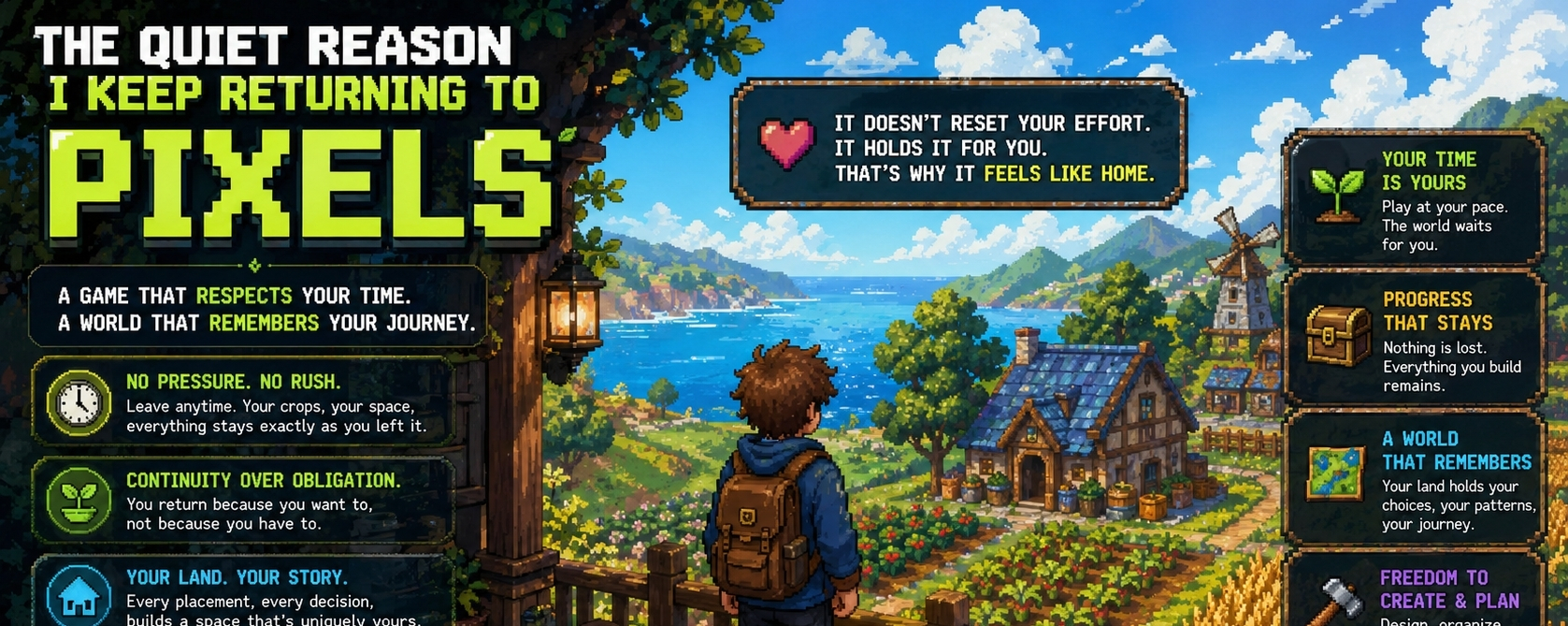
I opened Pixels today without any clear intention, and that alone changed the way the experience felt. There was no checklist in my head, no urgency to optimize anything, no quiet pressure to make the session “worth it.” I didn’t rush toward crops or rewards or try to calculate what I should do first. I just walked around my land slowly, almost like I was revisiting a place rather than playing a system. For a moment, it felt a bit empty, like nothing was really happening. But then that silence started to settle in differently. It wasn’t emptiness, it was stillness. And that stillness made me realize something I usually overlook I wasn’t coming back because I needed to, I was coming back because I could continue.
That feeling is surprisingly rare, especially in games that revolve around progression and rewards. Most games, especially those tied to earning mechanics, are built around urgency. You log out and things keep moving, timers expire, opportunities disappear, and when you return, there’s always this subtle reminder that you missed something. You feel slightly behind, slightly disconnected, like the game moved on without you. Pixels doesn’t create that gap in the same way. When I leave, everything stays exactly where I left it. My crops don’t feel like they’re punishing me for being gone. My space doesn’t feel abandoned or outdated. It just sits there, quietly holding whatever I was building, waiting for me to step back into it.
And to be completely honest, that changes the entire emotional tone of the experience. Instead of feeling like I have to keep up, I feel like I’m simply continuing something that belongs to me. That small shift removes a lot of invisible pressure. It’s not loud, it doesn’t announce itself, but it shapes how you relate to the game over time. You stop thinking in terms of efficiency and start thinking in terms of continuity. You don’t ask, “What can I get right now?” You start asking, “What was I doing here?” That question feels softer, more personal, and somehow more meaningful.
What stands out to me is how the game handles your time. Many modern games try very hard to control it. They rely on daily cycles, streak systems, limited rewards, and constant reminders to keep players engaged. At first, it works because no one wants to miss out. But slowly, that engagement turns into obligation. You’re not returning because you want to, you’re returning because it feels like you should. Pixels doesn’t push in that way. It gives you space. It lets your progress sit without decaying into irrelevance. And because of that, the decision to come back feels like your own, not something designed for you.
There’s also something subtle happening with the land itself. It starts to act like a memory. Every small action leaves a trace — where you placed items, how you arranged things, what you decided to prioritize. Over time, those details build into something that feels uniquely yours. It’s not just about gathering or crafting anymore. It’s about shaping a space that reflects how you think and play. So when you return, you don’t feel lost. You recognize your own patterns. You remember your last decisions. The next step doesn’t need to be forced, it just becomes obvious.
The loop itself is simple, and maybe that’s why it works the way it does. You gather, you craft, you store, you organize, and then you prepare again. There’s nothing overly complex about it. But the way these steps connect makes the experience feel continuous rather than repetitive. Even when you stop playing, it doesn’t feel like something has ended. It feels like something has been paused. And when you come back, that pause lifts naturally. You don’t need to restart mentally. You just step back into the flow. #pixel
But at the same time, I can’t ignore the risk here. Systems like this depend heavily on meaning staying intact. If the loop becomes too predictable, too mechanical, it can slowly lose its weight. People might still log in, but only because it’s become a habit, not because it feels engaging. And habit without meaning doesn’t last forever. That’s where careful design matters. Not big, dramatic changes, but small shifts that make you rethink your approach. Small reasons to adjust your layout, your planning, your priorities. Those tiny variations are what keep a slow system alive.
Right now, it feels like Pixels is walking that line fairly well. It’s not overwhelming, but it’s not empty either. It doesn’t rush you, but it doesn’t leave you without direction. It creates a kind of balance that’s easy to overlook because it doesn’t demand attention. And maybe that’s the point. It’s not trying to impress you every time you log in. It’s just trying to remain consistent enough that your progress feels stable, and your time feels respected. $PIXEL
The real issue, at least from where I’m standing, is that players don’t stay just because of rewards. Rewards can attract attention, but they don’t hold it on their own. What actually keeps people coming back is the feeling that their actions matter over time. That what they did yesterday still exists today, and what they do today will still carry forward tomorrow. That kind of continuity builds attachment in a way that incentives alone cannot.
And maybe that’s why I keep returning, even on days when I don’t have a clear reason to. It’s not because I’m chasing something big. It’s not because I expect a breakthrough moment. It’s because nothing I did feels wasted or erased. The game doesn’t reset my effort or rush past it. It just holds it there, quietly, like it’s waiting for me to pick it back up. And in a space where so many games are trying to pull your attention in every direction, that quiet sense of continuation feels unexpectedly strong. @Pixels