
At the end of last month, a GameFi project with top-tier VC funding slid into my "KOL Order Square" group, throwing out a budget of tens of thousands of U to help find some Twitter accounts and Discord activity that can "do data." I casually asked, "How's your game's Day-7 retention looking?" That guy sent a wry laughing emoji: "Don't even mention it, we just launched three days ago, and the token pool is getting drained by those multi-account bots outside. Right now, spending cash to create some fake hype is purely to give the investors something to chew on when we launch the token in a few days."
This is the most nauseating death loop in the current Web3 gaming space: project teams spend real money on user acquisition, only for it to be fed to those automated scripts hiding behind proxy IPs. Everyone is turning a blind eye, pretending there's prosperity.
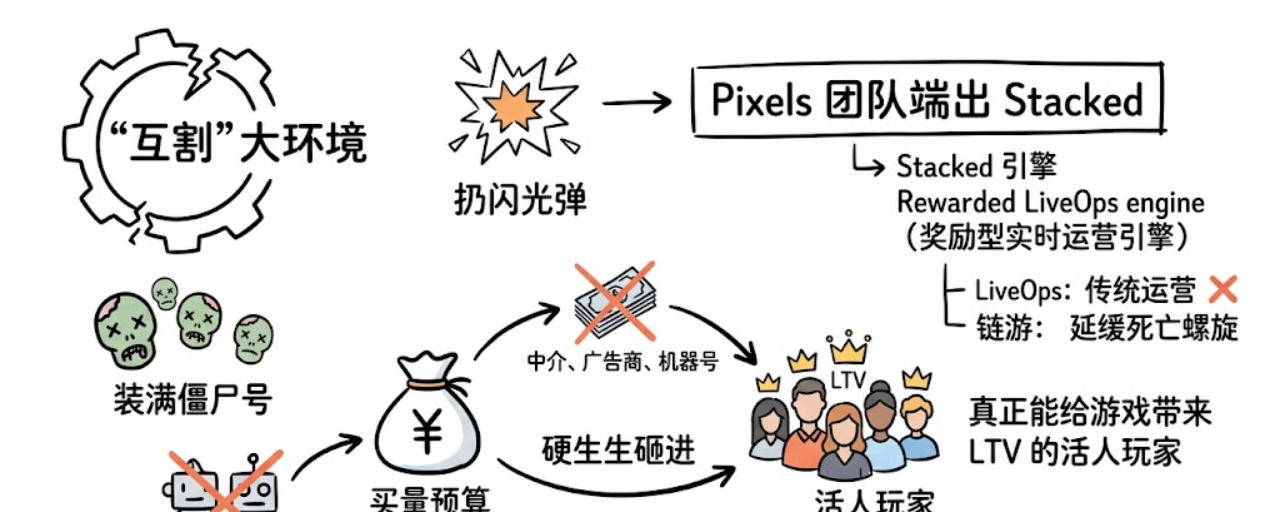
In this utterly broken environment of 'mutual liquidation', the @Pixels team’s recent release of the Stacked engine feels like throwing a flashbang into a room filled with zombie accounts.
Let's break down the fancy jargon from the officials. Stacked positions itself as a 'Rewarded LiveOps engine'. LiveOps in the traditional gaming world means online operations, but in the blockchain gaming space, it often implies 'the project team is cooking up some tricks to delay the death spiral'. However, Stacked's gameplay is entirely different; its core demand is brutally simple: to smash that user acquisition budget that was originally going to be siphoned off by intermediaries, advertisers, and bots straight into the hands of real players who can actually bring LTV (lifetime value) to the game. It ensures that genuine players receive real earnings (fiat or crypto) at the right time.
What makes me most cautious yet curious in this logic is the so-called 'AI game economist' sitting atop the engine.
To be honest, as someone who battles various anti-witch mechanisms in the code trenches daily, seeing 'AI' and 'economists' come together makes me think: what genius thought up this token gimmick? But as I dug deeper, I found these folks are genuinely serious. This system has already distributed rewards over 200 million times within Pixels' extensive ecosystem, generating a solid $25 million in revenue. This so-called AI isn’t just a chatbot; it’s a relentless cyber auditor, constantly monitoring on-chain and behavioral data: Why do these high-net-worth players stop playing after day three? Which interaction’s rewards are being cash-out by the exploiters? It can instantly draw conclusions and deploy experimental strategies directly. $币安人生
Fraud-resistant and built in production—these two points form the hardest moat for Stacked.
And at this point in the game, the core profit point has finally surfaced: the qualitative change of the $PIXEL token.

Previously, everyone viewed pixel merely as a farming token in a hit game; once that game flopped, the token would go to zero. But now, it's been forcefully wedged into Stacked’s B2B engine, transforming into a cross-game ecosystem of 'rewards and loyalty fuel'. This means it is no longer shackled by the lifespan of a single game. As long as external game studios integrate with Stacked to avoid pitfalls and minimize exploitation, $PIX $PIXEL becomes the hard currency for settling transactions across the entire gaming network. This pivot from 'selling hit products' to 'building industry infrastructure' is nothing short of ambitious.
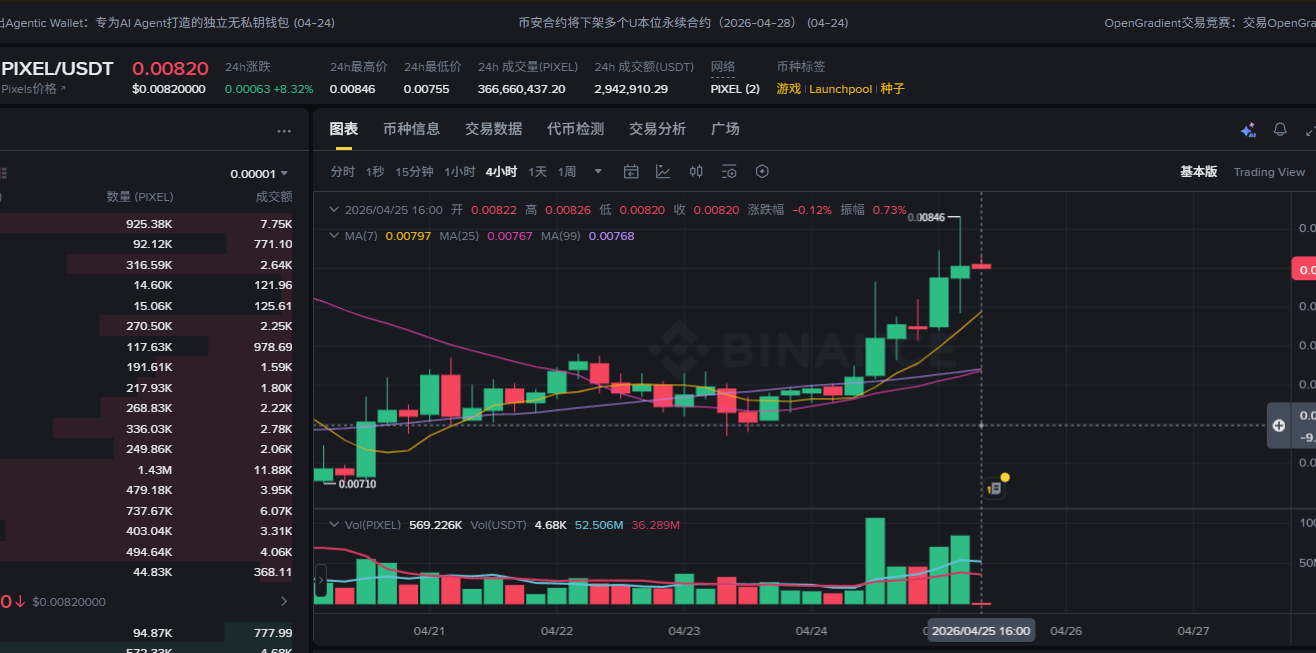
However, I still need to scrutinize this grand narrative with a critical eye. Opening up to external studios is a risky move. Web3 entrepreneurs are all high and mighty, thinking they can launch their tokens and rake in profits. Are they really willing to hand over the core economic power and player retention secrets to a system developed by another group of peers? Can any AI easily handle the complex and greedy nature of human protectiveness?
This experiment called Stacked, is it the ultimate redemption of blockchain gaming economics, or yet another tower of Babel built on a data sandbox? Everything hinges on the real integration rate of external studios in the coming months. For those of you in the game, hold onto your chips tightly; let’s keep a close watch on the next moves of #pixel .